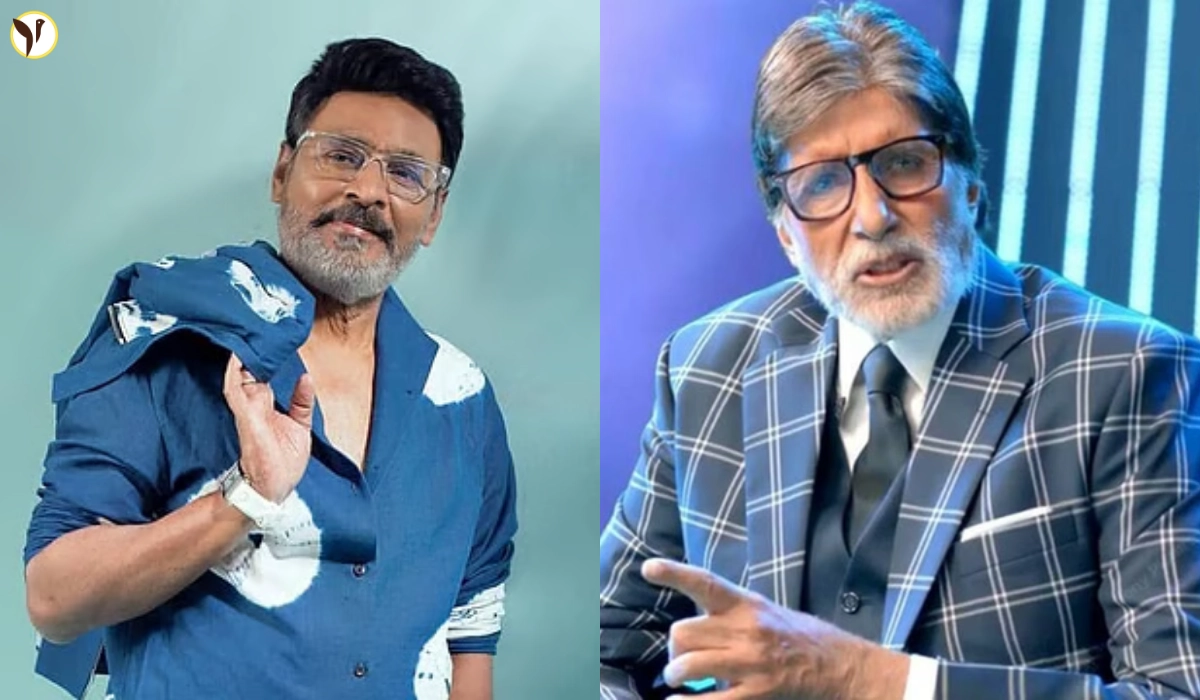


Tamil cinema's "Screenplay King," who once coached Amitabh Bachchan in Tamil to perfect his Hindi delivery, dies of a cardiac arrest in Chennai — just 17 days after losing his own mentor, Bharathiraja.
Veteran filmmaker K Bhagyaraj, the writer-director behind Amitabh Bachchan's 1986 hit Aakhri Raasta (also spelled Aakhree Raasta), passed away in Chennai on Saturday, June 27, 2026, after suffering a cardiac arrest. He was 73.
Bhagyaraj — born Krishnaswamy Bhagyaraj — complained of chest pain early in the morning and was rushed to Apollo Hospital in Chennai's Greenways area, where doctors declared him dead on arrival, according to family members cited by multiple regional outlets.He is survived by his wife, actor Poornima Bhagyaraj, and their children, actor Shanthanu Bhagyaraj and daughter Saranya Bhagyaraj.
For Hindi film audiences, Bhagyaraj is best remembered as the man who directed Bachchan in a rare double role for Aakhri Raasta. But that film was only one chapter in a nearly five-decade career that reshaped how middle-class life was portrayed on the Tamil screen — and earned him the title "Screenplay King."
What Happened: The Final Hours
According to family accounts relayed to the press, Bhagyaraj had been in good health and active in public life until his final days — he had recently travelled to Goa to attend the wedding of actor Khushbu Sundar's daughter. His sudden departure marks the end of an illustrious era for cinema, where he was widely celebrated for his unparalleled screenplay writing and exceptional mastery over family-centric entertainment.
Bhagyaraj was admitted to Apollo Hospital in Chennai's Greenways area after experiencing a cardiopulmonary cardiac arrest, and despite medical efforts, the celebrated filmmaker passed away on 27 June 2026.
His funeral was held the same day at the Besant Nagar crematorium in Chennai. The Tamil Nadu government accorded the proceedings full state honours, in recognition of his contribution to cinema. Tamil Nadu Chief Minister C. Joseph Vijay and superstar Rajinikanth were among those who arrived to pay their final respects, with the Chief Minister offering floral tributes and meeting Bhagyaraj's family.
Why This Death Hits Differently — The 17-Day Coincidence
What has compounded the grief in Tamil film circles is timing: Bhagyaraj's death comes just 17 days after the passing of his mentor and acclaimed filmmaker Bharathiraja, the man who gave Bhagyaraj his start in the industry and directed several of the films Bhagyaraj wrote. Losing two foundational figures of Tamil cinema's golden era within the same month has left the industry — and its long-time television audiences — processing a rare double bereavement.

Who Was K Bhagyaraj? A Career Snapshot
|
|
|
|
|
|
|
|
|
|
|
|
|
|
|
|
|
|
|
|
|
|
|
|
|
|
|
|
|
|
|
|
|
|
|
|
The Aakhri Raasta Connection: How a Tamil Story Became an Amitabh Bachchan Classic
This is the part of Bhagyaraj's career that Hindi-film audiences know best, and it's worth unpacking properly, since most obituaries gloss over the actual creative chain involved.
Bhagyaraj did not just direct Aakhri Raasta — he originated the story twice over:
- He wrote the original story for the Tamil film Oru Kaidhiyin Diary, starring Kamal Haasan, which was directed by his own mentor, Bharathiraja.
- He then wrote and directed the Hindi remake himself — Aakhri Raasta (1986) — this time casting Amitabh Bachchan in a demanding dual role.
Aakhri Raasta is a 1986 Hindi-language vigilante action film written and directed by K. Bhagyaraj, presented by T. Rama Rao and produced by A. Purnachandra Rao under the Lakshmi Productions banner. The film starred Amitabh Bachchan in a dual role, alongside Jaya Prada, Sridevi, and Anupam Kher, with Rekha providing Sridevi's dubbed voice for the film.
The Plot, In Brief
David D'Costa (Bachchan) is a poor, devoted party worker in Chennai whose wife Mary is raped by a corrupt politician and dies by suicide afterward. When David tries to confront the politician, the evidence is destroyed and he is wrongly sentenced to 24 years in prison for his wife's murder, leaving his infant son James in the care of a friend, Mahesh. Released decades later, David discovers his son was raised not as the hardened criminal he'd hoped for, but as a principled police officer — now tasked with stopping the very vigilante killings his own father is committing.
It's a premise that doubles as a meditation on fatherhood, justice, and the irony of revenge — themes Bhagyaraj had already explored in the original Tamil version before adapting them for a different language and a much bigger star.
A Language Barrier, Solved Through Trust
One of the most-cited pieces of trivia about the film captures Bhagyaraj's working method, and why Bachchan trusted him: as the original screenplay was translated into Hindi and the director didn't know Hindi himself, Amitabh Bachchan would go through the script every morning and ask Bhagyaraj to deliver the dialogue in Tamil — so Bachchan could judge whether the emotion had been conveyed properly in the Hindi version, with the director acting out the scenes for the benefit of the rest of the crew.
It's an unusual arrangement — a director directing one of Hindi cinema's biggest stars in a language neither of them shared fluently — and it speaks to why the film is still discussed in film circles decades later. On the very first day of shooting, despite already having the full script, Bachchan asked Bhagyaraj to narrate how he planned to shoot the scene, partly to test whether the director was prepared; Bachchan reportedly understood the vision before Bhagyaraj had even finished explaining it.
The Hindi title even outlived the film itself in pop culture: a comic character named "Aakhri Pasta" in the Housefull film franchise is a direct pun on Aakhri Raasta's name — a small but telling sign of how deeply the film's title embedded itself in Bollywood's collective memory.
Beyond Bollywood: Why Tamil Cinema Calls Him the "Screenplay King"
While Aakhri Raasta is his most visible Hindi credit, it represents a small fraction of a career that fundamentally altered Tamil commercial cinema. Bhagyaraj's real legacy lies in how he wrote for ordinary people.
Career origins. Bhagyaraj grew up admiring screen icons like M.G. Ramachandran and Rajesh Khanna, eventually dropping out of college and moving to Madras to break into the industry. He started in the mid-1970s as an assistant director to filmmakers G. Ramakrishnan and Bharathiraja, writing scripts and taking brief, minutes-long roles in landmark films such as 16 Vayathinile (1977) and Sigappu Rojakkal (1978).
The breakthrough. Bharathiraja cast Bhagyaraj in the lead role of the 1979 film Puthiya Vaarpugal, for which Bhagyaraj also wrote the dialogue — winning him a Tamil Nadu State Film Award. From there, he carved out a niche no one else occupied quite the same way: stories about lower-middle-class families, romantic misunderstandings, and social commentary, all delivered through razor-sharp, often comic dialogue.
Signature works. His most enduring titles — many of which still run on Tamil television decades later — include:
- Mundhanai Mudichu (also won him the Filmfare Best Actor Award)
- Andha 7 Naatkal (remade in Hindi as Woh Saat Din)
- Thooral Ninnu Pochu
- Darling Darling Darling
- Idhu Namma Aalu
- Indru Poi Naalai Vaa
- Mouna Geethangal
- Rudra
Several of these were dubbed or remade across Telugu, Kannada, and Oriya cinema as well — a reach few of his contemporaries matched.
A multi-hyphenate career. Acting and directing were only part of it. Bhagyaraj also worked as a producer, authored novels, and served as editor of the weekly magazine Bhagya.
Veteran Tamil filmmaker, writer K Bhagyaraj dies of heart attack at 73 - India Today https://t.co/b7v1T45Ntk
— Davan s. Mani (@DavanMani) June 27, 2026
Industry Reaction: A Shared Sense of Loss
The response from across the Indian film industry — not just Tamil cinema — has been immediate and personal, suggesting Bhagyaraj's influence travelled far beyond language lines.
Telugu superstar Venkatesh, who worked with Bhagyaraj on Sundarakanda and Abbaigaru, said in a statement that Bhagyaraj's work transcended languages and touched the hearts of millions, adding that he felt fortunate to have been part of films born from the filmmaker's storytelling.
Director M Rajesh, known for several Tamil blockbusters, said in his tribute that Bhagyaraj's storytelling, humour and timeless screenplays had inspired generations of writers and directors, and that his legacy would continue through his films and the filmmakers he influenced.
Tamil Nadu Chief Minister C. Joseph Vijay called the loss "irreparable," noting in a message shared on X that Bhagyaraj's passing as an eminent director, actor, screenwriter, dialogue writer, and music composer had caused him profound shock and deep sorrow.
Kerala Chief Minister V D Satheesan also weighed in, remembering Bhagyaraj's cross-industry connections: he noted Bhagyaraj's special bond with Malayalam cinema, particularly his memorable role in Mr. Marumakan, which fans in Kerala continue to recall fondly, and said his contributions would inspire generations to come.
Telugu megastar Chiranjeevi reportedly told reporters he was especially shaken because he had met Bhagyaraj only two days before the filmmaker's death, while tributes also poured in from Kamal Haasan, Mammootty, and Arun Vijay, among others.
Why It Matters: The End of an Era for Middle-Class Tamil Cinema
Bhagyaraj's death isn't just the loss of one filmmaker — it closes out a specific creative era in Tamil cinema that he helped define alongside his mentor Bharathiraja, who died just over two weeks earlier.
Through the late 1970s and 1980s, Tamil commercial cinema was dominated by larger-than-life heroics. Bhagyaraj's films offered a counter-current: ordinary clerks, shopkeepers, and working-class families navigating love, pride, and small-town politics, told with comic timing that never undercut the emotional stakes. That formula — what some critics now call "the Bhagyaraj template" — went on to influence an entire generation of Tamil filmmakers who built careers on dialogue-driven, character-first storytelling rather than spectacle.
His death also closes the loop on one of Hindi cinema's more unusual cross-industry collaborations: a Tamil writer-director who, without being fluent in Hindi, helped craft one of Amitabh Bachchan's most discussed performances of the mid-1980s — proof that some of Bollywood's most memorable moments were built on creative bridges between film industries that don't always get equal credit.
What Happens Next
- State honours and tributes: The Tamil Nadu government has confirmed state honours for Bhagyaraj's funeral rites, and further official tributes — including possible posthumous recognitions — are likely in the coming days as the state's film and cultural bodies respond formally.
- Industry retrospectives: Expect a wave of restorations, re-releases, or special television screenings of his most popular films, a pattern commonly seen after the death of a filmmaker with a large TV-rerun fanbase (as already happened following Bharathiraja's passing weeks earlier).
- Family continuity: With his son Shanthanu Bhagyaraj and wife Poornima Bhagyaraj both active in the industry, attention will likely turn to whether any of Bhagyaraj's unfinished projects, scripts, or planned works are completed or released in tribute.
- Critical reassessment: As is common after the death of a prolific writer-director, film historians and critics are expected to revisit his filmography over the coming weeks, particularly his Tamil work, which has historically received less international attention than his Bollywood crossover.
Other Articles to Read: