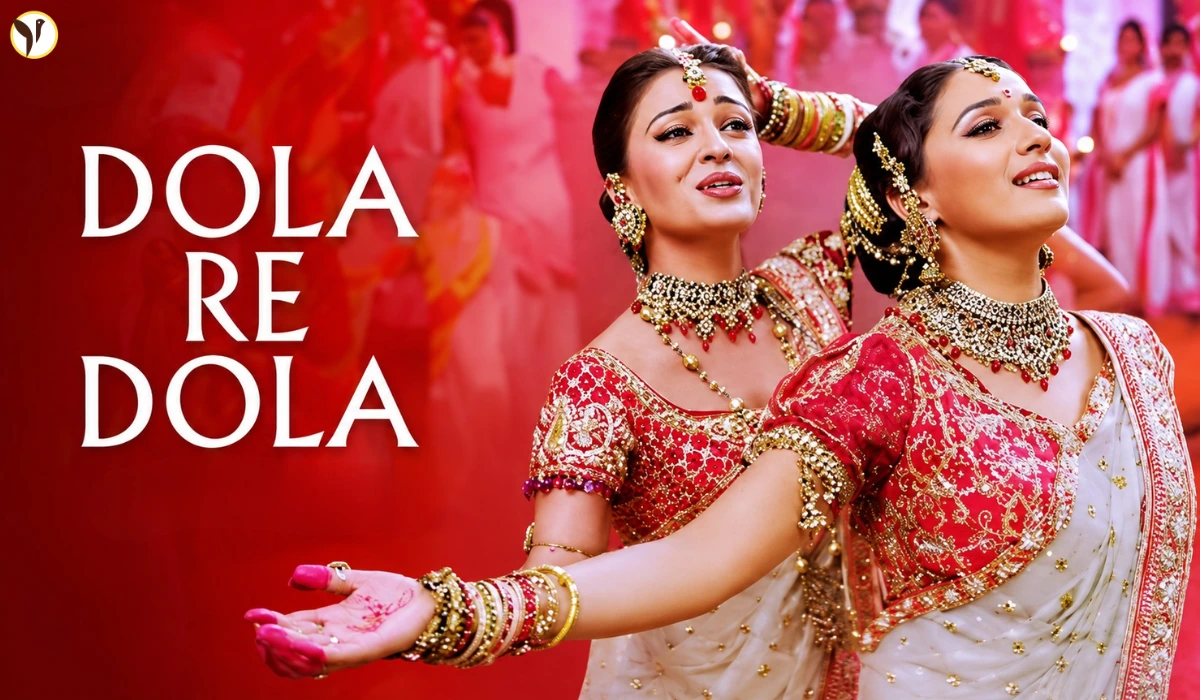


A crew member's account of what really happened behind the curtain of one of Hindi cinema's most celebrated dance sequences — 13 hours, no complaints, not a single step changed.
When Dola Re Dola plays, audiences see two of Bollywood's greatest dancers in absolute sync — fluid, fearless, luminous. What they don't see is what happened between 9 in the morning and 10 at night on one particular shooting day in 2002, when Madhuri Dixit was running a fever, battling dizziness from a four-month pregnancy, and still refused to let her choreographer soften a single move.
The revelation, shared recently by Rubina Khan — a former member of the late choreographer Saroj Khan's crew — has given fans a rare window into the physical and emotional cost behind one of Hindi cinema's most treasured songs.
The Spin-and-Drop: A 13-Hour Battle
The sequence at the centre of this story is deceptively simple on screen — Madhuri whirls gracefully and sinks to the floor in one sweeping motion, timed perfectly with the swell of Ismail Darbar's music. In reality, nailing that shot took an entire working day.
Madhuri Dixit was four months pregnant with her first child, Arin Nene, at the time. The repeated spinning left her disoriented; the pregnancy amplified the dizziness with each take. On top of that, she was dealing with fever. Yet not once did she signal fatigue to the crew or suggest that the choreography needed adjustment.
Her reverence for Saroj Khan, fondly called "Master Ji" across Bollywood, ran deep. To Madhuri, what Saroj Khan designed was final. The actress would find a way to execute it — not negotiate around it.
|
|
|
|
|
|
|
|
|
|
|
|
|
|
|
|
|
|
|
|
|
|
|
|
|
|
|
Why Sanjay Leela Bhansali Had to Fly Madhuri Back
This story has a chapter that predates the set entirely. By 2001, Madhuri Dixit had stepped away from Bollywood. She had married Dr. Shriram Nene in 1999 and relocated to the United States. Her screen absence felt permanent to many.
It took Sanjay Leela Bhansali's personal persuasion to bring her back. He convinced her to return to India specifically for Devdas — and, crucially, for the role of Chandramukhi, the courtesan whose warmth and grace anchored the film's emotional middle. Madhuri agreed. She flew back, stepped into one of the most demanding shoots of her career, and did so while carrying her first child.
Saroj Khan Was Also Fighting Her Own Battle
The parallel story on set is equally staggering. While Madhuri pushed through pregnancy discomfort and fever, Saroj Khan herself was gravely ill throughout the filming of Dola Re Dola.
Sanjay Leela Bhansali, in a tribute following Saroj Khan's passing in July 2020, confirmed the extent of her suffering: the legendary choreographer often lacked the strength to stand, and directed the entire sequence — 15 days of it — while lying on the floor. Her focus never wavered. Her creative instinct never dimmed.
At the time we were shooting, Saroj ji was extremely unwell. She was in a lot of pain, but she would lie down on the floor and give instructions. She shot for 15 days."— Sanjay Leela Bhansali, Director, Devdas (Source: The Quint)
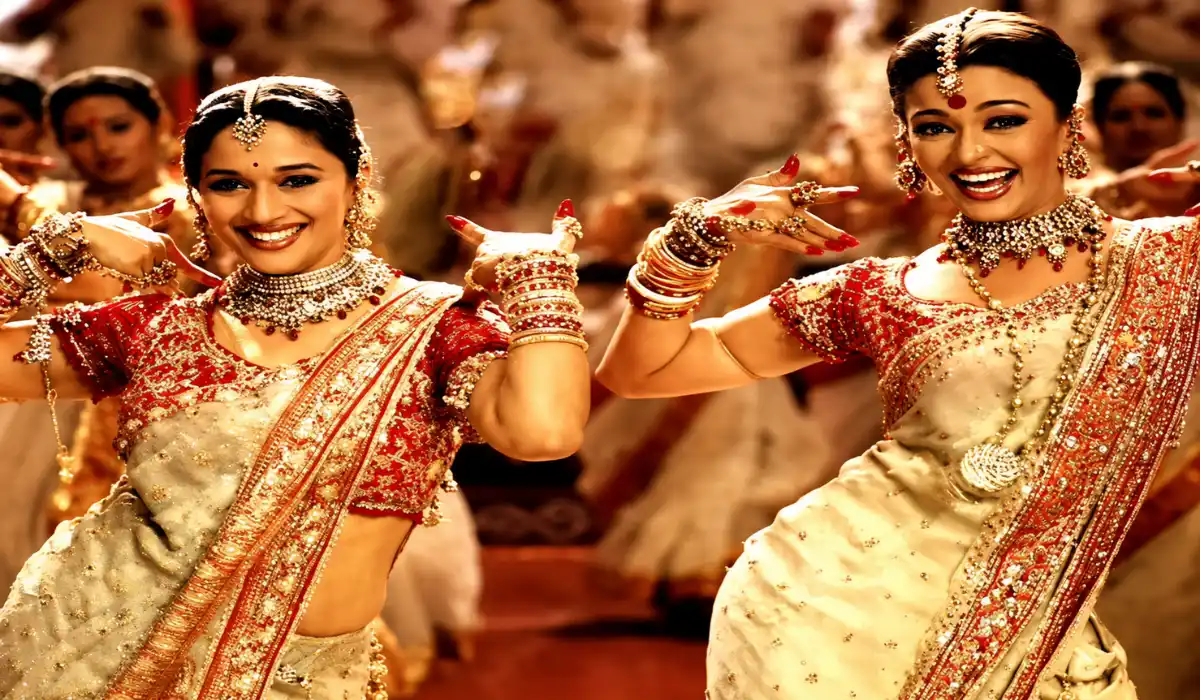
Saroj Khan's fear on this song was also unique: for the first time, Bollywood's two most formidable dancers were sharing the same frame. She was intensely conscious that the choreography had to serve both — that neither Madhuri nor Aishwarya could be made to look lesser. The result was a bespoke dance language called Nautwary — a form she designed specifically for this song, blending the footwork of Kathak with the expressiveness of Bharatnatyam.
The dancer added, "She'd never ask for a step to be changed"https://t.co/1J7WWpdHeJ
— NDTV Movies (@moviesndtv) May 21, 2026
Aishwarya Rai's Silent Sacrifice
The resilience on that set wasn't Madhuri's alone. Reports from the production also indicate that Aishwarya Rai Bachchan continued shooting despite her ears bleeding from the weight of heavy traditional earrings worn during filming. She made no demand for the shoot to stop.
What emerges from these revelations is a portrait of a specific era in Indian cinema — one where the gap between what audiences saw and what artists endured was enormous, and quietly, almost completely hidden.
The Song's Legacy — And What These Revelations Change
Released in 2002, Dola Re Dola became an instant cultural event. It won Saroj Khan her first National Film Award for Best Choreography — and she would go on to win 17 awards for this one composition alone. The song was, at the time, the most expensive Bollywood music video ever produced, with a budget of ₹2.5 crore.
More than two decades later, it remains one of the most searched and streamed songs in Hindi cinema's digital catalogue. But what Rubina Khan's testimony adds is something a streaming number can never measure — it adds weight. The lightness you see on screen carries a physical reality that reframes every viewing.
Madhuri Dixit, now 58, is currently preparing for her return to OTT with the Netflix series Maa Behen, set to premiere on June 4, 2026, alongside Triptii Dimri and Dharna Durgaa. She has spoken in interviews about the years of dedication that shaped her craft — but stories like this one, from the people who stood off-camera and watched it happen, carry a different kind of testimony.
What This Story Really Means for Bollywood History
It would be easy to read this as a celebration of suffering — as if enduring pain without complaint is the ultimate marker of artistry. But what this story actually illuminates is something more precise: the relationship between Madhuri and Saroj Khan was one of complete artistic trust. When you trust your choreographer absolutely, you don't ask for modifications. You find a way to honour the vision, even when your body is telling you otherwise.
That is the kind of creative faith that produces once-in-a-generation cinema. And Dola Re Dola, with everything we now know about how it was made, stands as exactly that.
Other Articles to Read: