
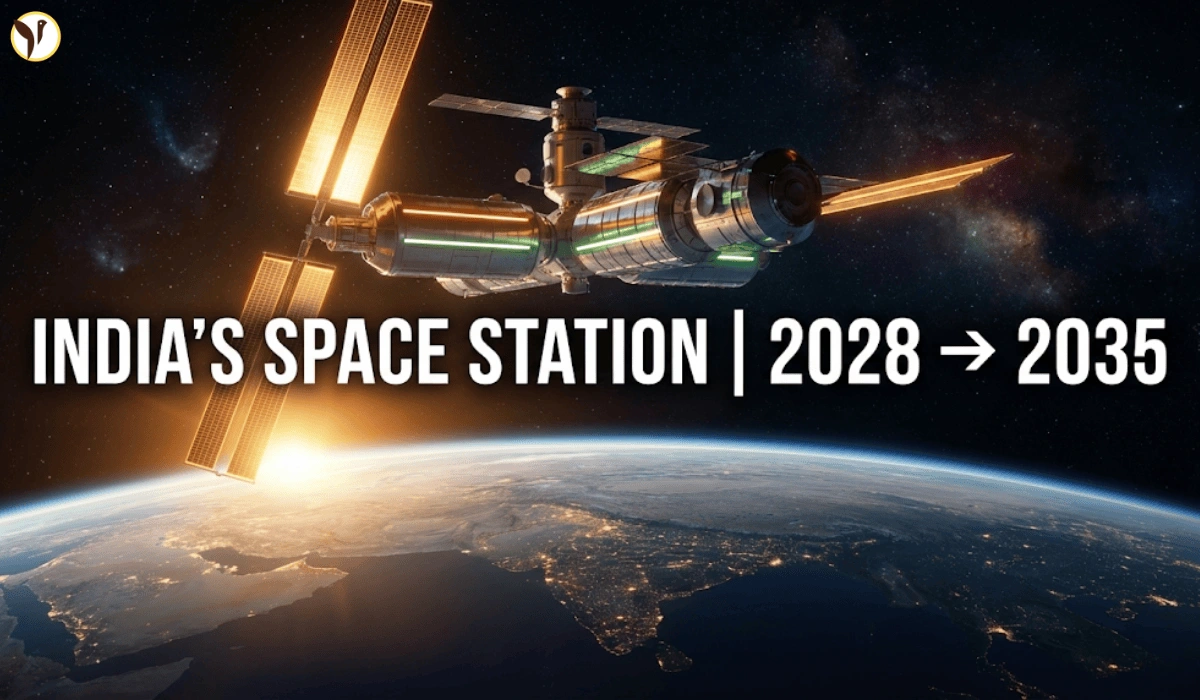


The planned Indian Space Station (Bharat Antariksh Station) will be situated in Low Earth Orbit (LEO) approximately 400 km above sea level. This is the same altitude that the international space station (ISS) orbits at. The low earth orbit of the station is the best choice because of how quickly astronauts can reach the ISS for crew rotations, how easy it is to resupply the ISS, and that it is a very stable area for conducting microgravity research.
One thing that separates India's ISS from all other countries' stations is the philosophy behind how it was designed. That philosophy was influenced heavily by ISRO's history of developing new space systems through many successful missions, as well as the intelligence developed from the many engineering and scientific challenges faced from earlier orbital missions.
Life-Support Systems for Extended Human Stay
ISRO has already begun working on life-support technologies through the Gaganyaan program, where systems for oxygen generation, CO₂ removal, cabin pressure control, and thermal management are being tested.
In 2021 and 2023, ISRO ran controlled-environment tests simulating human survival in closed modules—these will now scale up for use in the station.
The station will need:
-
Regenerative Environmental Control Systems (to recycle air and possibly water)
-
Radiation shielding for solar storms and cosmic rays
-
Thermal control panels for temperature stability as the station faces extreme heat and cold every 90 minutes in orbit
These systems are being modeled on lessons from Chandrayaan-2 orbiter, which survived long durations in space, and INSAT satellite buses, known for reliability.
Microgravity Experiments: Based on Earlier Success
India already performed biological and material science experiments in microgravity during earlier missions such as:
-
PSLV Orbital Platform (POEM)
-
Microgravity experiments on Space Capsule Recovery Experiment (SRE-2007)
-
BIO-MODULE tests on sounding rockets launched from Sriharikota
These experiments offered insights into protein crystal growth, combustion, and material behavior in zero gravity.
Building on those results, Bharat Antariksh Station will host:
-
Protein crystallization labs (useful for new drug development)
-
Material solidification experiments (helps create stronger alloys)
-
Fluid dynamics testing (important for spacecraft design and fuel systems)
This is the first time India will allow these experiments to run for months, offering more accurate data than short-duration missions.
Earth Observation and Space Environment Studies
ISRO has decades of expertise in Earth observation, thanks to satellites like:
-
Cartosat series
-
Resourcesat
-
Oceansat
-
INSAT weather satellites
But astronauts aboard the Bharat Antariksh Station will be able to perform real-time visual analysis, something that satellites alone cannot do.
Examples include:
-
Monitoring cyclones, monsoon patterns, and snowcaps
-
Studying lightning, auroras, and atmospheric glow
-
Tracking space debris in LEO (important for safety)
India has already gathered atmospheric data from missions like Megha-Tropiques and SARAL, and now the station will allow continuous human observation, giving far more context to satellite readings.
Technology Demonstrations for Deep-Space Missions
Many future missions depend on technologies that must be tested in orbit first.
ISRO learned this during missions like:
-
Chandrayaan-3, which tested soft-landed systems
-
Mangalyaan (Mars Orbiter Mission), which tested deep-space communication
-
RISAT and Astrosat, which pushed India’s capability in sensors and optics
Now, the space station will act as an on-orbit test lab for:
-
Advanced docking systems (for crew vehicles & resupply ships)
-
High-efficiency solar panels
-
New propulsion systems for orbit correction
-
Radiation-resistant electronics
-
Autonomous robotic arms for maintenance
With these tests, ISRO is preparing for crewed lunar missions, orbital manufacturing, and even interplanetary crewed missions in the long term.
Why Scientists Are Excited
For researchers, the Bharat Antariksh Station offers something India never had before—
a permanent microgravity research platform.
Experiments can run for weeks or months, giving scientists accurate results. This could advance:
-
Space medicine (understanding bone loss, muscle changes, immune response)
-
Crop studies (testing seed growth and genetics in space)
-
Material innovations (manufacturing defect-free alloys and fibers)
-
Pharmaceutical breakthroughs (better protein crystallization)
India’s earlier microgravity missions showed promising results, but duration was always a limitation. With BAS, those limits disappear.