
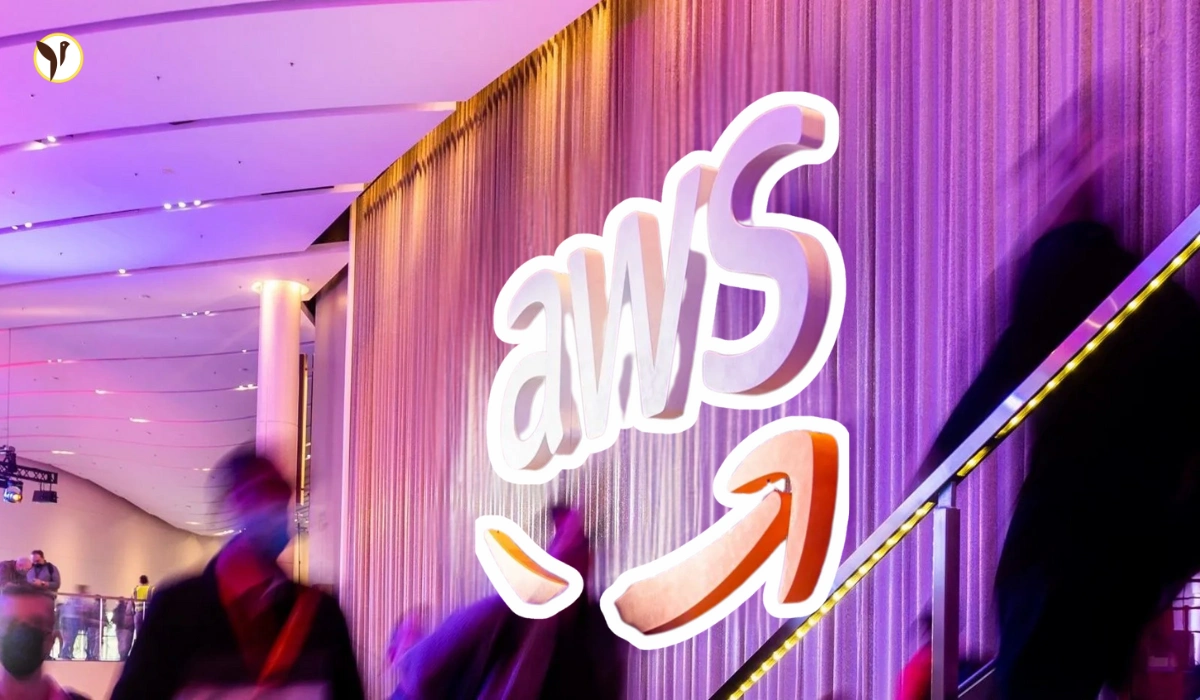


The cloud field is not at the early development stage when engineers and business executives come to Las Vegas to attend AWS re:Invent. Cloud computing has become the very basic infrastructure of large companies, hospitals and governments. The nature of the questions that people take to this conference has changed because of that change.
AWS re:Invent has been confused with a venue where ideals are generated on stage. Actually, it is the place where Amazon Web Services unveils the choices that it has already made - months of hearing customer feedback, feeling the pressure of the regulatory body, arguing among each other how complicated the platform has grown. In 2026, such pressures are no longer background noise. They are the main story.
A cloud giant that is under greater scrutiny than hype.
AWS was the leader in scale and speed of re:Invent, many years. The new services were being announced at a faster rate than most customers comprehended. The emphasis was on growth and complexity was viewed as a by-product of innovation.
That is no longer the case. In the modern world, companies are no longer so impressed by the number of tools that AWS can construct. They desire predictability, stability, and less surprises. Not only is it the case that cloud failures impact internal IT systems, but it is also the case that they affect real-world services. Consequently, AWS comes into re:Invent 2026 in greater scrutiny than ever.
The reason why the conference is important this year is that it will show how AWS perceives itself. It remains an experimental platform, and is now speedy, or has it come to terms with the reality that it now operates more like public infrastructure?
The cost control becomes centralized.
Money is one of the largest transformations that would determine re:Invent 2026. Numerous organizations are now grappling with the need to justify cloud bills that are increasing at a faster rate compared to the revenue after several years of rapid adoption of clouds. Teams that dealt in the technical decisions a long time ago are now engaged in finance in a big way.
AWS has reacted with solutions of being able to monitor usage and control spending, yet the issue of trust runs deeper. The customers are interested in understanding that their cloud service is not going to make them penalize because of expansion or experimentation. They desire more articulate pricing behavior as opposed to superior dashboards.
This will manifest at re:Invent in the form of less flashy changes, not necessarily announcements: safer defaults, better boundaries, and systems that lock out accidental overspending. It is not about leveraging more cloud but it is about leveraging it without trepidation.
Artificial intelligence without coercion.
AI will be another prominent theme in case, AWS will be cautiously toned. This is contrasted with some competitors where AWS has not promoted a single right AI model or solution. Rather it is marketing itself as an infrastructure and tools provider that enables customers to make a choice.
This portrays actual customer anxiety. Several firms think that AI is significant, yet not many of them are sure of the models or architectures that will remain relevant in five years. AWS seems to be gambling that being flexible is more important than being dominant.
In re:Invent 2026, it will probably focus on control, security, and integration the role of AI in existing systems without compelling risky and irreversible choices. Such a policy will yield fewer headlines, but it is much more consistent with the behavior of large organizations.
Cloud labor is evolving, and AWS is aware of it.
The other theme that is being silently run through re:Invent 2026 is the transformation of technical jobs. Automation and AI systems imply that fewer individuals work with larger systems. The previous separation between developers, operations teams and security specialists is becoming more obscure.
AWS tools are becoming more of the assumption that customers desire self-managing systems most of the time. But that creates new risks. When something is wrong it may be more difficult to know why.
AWS now has the challenge of making operations in the clouds easy without concealing issues until they become severe. Communication on shared responsibility and better understanding of system behavior is the manifestation of that tension.
The accountability is no longer at will.
Throughout its history, AWS has been keen on the fact that it is the responsibility of the customers to determine the way in which they utilize its services. The principle enabled fast expansion but this is more difficult to argue today as governments and key services rely on cloud platforms.
AWS is not going to declare a radical change in accountability at re:Invent 2026. Rather, the change will manifest itself in marginal ways: default security settings, more noticeable routes of compliance, and more robust safety boundaries being embedded into services.
These options indicate that AWS realizes that it can no longer act like a neutral provider of tools on its own as it becomes increasingly essential. The product is to incorporate reliability and safety, which have become part of it and not an addition.
Global access confronts political fact.
AWS is a global company, yet the definition of global cloud is different. Governments are becoming more concerned with the location of data, who is in control, and how the system will act in case of political or economic instabilities.
Re:Invent 2026 can feature the announcements regarding new regions, yet the more significant signals will be technical. The degree of regional systems independence. How is data separated? When borders and laws come in?
These questions are important since the trust in cloud platforms is now a national policy concern rather than a performance one.
Read More Articles:
What is unannounced is also important.
Among the most significant indicators at re:Invent are those that AWS does not focus on. Over the past years the company has been silent in decreasing the focus on services that did not attract users without making it known publicly.
In case re:Invent 2026 repeats this trend, it will demonstrate a firm that practices focus instead of continuous growth. It can be disappointing to some developers, but it gives more peace of mind to the customers who do not need as many moving parts in the systems that they rely on day in day out.
A maturity, rather than a spectacle, conference.
AWS re:Invent 2026 is not going to be remembered under one headline announcement. It is significant in its tone and direction. It seems that AWS is recognizing the fact that the cloud business has matured- and so has its own duties.
The question to the customers is no longer how powerful AWS will be. Whether AWS can be dependable, comprehensible and credible as the cornerstone to contemporary online existence is a question.