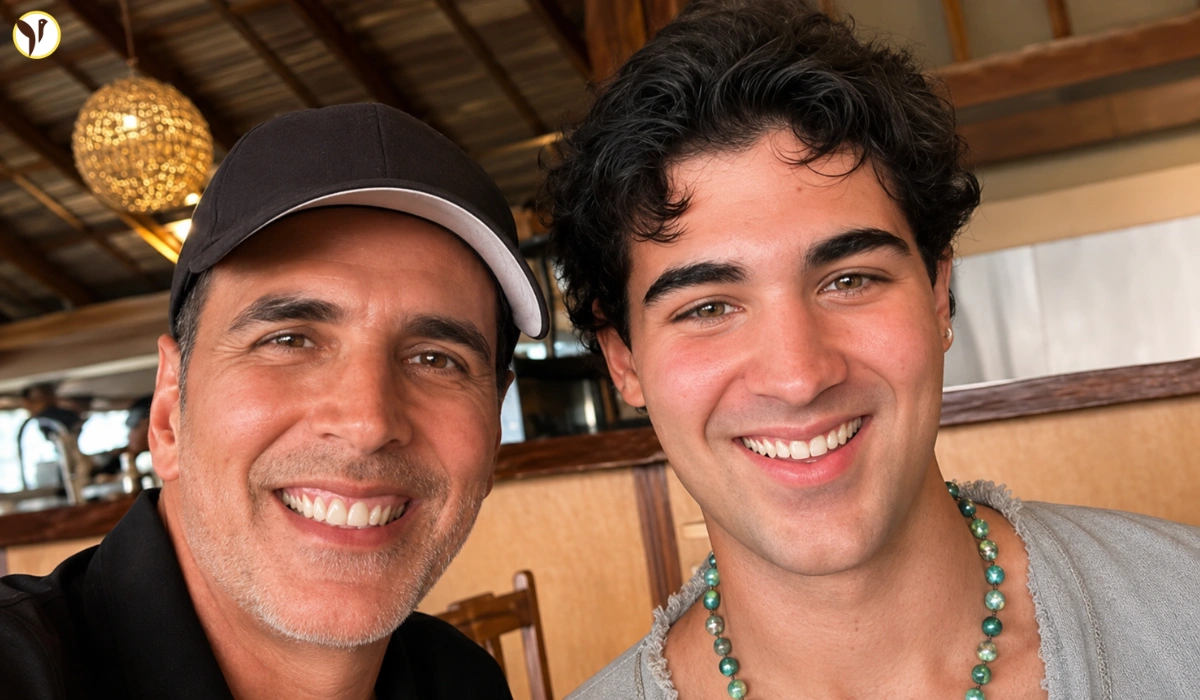


In an industry where privilege often translates into designer wardrobes, private jets, and constant public display, Aarav Bhatia stands apart. The son of Bollywood star Akshay Kumar and author Twinkle Khanna has chosen thrift shopping, self-reliance, and a deliberately modest lifestyle—even though his father can, by any measure, buy him nearly anything.
Akshay Kumar has spoken openly about his son’s habits in interviews, including a notable conversation on cricketer Shikhar Dhawan’s show. Aarav cooks his own meals, does his laundry, washes utensils, and shops at second-hand stores such as Thrifty. His reason is straightforward: he does not believe in wastage. “He doesn’t want to buy expensive clothes despite knowing that his father can afford them,” Akshay has said. “He goes to a shop called Thrifty which sells second-hand clothes… He says, ‘Waste nahi karna. Mainu nahi chahide’ (I don’t want to waste. I don’t need them).”
This is not a temporary phase or a publicity gesture. Aarav has lived independently since the age of 15, when he left home to study abroad. After schooling at École Mondiale World School in Mumbai and time at United World College in Singapore, he settled in London to pursue fashion design. Reports place him in his early-to-mid 20s (born 15 September 2002). He has stayed largely out of the limelight, appears rarely at high-profile events, and has repeatedly made clear he has no interest in joining the film industry.
Why This Matters Beyond Celebrity Gossip
Akshay Kumar’s reported net worth has been widely cited in the range of ₹2,700 crore in multiple Indian media reports, though other estimates (including some international ones) place it lower, around $250 million or figures closer to ₹400 crore depending on the source and methodology. The precise number is secondary. What stands out is the gap between available resources and chosen behaviour.
Most star children grow up surrounded by staff, branded clothing, and the assumption that access equals entitlement. Aarav’s approach challenges that script. His preference for pre-owned clothes aligns with broader conversations about sustainable fashion and conscious consumption. In a world where fast fashion generates enormous waste and environmental cost, a young person from extreme privilege choosing second-hand is a quiet but noticeable statement.
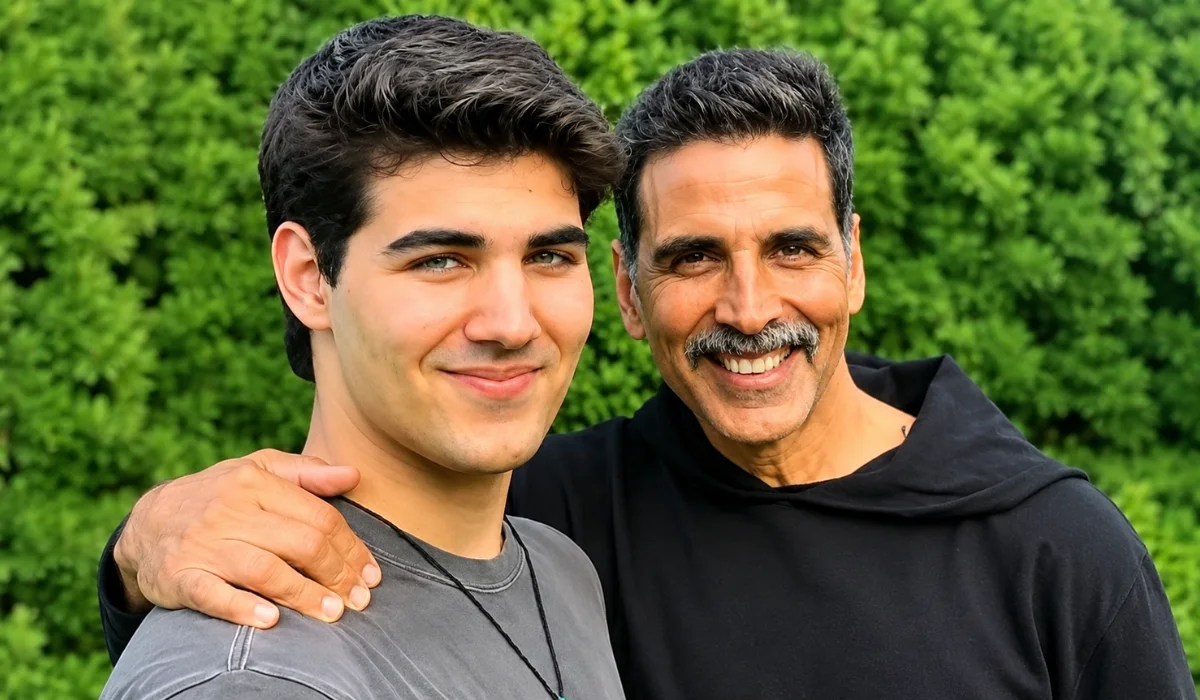
It also reflects parenting. Akshay has repeatedly expressed pride, saying he and Twinkle are happy with how they raised their son. He has compared his own early independence—he left home around age 14—to Aarav’s decision. The actor has described himself more as a friend than a strict disciplinarian, while noting Twinkle’s role in keeping the family grounded. Their daughter Nitara, by contrast, is described as enjoying good clothes, showing that the household does not impose a single rigid style on both children.
Background and Timeline
- Early years: Born into one of Bollywood’s more enduring family units. Maternal grandparents are Rajesh Khanna and Dimple Kapadia.
- Age 15: Left home for studies overseas—a decision Akshay initially resisted but ultimately supported.
- Education path: Mumbai school → Singapore → London fashion studies.
- Personal disciplines: Black belts in martial arts styles including Goju Ryu Karate and Kudo; national gold medal in Judo. These remain largely private achievements.
- Lifestyle consistency: Multiple interviews over years (2024 onward, with later coverage into 2025–2026) reaffirm the same habits—cooking, cleaning, thrift shopping, rejection of film career.
More recent reports have added another layer: Aarav has taken on practical, low-paid work (described in some accounts as around ₹4,500 a month) while learning traditional prints and techniques in Indian villages. This fits the pattern of someone determined to understand fashion from the ground up rather than through inherited access.
Akshay Kumar's Financial Standing vs. The Thrift Reality
|
|
|
|
|
|
|
|
|
|
|
|
|
|
|
|
|
|
|
|
The Broader Context of Celebrity Children and Values
Indian entertainment media frequently celebrates or critiques the lifestyles of star kids. Some embrace the spotlight and luxury; others maintain distance. Aarav belongs firmly in the second group. He has been spotted occasionally—such as at Huma Qureshi’s Eid gathering—where his understated style drew notice, but he does not cultivate a public persona or social-media presence in the conventional sense.
His choices invite a useful comparison. While many young people from affluent backgrounds face pressure to signal status through consumption, Aarav appears to treat money as a tool rather than a scoreboard. The thrift habit is not presented as deprivation; it is framed as principle. In fashion design, that principle has practical value. Designers increasingly face scrutiny over materials, waste, and ethics. Someone who already prefers pre-owned clothing enters that conversation with lived credibility.
For ordinary readers, the story carries a quieter message. Frugality and self-sufficiency are not only strategies for those with limited means. They can be deliberate choices even when means are abundant. Akshay’s own career began with modest earnings as a martial-arts instructor before the film breakthrough. Seeing that trajectory reflected, in different form, in his son’s life adds resonance.
What Happens Next
Aarav continues to focus on fashion rather than cinema. Akshay has said he offered involvement in the family’s production company and received a clear no. The actor’s response has been consistent support: it is Aarav’s life. Whether the younger Bhatia builds a design label, works behind the scenes, or develops a practice rooted in traditional crafts and sustainability remains to be seen. What is already clear is the foundation—independence, practical skills, and a stated aversion to waste.
Public interest in the story has persisted because it runs counter to expectation. In an era of visible excess, a young man with every resource choosing restraint continues to register. It does not require exaggeration or speculation. The facts, as shared by his father across interviews, are sufficient: Aarav advocates thrift not because he must, but because he prefers it. His father can buy almost anything. His son has decided he does not need most of it.
Other Articles to Read: