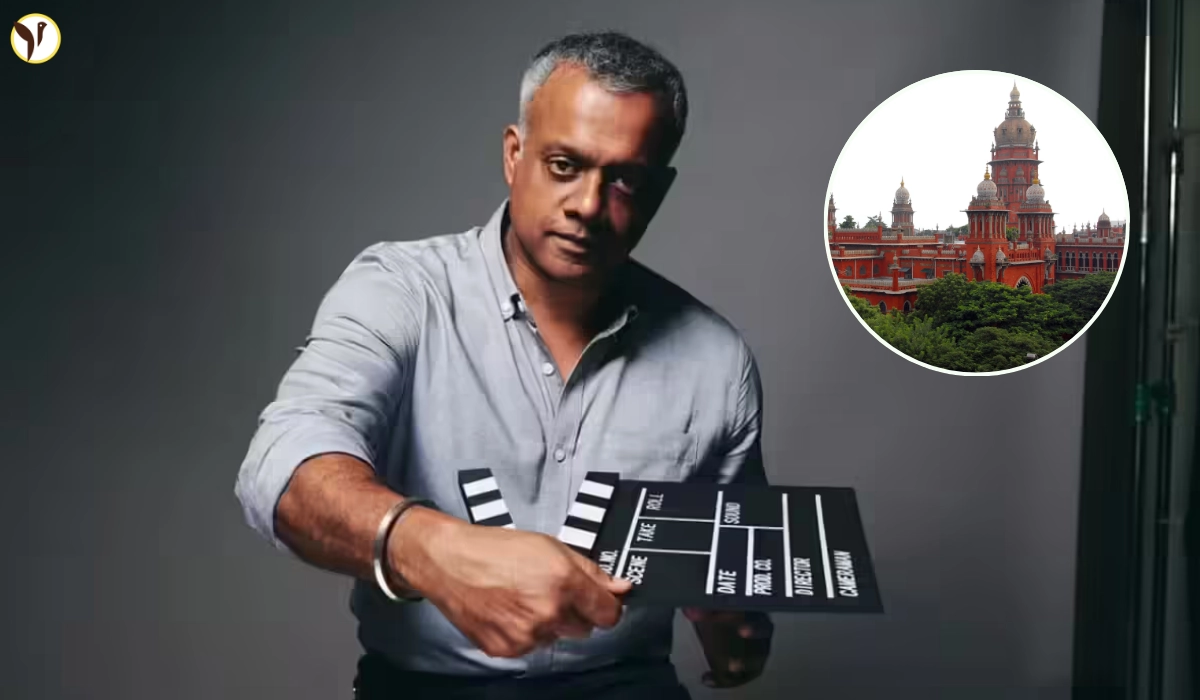


Something about legal fights in the film industry always feels confusing at first. Big names, big money, and long timelines… but this case involving Gautham Vasudev Menon is not just about money, it’s about a promise that never really turned into a film.
Now the story is getting attention again after a major court decision, and honestly, it explains a lot about how film deals work behind the scenes.
Why Gautham Vasudev Menon Case Is Trending After Court Verdict
The recent verdict by the Madras High Court has made this issue headline news again. A Division Bench comprising Justices R. Subramanian and R. Sakthivel dismissed the appeal filed by Gautham Vasudev Menon and his production company, Photon Factory.
By upholding the previous ruling, the Bench confirmed that the earlier order stands: the filmmaker must repay ₹4.25 crore to R S Infotainment.
What makes this more serious is that the amount is not just the principal money. The court has also ordered:
- 12% yearly interest calculated from May 2010
- Additional legal costs to be covered by the appellant
- Full repayment obligation confirmed without further delay
The judges clearly stated there was no strong or "aggravating" reason to change the earlier decision. So basically, the case is now legally settled in favor of the financier, marking a major high-court defeat for the director.
What Was The Original Film Deal And Where It Went Wrong
To understand this case, we have to go back to 2008. That’s when an agreement was signed between Photon Factory and R S Infotainment for a Tamil film called “Production No. 6.”
Here’s what the deal looked like:
- Total planned budget was ₹13.5 crore
- Shooting was supposed to start in December 2008
- Film had to be completed by April 2009
But things didn’t go as planned.
R S Infotainment paid ₹4.25 crore in parts. However, according to court findings, the film never even started. Not delayed… not paused… it just didn’t begin.
Even after giving extra time in 2010, there was no progress. That’s when the financier decided to take legal action in 2013.
Unmade Film: Madras HC Directs Filmmaker Gautham Menon To Repay Rs 4.25 Crore To Production Firmhttps://t.co/21cRTkDCYk
— NDTV Profit (@NDTVProfitIndia) March 24, 2026
Producers Defence And Why Court Rejected It
Gautham Menon and his team did not stay silent. They argued that the financier failed to pay the full agreed amount, which affected the project.
They also claimed:
-
The project later changed and evolved
-
Actors like Silambarasan were considered earlier
-
Another film eventually released
They tried to link the project with the film Neethaane En Ponvasantham, saying it fulfilled the agreement. But the court did not accept this.
After reviewing documents and evidence, the judges clearly stated:
-
The later film was part of a different agreement in 2011
-
There was no proof that earlier funds were used for it
-
No strong evidence that the original project even began
The court even noted that some documents like vouchers were not properly proven. Specifically, the Bench highlighted that Gautham Menon failed to produce stamped receipts or valid vouchers to prove that the ₹4.25 crore was actually spent on pre-production. Without these legally "stamped" documents, there was no trail to show where the money went.
So in simple words, the defence could not show clear proof, and that weakened their case a lot.
What The Court Observed About The Case
The judgment gives some strong observations, which make this case stand out.
According to the court:
- The production timeline was not followed
- No proper evidence of work being done
- The agreement conditions were clearly violated
- Attempts were made to avoid financial responsibility
One important point the court mentioned was that changing companies or roles cannot remove contractual obligations.
This part actually explains why the case lasted so long and why the final decision became strict.
How Much Money Gautham Menon Has To Pay Now
Now coming to the main question people are searching online.
The total amount includes:
- ₹4.25 crore principal amount
- 12% interest per year from 2010
- Legal expenses around ₹12 lakh
So the final payable amount becomes much higher than the original money.
This is why the verdict is being seen as a big financial and legal setback.
What This Means For The Film Industry
This case is not just about one director. It actually highlights a bigger issue in the film industry.
Sometimes projects are announced but never completed. Investors put money, but delays or changes create confusion.
This judgment sends a clear message:
- Agreements must be followed seriously
- Delays without proof can lead to legal trouble
- Financial accountability matters
For new filmmakers, this case becomes a strong lesson.
About Gautham Vasudev Menon Career And Background
Gautham Vasudev Menon is not a small name. He is known for directing some popular Tamil films and has a strong fan base.
Some known works include:
-
Romantic and emotional storytelling films
-
Stylish filmmaking style
-
Collaborations with top actors
Over the years, he built a reputation for unique storytelling. But like many filmmakers, he has also faced financial and production challenges. A prominent example is his ongoing struggle with production delays for the spy thriller Dhruva Natchathiram, which has remained one of the most discussed "stuck" projects in the industry as fans eagerly await its 2026 release.
This case shows that even experienced directors can get stuck in legal issues if agreements are not handled properly.
Gautham Menon Case Facts You Should Know
|
|
|
|
|
|
|
|
|
|
|
|
|
|
|
|
|
|
|
|
|
|
|
|
|
|
|
Why This Story Feels Bigger Than Just A Legal Case
At first, it may look like a simple money dispute. But when you read deeper, it feels like a story about trust, delays, and decisions that changed everything.
Film projects are not just business deals. They involve time, creativity, and expectations from many people.
When something breaks in that chain, the impact goes beyond money.
And maybe that’s why people are talking about this case so much right now.
Other Articles to Read
Source(Image / Thumbnail): timesofindia.indiatimes.com