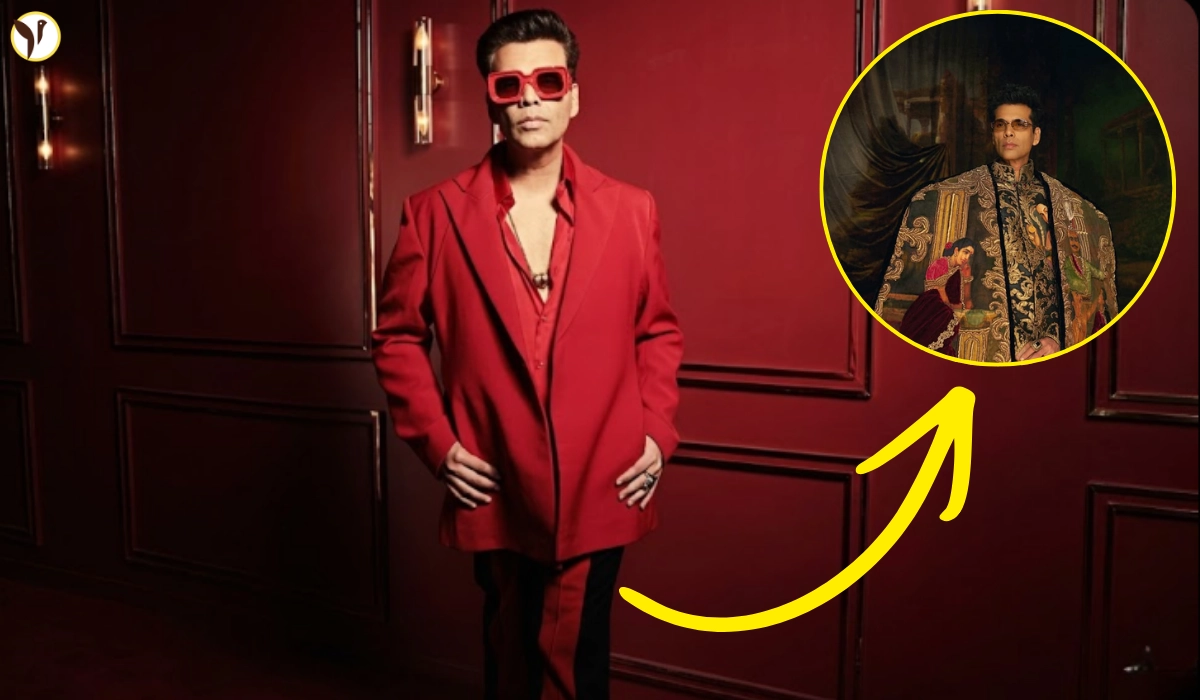


The Dharma Productions chief walked fashion's biggest stage wearing a Manish Malhotra creation that transforms 19th-century Indian painting into contemporary couture — and makes history in the process. When Karan Johar walked onto the Met Gala red carpet on the night of May 4, 2026, he did not arrive with a concept neatly rehearsed for cameras. He arrived, by his own account, with a feeling — one rooted in three decades of Indian cinema and borrowed from a 19th-century painter whose brushstrokes shaped how the subcontinent imagined its own gods. The result was a moment that transcended fashion: India's first filmmaker to attend the Met Gala, dressed in the visual language of one of the country's most consequential artists.
What Happened: A Garment Built Like a Painting
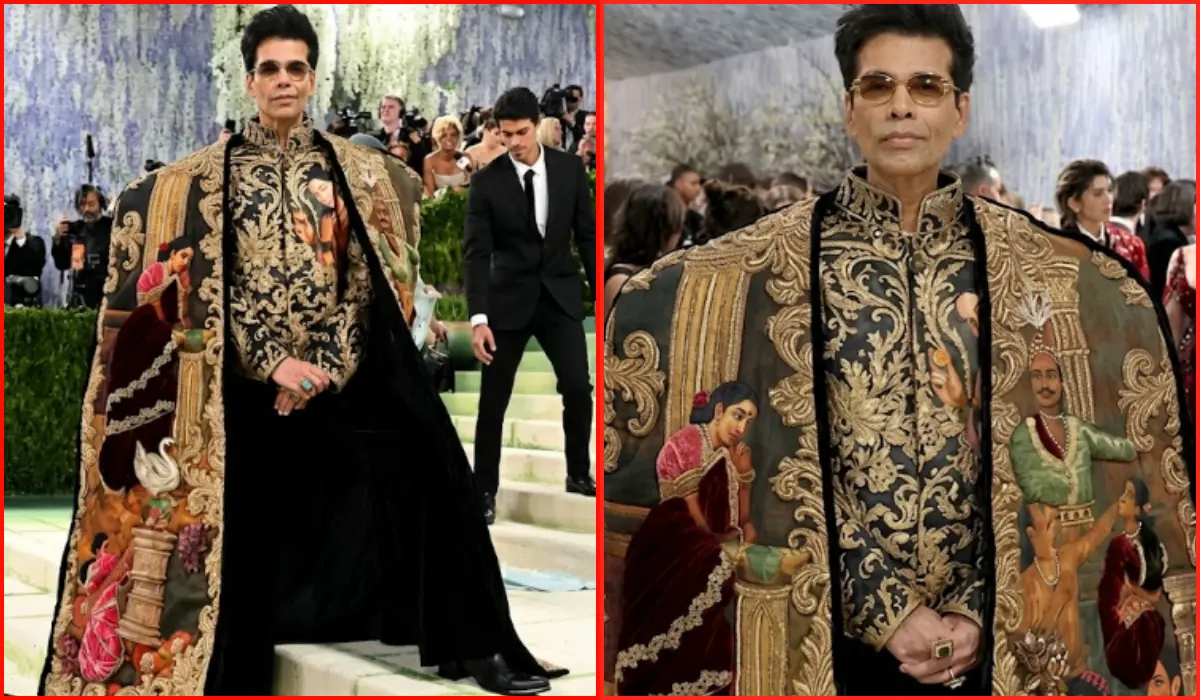
The silhouette Malhotra created is rooted in classical Indian drapery — restructured so the fabric moves with the body while preserving sculptural authority. But what makes the garment singular is its surface. Traditional artisans applied hand-painted gold detailing directly onto the cloth, stroke by stroke, as a painter would work on canvas. The result sits somewhere between costume, couture, and art object.
Four of Ravi Varma's most celebrated canvases informed the design: Hamsa Damayanti, Kadambari, Arjuna and Subhadra, and There Comes Papa. Each was chosen, Johar explained, not for spectacle but for the quiet emotional truth it carries.
"I didn't want to arrive here trying to explain India. I wanted to arrive feeling like myself and that automatically brings everything I come from with it." — Karan Johar
The look was developed with stylist Eka Lakhani in collaboration with Malhotra — a partnership spanning decades of Indian cinema, where clothing has consistently functioned as character and memory, not mere styling.
- 1st Indian filmmaker at Met Gala
- 4 Ravi Varma paintings referenced in the garment
- ~30 Years of Johar–Malhotra creative partnership
- 2026 Met Gala theme: "Costume Art"
Who Is Raja Ravi Varma — and Why Does He Matter?
For readers outside India, the reference demands context. Raja Ravi Varma was born in 1848 at Kilimanoor Palace in present-day Kerala into an aristocratic family. He mastered the oil-painting techniques of European academic realism while applying them to the figures of Hindu mythology — a fusion that had never been attempted at scale. The resulting images — luminous goddesses draped in silks, mythological heroes rendered with the warmth of portraiture — became the defining visual grammar of how modern India imagined its religious and cultural heritage.
Varma democratised this imagery further by introducing lithographic reproduction, making affordable prints available even to communities barred from entering temples. His portrayals of Hindu deities in humanised, accessible form carried particular significance for lower-caste communities, who could for the first time possess and venerate images of the divine. In 1904, the British Viceroy awarded him the Kaisar-i-Hind Gold Medal. In 2013, a crater on Mercury was named in his honour.
|
|
|
|
|
|
|
|
|
|
|
|
|
|
|
|
|
|
|
|
Why It Matters: A Historic First on Fashion's Biggest Stage
The Met Gala, held annually at the Metropolitan Museum of Art in New York, is widely considered the most exclusive and culturally resonant fashion event in the world. Its guest list of roughly 450 curated names spans film, music, sport, and global business. Until this year, no Indian filmmaker had ever walked its red carpet.
Johar's presence — alongside fellow Indian attendees Isha Ambani, designer Manish Malhotra (who both created the look and attended), and entrepreneur Ananya Birla — reflects a broadening of the event's cultural geography. But the significance of the filmmaker category is specific. Directors have historically had limited presence at the Met Gala, which skews toward actors, musicians, and models. Johar's appearance marks a recognition of cinema's directorial voice within fashion's global conversation.
Under Johar's stewardship, Dharma Productions has also recently expanded its international footprint. The studio's production Homebound, directed by Neeraj Ghaywan, premiered in the Un Certain Regard section at Cannes 2025 and was shortlisted at the 98th Academy Awards — the kind of global positioning that makes an invitation to the Met Gala's highest table plausible.
|
|
|
|
|
|
|
|
|
|
|
|
|
|
|
|
|
|
|
|
The Creative Philosophy: Cinema, Art, and Inheritance
What separates Johar's Met Gala moment from a straightforward cultural reference is the intentionality of the thinking behind it. In the weeks preceding the event, he spoke of the look not in terms of aesthetics but in terms of inheritance — the idea that one carries a visual and emotional culture within the body before one can consciously name it.
"For me it had to feel personal and the moment it felt personal, it became Indian, because that's where everything I know comes from. Every story I've told, every film I've made, every emotion I've tried to put on screen has come from this place. Raja Ravi Varma felt right because his work does something I've always tried to do in cinema." — Karan Johar
Johar also pointed to the parallel between Varma's artistic sensibility and his own filmmaking instinct: Varma's genius lay in making the epic feel intimate, finding the human inside the mythological, the everyday inside the grand. It is, in many ways, the same tension that has driven Johar's body of work — from the sweeping emotional architecture of Kabhi Khushi Kabhie Gham to the quieter interpersonal dynamics in more recent productions.
Karan Johar on the #MetGala carpet.https://t.co/9ahmyXebfO pic.twitter.com/Mf6NftWY8w
— Variety (@Variety) May 4, 2026
What Happens Next: Indian Representation at Global Fashion Stages
Johar's debut is likely to have a durable effect on how Bollywood and Indian creative industries engage with international fashion events. For years, Indian representation at the Met Gala has been dominated by actors and business figures. A filmmaker's presence — particularly one who framed his look as an act of cultural inheritance rather than celebrity styling — shifts the narrative.
It also poses a creative challenge for future Indian attendees: the bar for conceptual depth has been raised. Johar did not simply wear Indian fashion to an American event. He embedded a curatorial argument — about art history, cinema's debt to painting, and the texture of cultural memory — into a single garment. That is a different kind of statement.
For Manish Malhotra, the collaboration underscores his positioning as a designer equally fluent in cinematic history and global couture. The ensemble will likely enter the canon of significant Indian fashion moments at international events, alongside the looks Sabyasachi, Abu Jani Sandeep Khosla, and others have created for the global stage.
Other Articles to Read: