
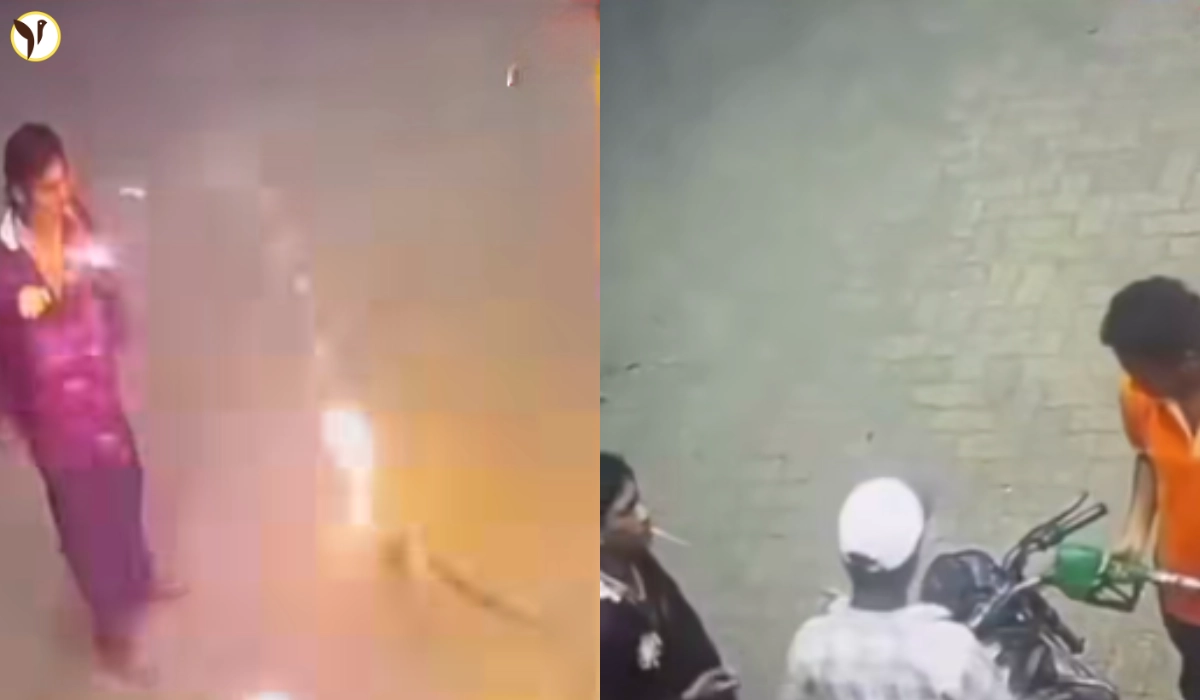


A routine fuel stop in Raipur nearly turned catastrophic when a man allegedly ignited a fuel nozzle after being stopped from lighting a cigarette. Quick action by petrol pump staff prevented what could have been a large explosion. The CCTV footage, now widely circulated, has renewed attention on everyday fire risks at fuel stations across India.
This incident is a reminder that petrol pumps are not ordinary public spaces. A single spark in the wrong moment can escalate into a life-threatening situation.
How the Fire Broke Out at Urla Petrol Pump
The incident occurred on the evening of February 18 at a petrol pump in the Urla area of Raipur, Chhattisgarh.
According to police sources and CCTV footage, two men arrived on a motorcycle for refuelling. While one remained seated on the bike, the other allegedly attempted to light a cigarette near the open fuel tank.
A staff member intervened and warned him against smoking on the premises. What followed unfolded in seconds. The man reportedly lit a lighter and directed it toward the fuel nozzle area. Flames erupted instantly, catching the motorcycle and briefly licking the dispenser unit.
Panic broke out among customers and staff as burning fuel splashed in the immediate area. The accused himself reportedly sustained minor burns from the flare-up.
Staff Response Prevented Escalation
What could have become a large-scale explosion was contained through rapid response.
Petrol pump attendants immediately pulled the nozzle away, shut off the fuel supply using the emergency cutoff mechanism, and deployed fire extinguishers. The blaze was extinguished within minutes.
Police later confirmed that there were no major injuries and no structural damage to underground fuel storage tanks or adjacent dispensers. Both individuals involved were detained, and a formal complaint was registered.
Authorities seized the motorcycle and the lighter allegedly used in the act. Charges relating to arson and endangering public safety have been invoked, pending further investigation.
Why Petrol Pumps Are Extremely Vulnerable to Fire
Fuel stations operate under strict safety frameworks for a reason.
Petrol vapour is highly volatile and can ignite at relatively low temperatures. The danger is not just the liquid fuel but the invisible vapour that forms around dispensing areas. Even a small flame, spark, or static discharge can trigger ignition.
In India, fuel outlets are regulated under Petroleum and Explosives Safety Organisation guidelines. These rules prohibit smoking within at least a 15-metre radius of dispensing units and mandate fire safety infrastructure at every licensed pump.
Below is a quick overview of standard safety requirements
|
|
|
|
|
|
|
|
|
|
|
|
|
|
|
|
|
|
|
|
|
|
|
|
Fire Incidents at Indian Fuel Stations
While large explosions are rare, minor fire incidents at fuel stations are reported each year across India. Many are linked to fuel leaks, electrical faults, static discharge, or negligence during refuelling.
Urban expansion has brought petrol pumps closer to residential areas. In cities like Raipur, where traffic density has increased sharply over the past decade, even a contained incident can have ripple effects.
The Raipur case did not result in a major blast, but the potential risk was real. Underground storage tanks, parked vehicles, and ongoing fuel dispensing create a highly sensitive setting.
Legal Action and Investigation
Police in Raipur have registered a case under sections related to arson and public safety endangerment. CCTV footage reportedly forms the backbone of the investigation.
Authorities are examining whether additional negligence occurred and whether stricter enforcement measures may be required at local fuel outlets.
Legal experts note that acts involving fire in public commercial spaces are treated seriously under Indian law, especially when multiple lives could have been endangered.
A puff of #cigarette nearly turned into a fireball at #Chhattisgarh's #Raipur petrol pump after a youth allegedly set a fuel nozzle ablaze using a lighter when asked not to smoke, that triggered flames on a motorcycle and pump. Amid panic, the pump staff averted a major disaster… pic.twitter.com/gMpE1iPGD2
— The Times Of India (@timesofindia) February 20, 2026
The case will now move through the judicial process.
Everyday Precautions Drivers Must Follow
For Indian motorists, refuelling is routine. But familiarity should not reduce caution.
Basic precautions include:
-
Switch off the engine before refuelling
-
Never smoke within petrol pump premises
-
Avoid using mobile phones near dispensing units
-
Do not overfill tanks
-
Ensure children remain seated inside vehicles
-
Cooperate immediately with pump staff instructions
Carrying a small vehicle fire extinguisher, especially for long-distance riders and commercial drivers, can add another layer of protection.
The Role of Staff Training
In this case, the response from petrol pump employees followed emergency protocol.
Attendants are trained to:
-
Remove ignition sources
-
Activate emergency cutoff valves
-
Use portable extinguishers
-
Clear nearby customers
Regular safety drills are part of compliance under regulatory norms. The quick containment in Raipur suggests preparedness at the outlet level.
However, prevention depends as much on public behaviour as it does on staff readiness.
Public Awareness and Behavioural Risks
Incidents like this highlight how small confrontations can escalate in high-risk environments.
The confirmed facts are clear. A lighter was used near a fuel nozzle. Flames broke out. Staff extinguished the fire. Police intervened.
The broader issue is behavioural compliance. Petrol pump safety rules are widely displayed, yet enforcement often relies on social cooperation.
A petrol pump is not merely a retail outlet. It is an operational hazard zone where minor defiance can have disproportionate consequences.
The Road Ahead
Following the incident, local authorities are expected to review enforcement measures and public awareness campaigns. Increased signage, CCTV visibility, and stricter on-site supervision may follow.
For now, the Raipur episode stands as a warning that safety instructions at fuel stations are non-negotiable.
Urban India’s vehicle population continues to grow. Fuel stations will remain high-density zones. The margin for error remains slim.