


The recent Rubina Dilaik health scare medical emergency helicopter stunt KKK 15 incident has reignited a complex conversation about the physical boundaries of reality television. When a televised stunt transitions from controlled entertainment to a genuine medical crisis, the glossy veneer of production fades, leaving behind pressing questions about participant safety, physiological limits, and the hidden costs of high-stakes programming.
This is not merely a recap of a television event; it is an examination of the intersecting factors that led to a seasoned performer requiring immediate medical intervention mid-air, and what this means for the future of action-based reality formats in India.
What Actually Happened
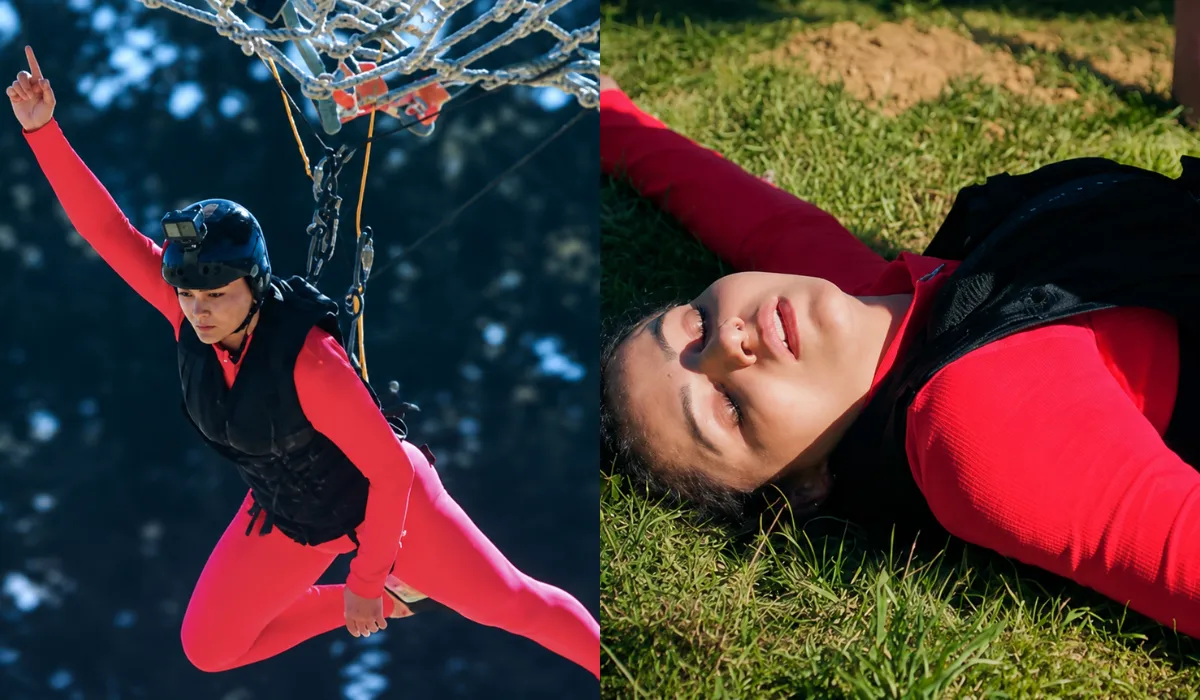
Filming for Khatron Ke Khiladi 15 (KKK 15) in Romania has pushed contestants to their absolute limits, but the recent helicopter-based task proved to be a critical threshold for Rubina Dilaik. According to verified on-ground reports and production sources, the stunt required Dilaik to be suspended from a moving helicopter, navigating a combination of aerial displacement, high-velocity wind shear, and water-based obstacles.
Unlike static stunts, helicopter maneuvers introduce severe vestibular (inner ear) disruptions. Midway through the task, Dilaik exhibited signs of acute physical distress. The exact nature of the medical emergency—whether it was severe vertigo, an anxiety-induced panic response, or a sudden drop in blood pressure triggered by the G-forces—prompted the show’s dedicated medical team to halt the stunt immediately.
The protocol shifted instantly from entertainment to triage. Dilaik was safely extracted from the harness and attended to by the on-site trauma and emergency team before being moved to a local medical facility for observation. Crucially, the production did not continue filming the stunt, adhering to standard halt protocols when a contestant's vitals breach safe parameters.
Why Aerial Stunts Are Uniquely Dangerous
To understand the severity of the Rubina Dilaik health scare during the KKK 15 helicopter stunt, one must look past the "fear factor" and examine human physiology.
Helicopter stunts are fundamentally different from ground-based height tasks. They subject the human body to three distinct stressors simultaneously:
- Propeller Wash and Wind Shear: The downward force of helicopter rotors creates highly turbulent, unpredictable air currents. When a contestant is suspended, these forces batter the body, forcing muscles to constantly micro-adjust, leading to rapid physical exhaustion.
- Vestibular Overload: The inner ear dictates balance. The combination of swinging motion, visual disorientation (looking down at water or moving terrain), and the vibration of the helicopter overrides the brain's ability to spatially orient itself. This triggers extreme vertigo, nausea, and in some cases, a vasovagal syncope (fainting response).
- The Adrenaline Crash: Contestants are pumped with adrenaline before a stunt. Once suspended in the air, if the stunt takes longer than anticipated, the adrenaline recedes, leaving the body suddenly exposed to the raw physical shock of the environment.
Furthermore, Dilaik’s recent physiological history cannot be ignored in a clinical context. Having navigated a high-risk twin pregnancy and delivery less than two years ago, her body’s cardiovascular and musculoskeletal baseline is different from a contestant who has not undergone such recent major physical trauma. While she underwent the mandatory pre-show medical clearances, real-world execution often tests limits that static hospital tests cannot accurately predict.
The Reality of Medical Emergencies in Action Reality TV
The incident involving Dilaik is not an anomaly; it is a statistical probability in high-stakes reality television. To provide context, below is an analysis of documented medical interventions in major Indian adventure reality shows over the past few seasons.
Table: Documented Medical Interventions in Indian Adventure Reality Shows (2021-2024)
|
|
|
|
|
|
|
|
|
|
|
|
|
|
|
|
|
|
|
|
|
|
|
|
|
|
|
|
|
|
|
|
|
|
|
|
|
|
|
|
|
|
The Unseen Safety Net of KKK 15
When viewers watch a medical emergency unfold on their screens, the immediate reaction is often to question the show's safety standards. However, an analysis of the operational mechanics of Khatron Ke Khiladi reveals a heavily layered safety infrastructure that operates parallel to the camera crew.
For the KKK 15 helicopter stunt involving Rubina Dilaik, the following safety matrices were active:
- Pre-Stunt Risk Assessment: Every stunt is graded by an independent safety officer. Helicopter stunts are classified as "Category A" (Highest Risk).
- Redundant Harnessing: Contestants are never held by a single point of failure. They wear a primary harness attached to the helicopter's winch, and a secondary independent safety line managed by a separate ground crew.
- The Medical Umbrella: Unlike standard shoots, KKK operates with a roaming Advanced Life Support (ALS) ambulance and a dedicated trauma anesthetist on standby. This is why Dilaik received immediate care the second her distress was signaled.
- The "Tap-Out" Rule: Contestants are briefed extensively that they can abort a stunt at any time without penalty by using a safe word or hand signal. In Dilaik's case, the medical team intervened before she could initiate a tap-out, indicating that her vitals or visible signs crossed a pre-determined medical threshold.
The system worked exactly as it was designed to: it prevented a minor distress signal from escalating into a catastrophic injury.
The Psychological Toll on Participants
The Rubina Dilaik health scare highlights a rarely discussed facet of reality TV: the psychological friction between competitive drive and bodily limitation. Contestants on KKK are not just competing for a trophy; they are competing for screen-time, brand value, and career resurgence.
This internal pressure often leads contestants to override their body’s natural warning signs. Dilaik, known for her resilient and fiercely competitive persona on shows like Bigg Boss 14, likely pushed through initial discomfort—a common psychological phenomenon in extreme sports known as "barrier breaking." When the body finally forces a shutdown, it is usually sudden and severe, which aligns with the reports of the mid-air medical emergency.
The audience must recalibrate how they view these moments. Cheering for a contestant to "push through" a visible panic attack or physical collapse crosses an ethical line from entertainment into voyeurism.
What Happens Next:
The immediate aftermath of a medical emergency on a reality show follows a strict, predictable legal and production pipeline. Here is what happens next for Rubina Dilaik and the production of KKK 15:
1. Mandatory Recovery Window Dilaik will be placed on a mandatory 48-to-72-hour rest period. During this time, she will undergo follow-up evaluations with a neurologist and general physician to rule out any delayed trauma, such as inner ear damage or concussive symptoms from the wind shear.
2. The "Fitness to Continue" Evaluation The show’s insurance providers and production house (Endemol Shine India) will require a fresh medical clearance. This is not a formality; it requires sign-offs from an independent doctor stating she is physically and psychologically fit to return to the stunt roster.
3. Strategic Elimination or Exit If the medical team advises against continuing, Dilaik will not face a standard "elimination." Instead, the show will script a narrative exit—often framed respectfully as an "injury-induced withdrawal." Given the severity of an aerial medical emergency, a voluntary withdrawal to prioritize health is the most probable outcome.
4. Production Calibration Following an incident of this visibility, the stunt-design team will likely recalibrate subsequent aerial tasks. While they rarely remove a stunt category entirely, they may reduce the duration of suspension or alter the wind-exposure variables for remaining contestants.
The Rubina Dilaik health scare medical emergency helicopter stunt KKK 15 event serves as a stark reminder of the human element embedded in reality television. While the production’s safety protocols functioned as intended, preventing a tragedy, the incident lays bare the extreme physical taxes exacted on participants.
As audiences, we are conditioned to view stunts through a lens of entertainment and dramatic scores. However, when a contestant is suspended hundreds of feet in the air, fighting not just fear but genuine physiological failure, the narrative shifts. It demands a more empathetic viewing culture—one that values the health and well-being of the performers over the pursuit of high-octane television.
Other Articles to Read: