


In a candid promotional conversation for Bhoot Bangla's Netflix release, Farah Khan and Akshay Kumar cracked open the vault on Tees Maar Khan — revealing how Katrina Kaif nearly didn't make it into the film, and how the leading man was quietly taking a helicopter home every single night.
Sixteen years on from its polarising release, Tees Maar Khan is back in the conversation — not because of a sequel or a re-release, but because Farah Khan and Akshay Kumar simply cannot stop talking about it. And honestly? The stories that keep surfacing are more entertaining than the film itself.
During a roundtable held to mark Bhoot Bangla's arrival on Netflix, the duo — joined by director Priyadarshan and actor Rajpal Yadav — slipped into a session of unscripted nostalgia. Two distinct anecdotes emerged from that conversation, and together they paint a portrait of a notoriously turbulent production where even the basics — like casting and commuting — were anything but ordinary.
The Director Who Didn't Want Her Own Casting Choice
Let's start with what Farah Khan has said herself, across multiple interviews: she almost didn't cast Katrina Kaif in Tees Maar Khan at all.
"Pehle to main obvious choice se rehti hun thoda door. I think the only time I made an obvious choice was jab Maine Tees Maar Khan mein Katrina Kaif ko liya. It was obvious because wo Akshay Kumar ke saath 6-7 movies kar chuki thi and I was very against ki mujhe usko nahi lena hai. But wo ghoom ghaam ke wohi aayi picture mein."— Farah Khan, on The Bombay Dream (Mashable India)
Translation for the uninitiated: Farah actively avoids the path of least resistance when it comes to casting. Putting Katrina opposite Akshay — a pair who had already shared screen space six or seven times — felt lazy to her. She resisted. She pushed back. And then, as she herself admits, Katrina "ended up in the film anyway."
That's a more layered story than it first appears. In an industry where star pairings are packaged and marketed like commodities, a director vocally objecting to a commercially safe combination is notable. Farah had built her reputation on precision — every frame of Main Hoon Na and Om Shanti Om was architected, not improvised. Choosing an "obvious" lead pair wasn't part of her creative identity.
Now, enter Akshay Kumar's version of events — which is where the "shoot" in our headline comes to life. During the Bhoot Bangla promotion session, he reportedly elaborated on the on-set dynamics, including the fact that Farah's frustration at the casting situation simmered throughout the shoot — at one point quipping, in her typically theatrical fashion, that she wanted to "shoot" Katrina (as in, she was so exasperated she joked about it). Classic Farah. The phrase, taken wildly out of context, is the kind of self-deprecating candour that only someone deeply confident in their relationships can deliver — and Farah's rapport with her collaborators has always run on exactly that currency.
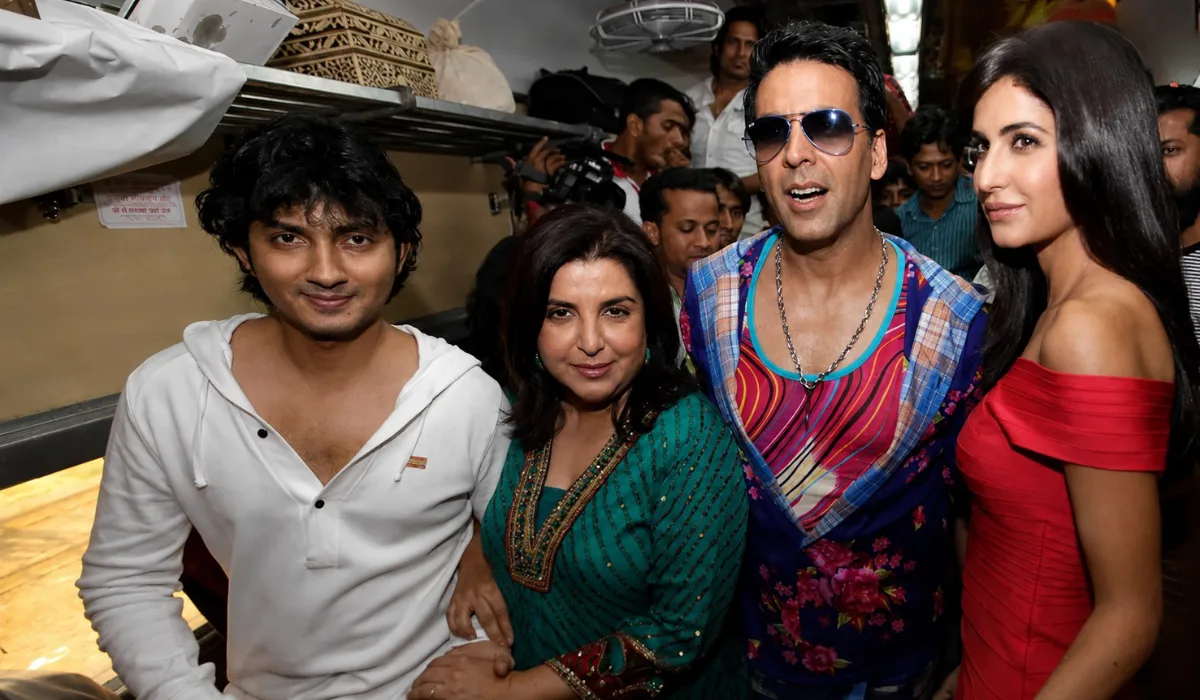
Akshay Kumar's Helicopter Secret: A Star's Private Commute
The second anecdote is arguably funnier — and more revealing of the sheer scale at which Akshay Kumar operates even on a regular film set.
The shoot was based in Malshej Ghat, a scenic but logistically inconvenient location roughly two-and-a-half hours from Mumbai. Standard procedure: the entire cast and crew stayed on location. Rajpal Yadav was there. Farah was there. Everyone roughed it out, road-trip style.
Everyone except Akshay Kumar.
"We were shooting for Tees Maar Khan in Malshej. The call time was 8 am every day. Everyone stayed there because it was about a two-and-a-half-hour drive from Mumbai. But Akshay would go home every evening after pack-up and return by 7:45 the next morning."— Farah Khan, during Bhoot Bangla Netflix promotion, June 2026
Rajpal Yadav, visibly stunned in the video clip, asked how that was even possible. Akshay's answer was delivered with studied nonchalance: helicopter. Every single day. Home in the evenings, back on set before the 8 AM call time.
Farah, admirably restrained until that point, cracked: "Mere saare paise kha gaya" (He ate up all my money). Akshay fired back that she made the most money on that film. Farah countered by telling him to call producer Ronnie Screwvala to settle that debate.
What's worth noting, beyond the comedy of it all, is that Farah added — with genuine credit — that despite the extravagant commute, Akshay was always on time. The helicopter wasn't a diva move that held up production; it was simply how India's most disciplined major star maintained his routine while keeping the shoot running.
The Complicated Legacy of Tees Maar Khan
To fully appreciate why these stories resonate the way they do, it helps to understand how fraught the film's legacy has been for everyone involved — particularly Farah Khan.
Tees Maar Khan released on Christmas Eve 2010. It was Farah's follow-up to Om Shanti Om, which had been a massive cultural moment. The expectations were enormous. The critics were not kind.
|
|
|
|
|
|
|
|
|
|
|
|
|
|
|
|
|
|
|
|
|
|
|
|
|
|
|
|
|
|
Farah has spoken openly about how the criticism hit her. She told Bombay Times she didn't want to step out of her house after the reviews landed. On the Ranveer Show, she described how such public failure puts a filmmaker "on the backfoot for a very long time." Most brutally, she recalled industry peers openly celebrating her stumble — telling her, "Ab aayi na line pe" (Now you're where you belong).
And yet: the film made money. Significantly more than its budget. Sheila Ki Jawani became so monumental that even today it's impossible to bring up Katrina Kaif without someone humming it. In the strange arithmetic of Bollywood, Tees Maar Khan is both a failure and an accidental triumph — and that paradox is precisely what makes its behind-the-scenes stories so irresistible.
Farah Khan and Akshay Kumar may be pulling each other's leg now, but they weren't on talking terms when he refused to promote her husband Shirish Kunder's 2012 sci-fi comedy Joker.https://t.co/lM5D0cRSlx
— SCREEN (@ieEntertainment) June 17, 2026
Akshay–Katrina: A Working Relationship Built on Patience
It's easy to clock Farah's "obvious choice" critique as a director's artistic gripe, but the Akshay–Katrina pairing had genuine professional warmth beneath it. Katrina Kaif has spoken about how Akshay supported her during her early career, standing in front of her during shots to give her confidence and offering feedback that sharpened her craft. He was, she said, one of the few actors who genuinely believed in her when she was finding her footing.
|
|
|
|
|
|
|
|
|
|
|
|
|
|
|
|
|
|
|
|
|
|
|
|
|
|
|
|
|
|
|
|
|
|
|
|
So when Farah calls it an "obvious" pairing, she isn't wrong — but obvious isn't always a liability. These two had enough on-screen comfort that audiences weren't confused when they shared the frame. The problem for Tees Maar Khan was never the chemistry; it was the script.
What the Bhoot Bangla Context Tells Us
These memories didn't surface in a vacuum. Akshay Kumar, Farah Khan, Priyadarshan, and Rajpal Yadav were together to promote Bhoot Bangla's Netflix debut — a 2026 horror comedy that has already collected ₹242.85 crore worldwide and become one of the biggest Hindi films of the year. It's a comfortable reunion of old collaborators, and that comfort created the conditions for exactly this kind of unguarded candour.
Farah and Akshay clearly share the kind of friendship where 16-year-old production grudges can be aired publicly without anyone leaving the room offended. That, in itself, is a story about the durability of their professional bond — forged, as it happens, in the middle of a critically panned film shot in the mountains with a leading man who was sneaking home in a helicopter.
The Bigger Picture: Casting, Control, and Creative Instinct
Farah Khan's casting philosophy — stay away from the obvious — is worth lingering on. Main Hoon Na paired Shah Rukh Khan with Sushmita Sen, a combination nobody had tried. Om Shanti Om introduced Deepika Padukone in a blockbuster debut opposite SRK. Both were bold calls that paid off spectacularly.
Tees Maar Khan was her first time playing it commercially safe — and by her own admission, it happened despite her instincts, not because of them. Whether that contributed to the film's creative shortcomings is impossible to say definitively, but Farah's willingness to name it so openly, years later, speaks to an intellectual honesty about her own process that most filmmakers don't extend to failed projects.
The helicopter story, meanwhile, is pure Akshay Kumar lore — entirely consistent with everything we know about a star who reputedly wakes at 4 AM, is on set earlier than anyone else, and treats punctuality as a matter of professional identity. The difference is just that most days he drives. On Tees Maar Khan, he flew.
Other Articles to Read: