


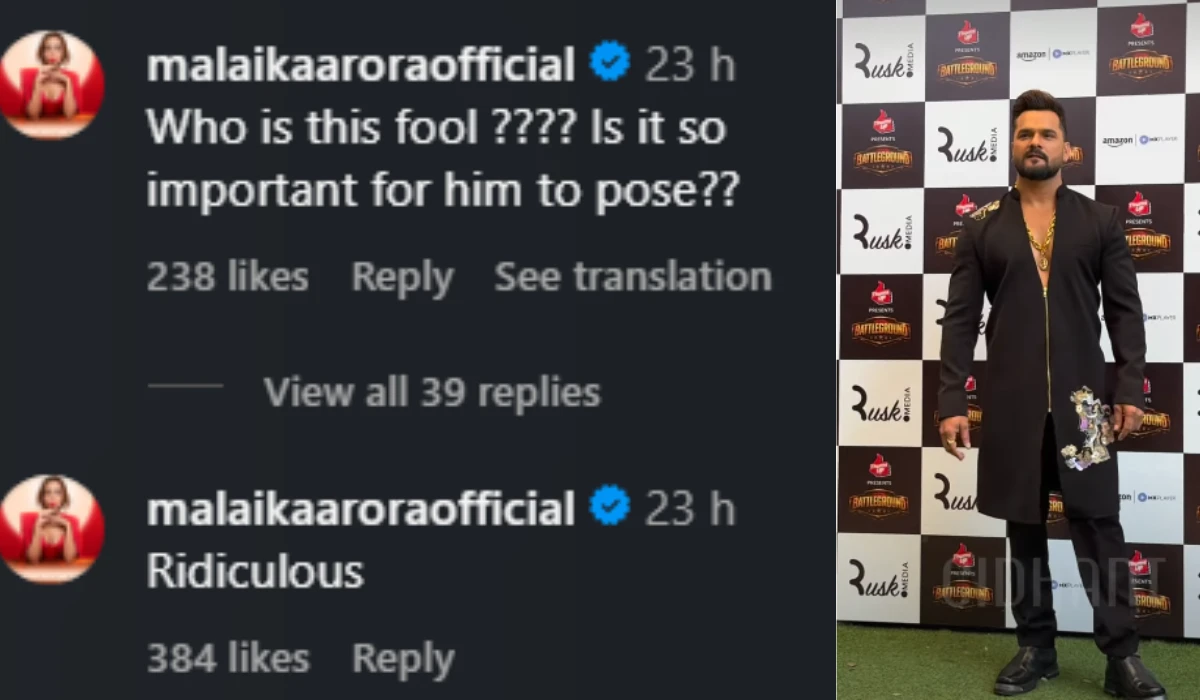
In the modern digital economy, a three-second interaction captured on a smartphone can instantly become a cultural flashpoint. Recently, a viral video circulating across social media platforms showed Bollywood personality Malaika Arora failing to recognize a prominent Bhojpuri cinema star during a paparazzi interaction. When confronted with the resulting online backlash and the relentless questioning by the press, her response was blunt: "This is disgusting."
To the casual scroller, this is just another celebrity spat—a moment of schadenfreude to be consumed and forgotten. However, looked at through a broader lens, the incident is a highly revealing case study. It exposes the invisible but rigid hierarchies within the Indian entertainment industry, the friction between regional dominance and mainstream glamour, and the predatory nature of the modern paparazzi ecosystem.
Here is a deep dive into what actually transpired, the sociological undercurrents at play, and why this moment matters far beyond the realm of gossip.
The Anatomy of the Incident: What Actually Happened?
The timeline of the event is straightforward, even if the context is complex. While stepping out for a professional commitment in Mumbai, Arora was swarmed by the usual contingent of videographers. In an attempt to elicit a reaction, a photographer held up a placard featuring a picture of a highly successful Bhojpuri actor and asked Arora to identify him.
Arora drew a blank, openly admitting she did not know who the individual was. Rather than moving on, the press persisted, later showcasing her inability to recognize the star as a slight against the Bhojpuri film industry. When the clip gained traction and was met with aggressive trolling directed at Arora, sources close to the actor indicated that she found the manufactured outrage and the deliberate baiting "disgusting."
It is vital to separate the facts from the narrative. The fact is a mainstream Bollywood celebrity did not recognize a regional star—a common occurrence in a fragmented industry. The narrative, spun by engagement-driven media portals, was that a Bollywood "elite" deliberately snubbed a regional artist.
The Invisible Wall: Quantifying the Industry Divide
To understand why Malaika doesn't recognize a Bhojpuri star, one must look at the structural reality of Indian cinema. It is not necessarily a matter of arrogance; it is a matter of segregated market economies.
Bollywood and Bhojpuri cinema operate in parallel universes. They have different distribution networks, different primary audience demographics, and drastically different PR machinery.
|
|
|
|
|
|
|
|
|
|
|
|
|
|
|
|
|
|
|
|
|
|
|
|
|
Deconstructing the "Disgusting" Remark
When the phrase "This is disgusting" is attributed to Arora, it requires contextual unpacking. Based on the progression of the event, the disgust was likely not directed at the Bhojpuri star himself, but rather at the weaponization of ignorance by the paparazzi.
The paparazzi ecosystem in Mumbai has evolved. It is no longer just about taking candid photos; it is about manufacturing "viral moments." Paps are known to use provocative props—playing songs of ex-partners, holding up pictures of rival actors, or in this case, testing a celebrity's knowledge of regional stars. The goal is to capture a moment of confusion, which can then be edited into a short-form video with a sensationalist headline.
When this tactic results in coordinated online harassment, calling the setup "disgusting" is a rational critique of a toxic media practice. It highlights how the press often pits artists against each other to farm engagement, creating a false narrative of disrespect where there is merely a lack of exposure.
The South Indian Contrast: Why Bhojpuri Feels Left Out
To fully grasp the frustration of Bhojpuri cinema fans, one must look at the recent history of South Indian cinema. Over the last five years, films like Baahubali, KGF, RRR, and Pushpa have forced Bollywood to take notice. South stars like Prabhas, Allu Arjun, and Yash are now recognized by mainstream Hindi media and Bollywood celebrities alike.
Why did the South break through, while Bhojpuri cinema remains relegated to the margins of mainstream recognition?
- Production Scale: South Indian industries (Telugu and Tamil) invested heavily in VFX, global scale, and pan-Indian storytelling. Bhojpuri cinema, while highly profitable, has largely stuck to traditional, grassroots narratives that resonate locally but don't translate to pan-India multiplex culture.
- Dubbing Strategy: South producers strategically dubbed their films into Hindi, capturing the North Indian streaming market. Bhojpuri films are already in a Hindi dialect, meaning they don't have a "dubbed" entry into the mainstream—they are often viewed as a sub-genre rather than a parallel industry.
- Cultural Perpetuation: Despite producing icons like Manoj Tiwari, Ravi Kishan, and Pawan Singh, Bhojpuri cinema has battled an unfair stereotype in elite Mumbai circles, often being typecast solely for its item numbers rather than its mass-market storytelling.
The anger from Bhojpuri fans stems from a valid grievance: their industry generates massive revenue and employs thousands, yet it is treated as a novelty by the Mumbai elite.
The Paparazzi Economy: Manufacturing Class Clashes
This incident cannot be discussed without addressing the business model of digital entertainment journalism.
In the attention economy, conflict is currency. A headline that reads "Malaika Arora steps out in Bandra" generates 10,000 views. A headline that reads "Malaika snubs Bhojpuri star, says it's disgusting" generates 2 million views.
The paparazzi who asked the question were not conducting a journalistic interview; they were performing for the camera. This creates a dangerous feedback loop:
- The Bait: Paps ask a loaded, out-of-context question.
- The Reaction: The celebrity responds with confusion or frustration.
- The Edit: The video is cropped to remove the pap's provocation.
- The Outrage: Regional fans feel insulted; mainstream fans defend the celebrity.
- The Profit: Ad revenue flows to the media portal that hosted the video.
By understanding this cycle, the public can better consume celebrity news. The "disgusting" element is indeed the ecosystem itself—one that thrives on pitting different socio-economic and regional classes against one another for digital clout.
What Happens Next: The Inevitable Mainstream Merge
While this specific incident will fade from the trending charts, the underlying friction it represents will continue to build. However, the future points toward an inevitable integration.
1. The Streaming Equalizer: Platforms like Amazon MiniTV, MX Player, and even YouTube are actively commissioning Bhojpuri original series. As these platforms blur the lines between "regional" and "mainstream," crossover collaborations will become standard.
2. The Reality Show Bridge: Just as Bigg Boss has historically been a vehicle for regional stars to enter the Hindi-speaking consciousness (as seen with Ravi Kishan), future seasons of reality TV will continue to be the primary networking hubs where Bollywood and regional stars actually interact.
3. The Shift in Bollywood: With Bollywood struggling with a string of box-office failures, the industry is slowly losing its arrogance. Producers are increasingly looking toward regional hits for remake rights. It is only a matter of time before a major Bollywood production stars a leading Bhojpuri actor in a significant role, formally bridging this recognition gap.
Conclusion
The viral clip of Malaika Arora is not a story about one woman’s ignorance. It is a mirror held up to the Indian entertainment industry, reflecting its deep-seated regional divides, the toxic nature of engagement-driven paparazzi culture, and the economic silos that keep artists apart.
Labeling the interaction as "disgusting" is an entirely appropriate critique of a media environment that prefers to manufacture slights rather than celebrate the diverse, multi-lingual tapestry of Indian cinema. Until the structural economics of how entertainment is covered and consumed change, these manufactured class and regional clashes will remain a staple of our daily digital diet.
Other Articles to Read: