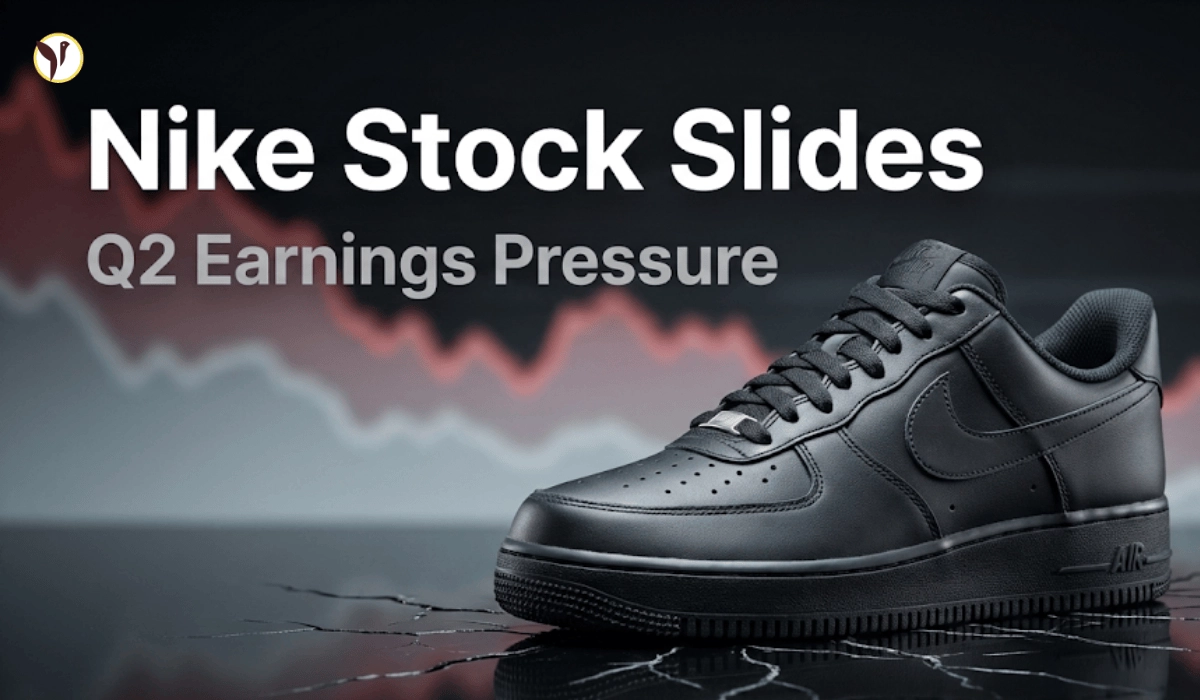


After reporting lower-than-expected earnings in Q2, Nike (NKE) shares have recorded their steepest pullback so far this year as a result of investor fear from both the US and globally.
Shares fell sharply before the market opened and continued their decline as investors continued to absorb the following news from Nike:
- A decrease in net income of 32% since 2017
- Continued pressure on margins
- Ongoing weakness in the Chinese market
- Increased pressure on costs in the North American market
Although revenues remained relatively strong based on Wall Street's expectations, the major red flag for Wall Street is that Nike is selling more products, but with lower profitability per sale.
Why Nike Stock Is Falling?
- Why did Nike stock fall immediately?
The Q2 earnings report reflected a decline in profits (in addition to lower growth) in comparison to the previous year. The markets respond more quickly to declines in profit levels rather than revenue declines.
- Why did profits fall even when revenue didn’t collapse?
Nike has had to cover:
-Higher production and logistics costs
-More aggressive discounting on products in order to reduce inventory buildup
-The effects of tariffs on North American business
These factors lead to lower margins, which are serious concerns for the long-term value of earnings.
- Why can’t Nike offset these costs easily?
Nike's direct-to-consumer approach, which was previously viewed as providing margins, is now being pressured because of:
- Increased costs of fulfilment
- A slowdown in the growth of online consumer demand
-Increased competition from local and premium brands
Therefore, the margin advantage that investors had priced into the company is not guaranteed to continue.
- Why can’t Nike offset these costs easily?
One of the highest margin markets for Nike is China. When there is weak demand in China, it ultimately impacts Nike’s profits disproportionately compared to sales. As a result, Nike is being negatively affected globally because of increased competition from domestic companies and decreased consumer spending in China.
- Why did the market react so aggressively?
The Q2 report not only showed an increase in net income; it also provided investors with some questions about the timing of Nike's recovery. Investors now have a clearer picture of the following things that could limit the growth rate of Nike going forward:
1- Margins will recover more slowly
2- Catalysts that could provide growth are not present
3- There is a greater risk of mistakes during any future transition of Nike's strategy
All of these things represent uncertainty, which is why Nike's stock has had such big price cuts.
What Is the Real Impact of This Earnings Report?
For Investors:
- The Reset of Growth Expectations
- The Compression of Valuations
- A Defensively Oriented Sentiment in the Near Term For Nike's Operations
On Nike’s Operations
- Increased Constraints on Costs
- A More Selective Approach to Product Launches
- Greater Focus on Cash Flow versus Growth
For The Broader Market:
Nike's Results Are Also Being Viewed As An Indicator of US Consumer Discretionary Spending; Specifically, Apparel & Footwear.
What you can do Now
If You Already Own the Stock:
- Revisiting the initial reason for the investment in the shares
- Concentrating on income, profit margins, and future guidance rather than daily pricing fluctuation.
- Assessing if the current situation is an anomaly (one time occurrence) or part of a bigger picture (a change in the business model).
The big question: What kind of changes are taking place in the business? Have there been any changes to the long-term business model or only the short-term prospects?
If You Are Considering Buying the Stock:
-Waiti for Earnings or Margin Stability
- wait for Confirmation from Management About Fixes to the Main Problem
-Do Not Make Decisions Only Based on Previous Highs or Brand Image
-Just Because a Price is Lower Does Not Mean It Is a Better Value.
If You Are a Short-Term Trader
-Significant price volatility can continue for longer periods of time after major news events are announced.
-Sharp price movements may result from analysts readingjusting their forecasts and institutional investors repositioning themselves.
-Short-term technical positioning is more closely correlated with stock movement, as opposed to news stories.
-Risk control is much more important than attempting to predict future stock movements.
Key Signals to Watch Next
-Future earnings and margin expectations.
-The company's future guidance and comment on its financial results.
-Current and expected demand in important markets for products/services offered.
-Current and historical cost and cash flow metrics.
The stock price will be greatly influenced by the above indicators moving forward.