
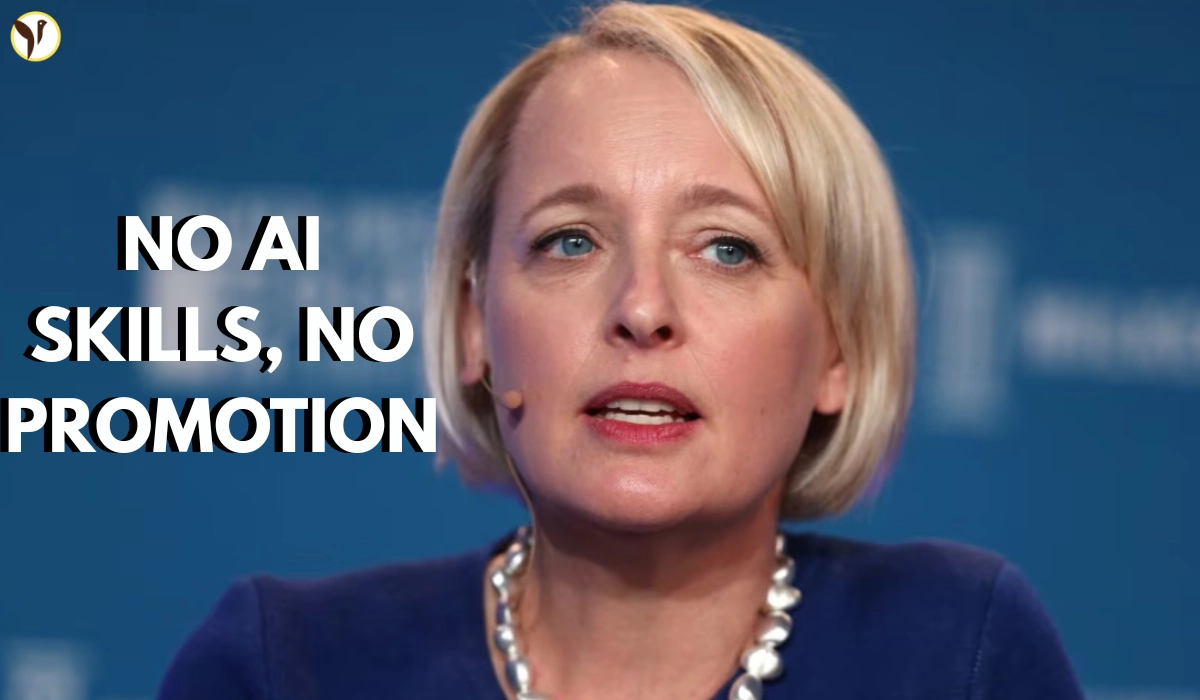


A major shift is unfolding inside global consulting giant Accenture. CEO Julie Sweet has told employees that understanding artificial intelligence is now closely tied to career growth. The company’s latest internal push signals that AI fluency will influence promotions across its massive workforce of about 750,000 people. Accenture is investing heavily in training programs so employees can work confidently with AI tools. The message reaching teams worldwide is simple: if you want to grow inside the company, you must learn how to use AI in everyday work.
Accenture’s Bold AI Push Is Reshaping Career Growth
Artificial intelligence is no longer treated as a specialized technical skill at Accenture. Leadership wants employees across roles—from consultants to analysts—to understand how AI tools can improve daily workflows.
The company has spent the last few years building a large-scale AI ecosystem inside the organization. Internal platforms, training modules, and productivity tools are being integrated into projects across industries.
According to company discussions and internal guidance, senior managers are increasingly paying attention to how frequently employees use AI-powered tools in their work. Employees who actively experiment with these tools and apply them to real projects are more likely to stand out during performance reviews.
For a consulting company whose business depends on advising clients about digital transformation, this shift makes strategic sense. If consultants are not comfortable using AI themselves, it becomes difficult to guide clients through AI adoption.
Massive Training Program: Hundreds of Thousands Already Trained
Accenture has backed its AI-first approach with serious investment in employee education. The company has launched one of the largest corporate AI training initiatives in the world.
|
|
|
|
|
|
|
|
|
|
|
|
|
|
|
|
|
|
|
|
|
|
|
|
These programs focus on practical skills. Employees learn how to use AI for research, automate repetitive work, analyze large data sets, and improve decision-making.
Promotions Now Reflect Real AI Usage
Accenture’s leadership believes promotions should reflect the realities of modern work. As AI becomes a core part of consulting services, employees who demonstrate fluency naturally become stronger candidates for leadership roles.
Managers are beginning to review indicators such as:
-
Regular use of internal AI tools
-
Ability to apply AI insights in client projects
-
Experimentation with generative AI platforms
-
Productivity improvements using automation
Employees who develop these capabilities may find themselves moving faster into higher responsibility roles. Those who avoid learning AI tools could face slower career progress.
Julie Sweet has described the shift as a natural step in workplace evolution. In her view, AI tools are becoming as essential as computers and email once were.
Entry-Level Hiring Continues Despite Automation Concerns
Interestingly, Accenture is not slowing hiring even as automation becomes more common. Instead, the company is continuing to bring in fresh talent.
The reasoning behind this strategy includes:
-
Younger professionals often have stronger exposure to digital tools
-
Many graduates are already experimenting with AI systems
-
New hires can adapt quickly to AI-powered workflows
-
Client demand for AI consulting services is growing rapidly
Accenture works with thousands of global clients who are trying to modernize their operations. To support these projects, the firm needs teams that understand emerging technologies.
Combining experienced consultants with AI-native young professionals is part of the company’s long-term strategy.
Big Tech Is Moving in the Same Direction
Accenture’s approach reflects a wider trend across the technology industry. Major companies are increasingly rewarding employees who adopt AI tools.
Organizations such as Cisco and Amazon have also begun integrating AI usage into performance reviews in different ways. Meanwhile, AI-powered platforms from Microsoft and Google are being embedded into everyday office software.
This trend suggests that AI literacy is quickly becoming a standard professional skill rather than an optional specialization.
Other Articles to Read:
- One Battle After Another: How Many Oscars Did the Movie Win at the 98th Academy Awards?
- 'Sinners’ Becomes Most Nominated Film in Oscars History
- North Korea Suddenly Launches Missiles Toward Sea of Japan — A New Warning Signal?
- AI Video or Real Footage? Viral Benjamin Netanyahu Clip Fuels Online Confusion
- What a Race: George Russell Wins Dramatic Chinese F1 Sprint Race
- Chaz Bono and Shara Blue Mathes Wedding – Inside the Glam Hollywood Wedding
AI Is Becoming the New Workplace Advantage
Across industries, companies are searching for employees who can combine human expertise with AI-powered tools. The ability to work with AI can improve research speed, automate routine tasks, and reveal insights hidden in large data sets.
Accenture’s promotion policy reflects this reality. The consulting giant wants leaders who understand how AI changes business operations and client expectations.
For professionals across the job market, the takeaway is clear. Learning how to use AI tools effectively could become one of the most valuable career skills in the coming years.
As companies continue investing billions into artificial intelligence, the workforce is entering a new phase where technology literacy shapes professional growth.