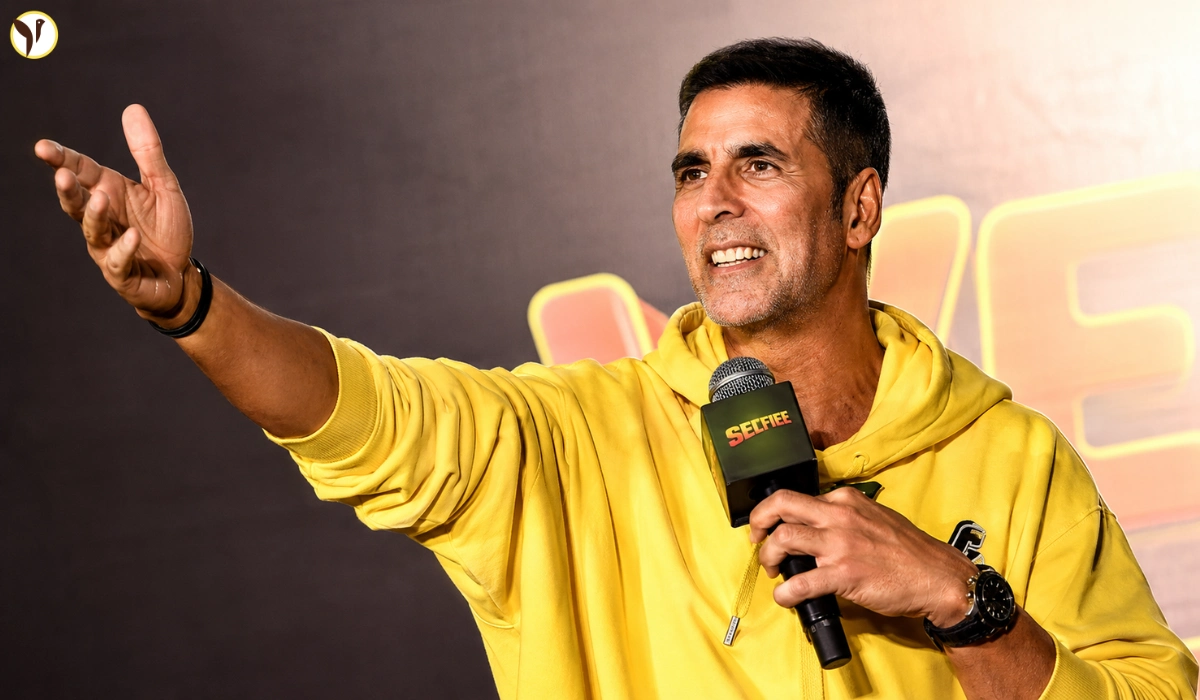


In a candid reckoning with his own past, Bollywood's most bankable survivor admits the action-star trap wasn't just a box the industry put him in — he helped lock the door himself.
There's something quietly disarming about a superstar calling himself out — not as PR strategy, not wrapped in self-deprecating charm for an awards night — but with the kind of flat, almost clinical honesty that sounds like it cost him something to say.
Akshay Kumar, the actor who has appeared in over 150 films across 35 years, recently made exactly that kind of admission. He revealed that after a full decade of playing action heroes in Bollywood, he looked back at that version of himself and felt the urge to deliver a sharp slap. Not to a villain on screen. To himself.
It isn't a headline designed to shock. It's a confession that, once you understand the shape of his career, lands with the weight of genuine hindsight.proved to be his first profitable film in three years.
The Action Decade That Almost Defined Him Forever
Akshay Kumar — born Rajiv Hari Om Bhatia in Amritsar — arrived in Hindi cinema in 1991 and found his footing almost immediately in action. Khiladi (1992) was his launchpad, and the film not only became a commercial success but gave him a nickname — "Khiladi Kumar" — that would follow him for the next two decades. What followed was a sequence of action films that locked in that image with industrial efficiency.
Mohra, Main Khiladi Tu Anari, Suhaag — all 1994. Khiladiyon Ka Khiladi in 1996. Sangharsh and Jaanwar in 1999. The films kept coming, the punches kept landing, and the mould hardened around him. By the end of the 1990s, he was one of the industry's most reliably cast action stars — a label that studios loved, because it told them exactly what they were getting, and what they were selling.
The problem with that kind of reliable is what it quietly forecloses. And Akshay Kumar, with the benefit of distance, saw exactly what he had been closed off from.
"He realised after the first decade in the Hindi film industry that he was stuck in the action star image and needed to break out urgently."
The Pivot That Changed Everything
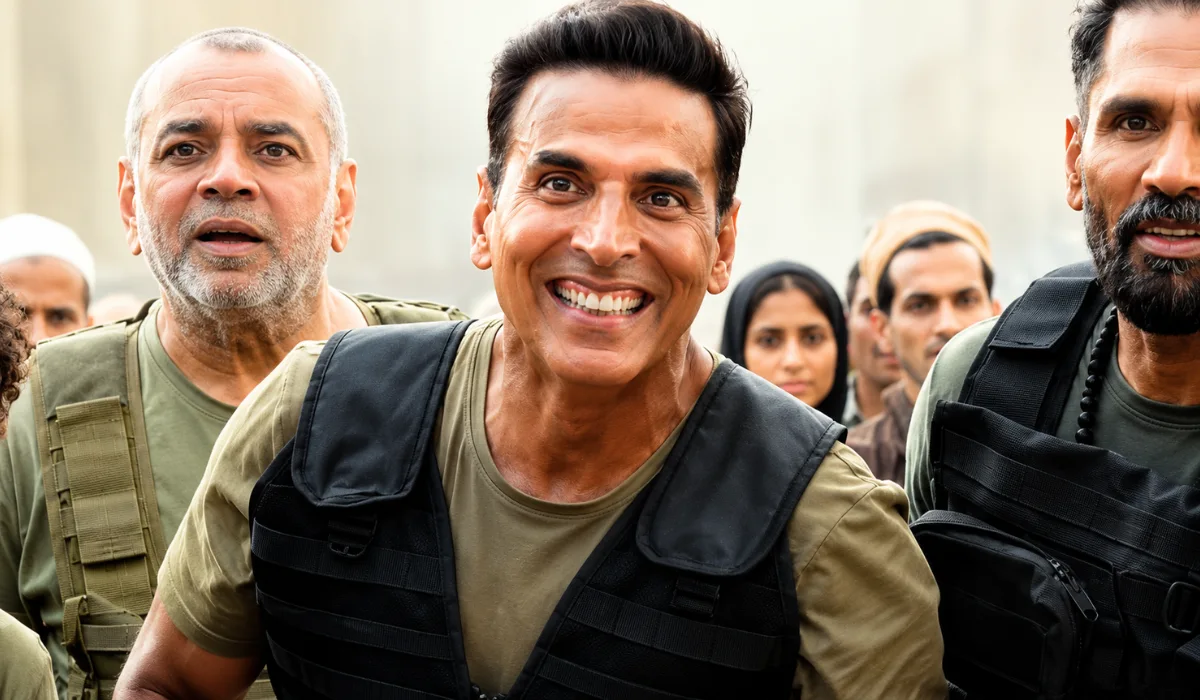
The turn came at the edge of a new millennium, and it arrived in the most unexpected costume: a bumbling, scheming, perpetually broke young man named Raju. Hera Pheri (2000) didn't just give Akshay Kumar a comedy hit — it gave him a new identity entirely. The film, directed by Priyadarshan, became a cultural touchstone, and Akshay's comedic timing — quick, self-aware, built on physical absurdity — proved to be as precisely calibrated as any punch he had thrown on screen.
The industry noticed. So did he.
What followed through the early-to-mid 2000s was a deliberate and systematic dismantling of the action-star box. Romance in Andaaz and Aitraaz. Slapstick in Awara Paagal Deewana, Mujhse Shaadi Karogi, and Bhool Bhulaiyaa. By 2007, he had achieved something rare in Bollywood — four consecutive box-office hits spanning completely different genres, collectively grossing over ₹500 crore. It was the year the industry stopped seeing him as an action star who could do comedy and started seeing him as something harder to define, and therefore harder to dismiss.
|
|
|
|
|
|
|
|
|
|
|
|
|
|
|
|
|
|
|
|
|
|
|
|
|
|
|
|
|
|
|
|
|
|
|
|
What the Confession Actually Means
It's worth pausing on the language Akshay used — the physical, visceral imagery of wanting to slap himself. That's not the vocabulary of mild regret. It's the language of someone who remembers a specific frustration: the helplessness of watching your creative range narrow, year after year, because of choices that felt safe and because the industry had decided what you were.
He is far from the only one who has found himself in this bind. Bollywood has a long and complicated relationship with typecasting — particularly for actors who arrive as action heroes. Very few have managed to exit that box with their career intact, let alone expanded. The ones who do — and Akshay Kumar is perhaps the most instructive example — tend to share a quality: they became uncomfortable before the audience did.
A Pattern of Radical Honesty
This isn't the first time Akshay Kumar has assessed himself without diplomatic cushioning. Earlier in his career, in an interview following his first Filmfare Award nomination, he was remarkably blunt with a journalist on set: he stated plainly that he didn't deserve the nomination, and that he knew — as well as the critics did — that he wasn't a good actor yet. He even recounted an incident where he was denied entry to a gymkhana precisely because he was an actor, a fact he relayed with no self-pity.
That quality — the ability to look at yourself without the armour that fame typically provides — is unusual in any industry, and especially in one as image-conscious as Bollywood. It also, perhaps, explains why his reinventions have worked where others haven't. He doesn't seem to carry his own mythology as dead weight.
“Wanted to break 'action hero' image and rebuild myself through new characters.
— News Arena India (@NewsArenaIndia) June 23, 2026
Earlier I was in industry only to earn money.
I wanted to slap myself after looking at movies it did initially.
I always want to focus on dismantle and redevelopment.”
- Akshay Kumar on career… pic.twitter.com/Xry3QJz87n
Where He Stands in 2026
The present moment in Akshay Kumar's career is, by any fair assessment, a story of measured recovery. After a sustained box-office slump that followed the enormous commercial peak of Sooryavanshi (2021) — during which virtually every release underperformed — he has found his footing again with OMG 2 (2023) and, most recently, Bhooth Bangla (April 2026), a horror-comedy directed by Priyadarshan that proved to be his first profitable film in three years.
The Priyadarshan reunion was itself a pointed choice: their seventh collaboration, coming 14 years after Khatta Meetha (2010). Priyadarshan, during promotional conversations, noted something revealing about Akshay's instincts — that he switches genres almost intuitively, that he gets bored before the audience does, and that he seems to sense when a phase has run its course before the data tells him so. That quality, the director suggested, is what separates him from peers who hold onto a successful formula until it collapses around them.
The action instinct hasn't disappeared, of course. His upcoming pipeline includes Hera Pheri 3 and Welcome to the Jungle — both franchise continuations with strong comedic DNA — alongside Haiwaan, which leans back toward thriller territory. The range remains intentional.
The Larger Lesson in the Confession
Akshay Kumar wanting to slap his younger self is, on the surface, an entertaining soundbite. But it sits on top of something more substantial: a working model of how a Bollywood career can be reconstructed from within, without waiting for an external crisis to force the change.
He saw the genre trap. He named it. He broke out of it — at personal commercial risk, at the cost of disappointing the audiences who expected him to keep punching. And thirty-five years later, with two National Film Awards, a Padma Shri, and a career that has outlasted virtually every peer from his generation, the self-deprecating honesty reads less like humility and more like the clearest possible account of what actually happened.
A slap, in this case, was the kindest thing he could have given himself.
Other Articles to Read: