
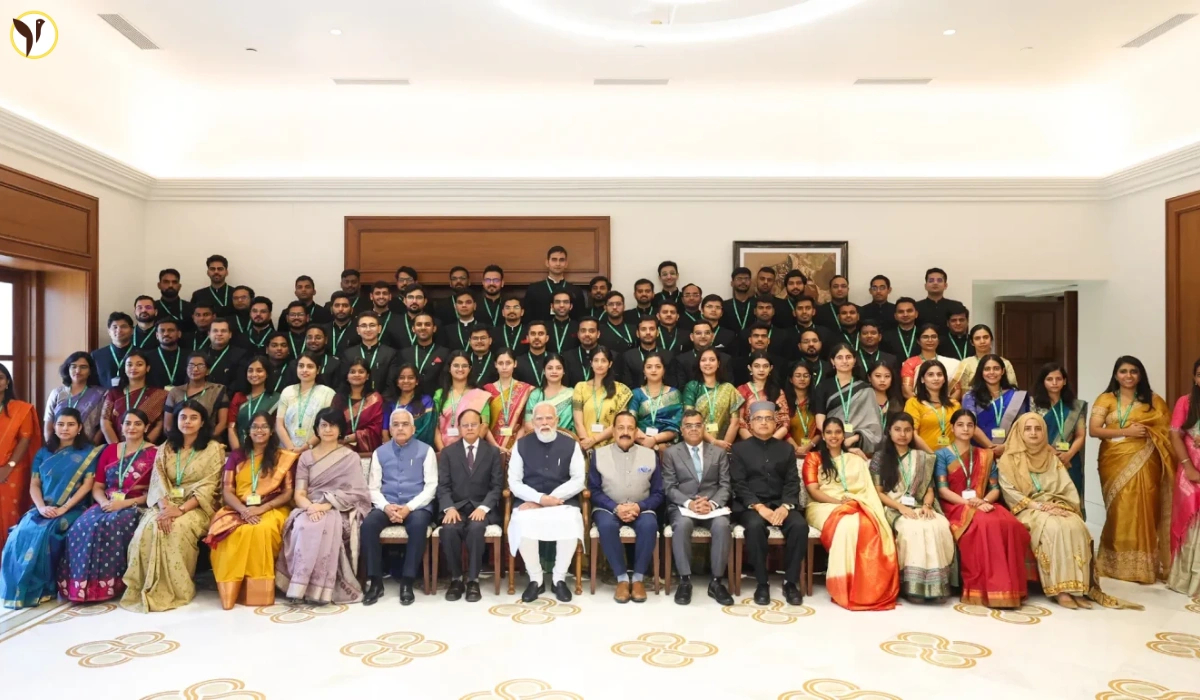


At a venue literally engraved with the words "Nagrik Devo Bhava," PM Modi told 183 IAS trainees that every government file in their hands carries someone's life — not just a signature.
Prime Minister Narendra Modi on Tuesday delivered a pointed message to India’s next generation of bureaucrats: citizens must come before everything else. Addressing 183 IAS officer trainees of the 2024 batch, currently serving as Assistant Secretaries in Union ministries and departments in New Delhi, Modi urged them to adopt a “Nagrik Devo Bhava” approach — effectively placing citizens at the heart of administrative decision-making.
The remark may sound familiar in a political system that routinely invokes “citizen-centric governance,” but Modi’s speech is worth closer attention for three reasons. First, it was directed not at senior administrators but at officers just entering the machinery of government — the officials who will eventually become district magistrates, secretaries, and policy gatekeepers. Second, it came with a broader push for whole-of-government coordination, a phrase that has become increasingly important as India tries to execute large, multi-ministry programmes. And third, it connects to a larger political and administrative theme of Modi’s third term: governance measured not by announcements, but by how directly the state improves everyday life.
What Happened: PM Modi's Message to the IAS 2024 Batch
On Tuesday, June 23, 2026, Prime Minister Narendra Modi interacted with 183 Officer Trainees of the IAS 2024 batch at Seva Teerth, the Prime Minister's newly built office complex in New Delhi. These officers, currently serving as Assistant Secretaries across various Union ministries and departments, are in the final stretch of their two-year training pipeline before formal induction into the Indian Administrative Service.
The Prime Minister's core message was direct: every administrative file represents the aspirations, concerns, and lives of countless citizens, and decisions made by these officers will shape "not just their own careers, but the future of crores of citizens." He invoked the phrase "Nagrik Devo Bhava" — citizen as god — as the guiding mantra for their careers ahead.
According to an official statement, Modi told the trainees that the real test of public service begins only when they handle real-life situations with integrity, sensitivity, and commitment — not in the classroom, but on the ground.
Why It Matters: More Than a Routine Pep Talk
It would be easy to read this as one more ceremonial address — Prime Ministers have addressed incoming civil servants for decades. But three details push this beyond routine, and they're the parts most wire reports skim past.
1. The venue itself was the message
This interaction took place at Seva Teerth, the integrated complex that now houses the Prime Minister's Office, the Cabinet Secretariat, and the National Security Council Secretariat, built under the Central Vista Redevelopment Project. The complex's entrance carries an architectural inscription of the exact phrase Modi used Tuesday: "Nagrik Devo Bhava." The name "Seva Teerth" itself translates to "pilgrimage of service" — a deliberate naming choice over the colonial-era "Executive Enclave" it replaced.
In other words, the Prime Minister wasn't just telling trainees to put citizens first inside a generic government hall. He told them inside a building whose architecture is built around that very idea, ending nearly eight decades of the PMO operating out of South Block. That symbolism — power as service, not authority — is the real subtext of Tuesday's interaction, and it's largely missing from same-day coverage.
2. This is a recurring — and evolving — pattern in Modi's bureaucracy doctrine
Modi has used these annual sessions with incoming IAS batches to refine a consistent message over more than a decade:
- 2014 batch (his first year in office): He asked young officers to stay "sensitive to circumstances and surroundings" and to be "frank and fearless" with seniors.
- 2022 batch (July 2024): He told trainees that "New India" demands pro-activeness, framing officers as either "speed-breakers or superfast highways" in service delivery.
- 2024 batch (Tuesday's address): The language has shifted further — from individual conduct to systemic, data-driven, AI-assisted governance, and a generational marker: Viksit Bharat @2047, India's hundredth year of independence.
Read together, these addresses trace an arc: from individual officer behaviour, to speed of execution, to a 2026 vision where data and technology are explicitly framed as instruments of citizen welfare rather than bureaucratic metrics. That's a meaningful shift in how the country's top political executive is trying to shape bureaucratic culture — not a one-off soundbite.
3. The women's representation data point is statistically significant
Modi specifically highlighted that more than 40% of the IAS 2024 batch comprises women officers — a figure that, if accurate across the full civil services intake, would mark one of the highest shares of women in IAS recruitment history. For context, women's representation in IAS recruitment has risen steadily over the past decade but has typically hovered in the 25–35% range in recent UPSC cycles. A jump past 40% in a single batch is worth independent tracking by anyone following civil service diversity trends, rather than treating it as a passing statistic in a speech summary.
Prime Minister @narendramodi interacted with IAS Officer Trainees of 2024 Batch posted as Assistant Secretaries.
— PIB in Maharashtra 🇮🇳 (@PIBMumbai) June 23, 2026
The young Officer Trainees shared their experiences from their field training and their attachment in Ministries.
Prime Minister urged the young civil servants to… pic.twitter.com/XRwMIVzV9p
Background: How an IAS Officer Reaches This Stage
To understand why this particular moment matters in an officer's career, it helps to know where the "Assistant Secretary" stage sits in the IAS training pipeline — a detail most news reports leave entirely unexplained.
After clearing the UPSC Civil Services Examination, every selected IAS officer goes through a structured, roughly two-year training program centered at the Lal Bahadur Shastri National Academy of Administration (LBSNAA) in Mussoorie, Uttarakhand — established in 1959 and considered India's premier civil services training institute.
The IAS Training Pipeline
- Foundation Course (about 4 months) — shared training with other civil services (IPS, IFS, etc.)
- Phase I training at LBSNAA — administrative and policy fundamentals
- District Training (nearly a year) — posted as Assistant Collectors in real districts, the first hands-on exposure to governance
- Phase II training — officers return to LBSNAA to share field experience and sharpen policy skills
- Assistant Secretaryship — a short central-deputation stint (roughly two to three months) in a Union ministry in New Delhi, working under a Joint Secretary
- Final induction into the IAS cadre
The Assistant Secretary phase — exactly where the 183 trainees Modi addressed currently stand — is the officers' first sustained exposure to how the national government actually functions, distinct from district-level fieldwork. It's a relatively recent addition to the training structure, introduced with the 2013 batch specifically so officers get a Centre-level perspective early in their careers, something many of their seniors never had.
This is precisely why Modi told them they "now stand at a crucial stage." They have already seen ground realities through district training; they are now seeing how Delhi processes those realities into policy. The Prime Minister's appeal to remember "the human impact behind every administrative file" lands at the exact pivot point between field experience and policy-making power.
What Happens Next: From Words to Implementation
A speech, however well-placed, is only the start. Three things are worth watching as this IAS 2024 batch moves forward:
- Cadre allocation and postings: Once their Assistant Secretaryship ends, these officers will be sent to their allotted state cadres, typically starting as Sub-Divisional Magistrates or similar field roles — the first real test of whether "citizen-first" guidance survives contact with ground-level administrative pressure.
- Tracking the AI and data-governance push: Modi's emphasis on treating data "not merely as numbers" but as a reflection of citizens' lives signals a continued institutional push toward AI-assisted public service delivery. Whether this translates into measurable changes in scheme implementation — not just rhetoric — will be visible in coming Economic Survey and NITI Aayog governance reports.
- Women officers' career trajectories: With over 40% representation in this batch, tracking how many women reach senior secretarial and cadre-leadership roles over the next 15–20 years will be a meaningful indicator of whether entry-level diversity is converting into long-term institutional change.
Other Articles to Read: