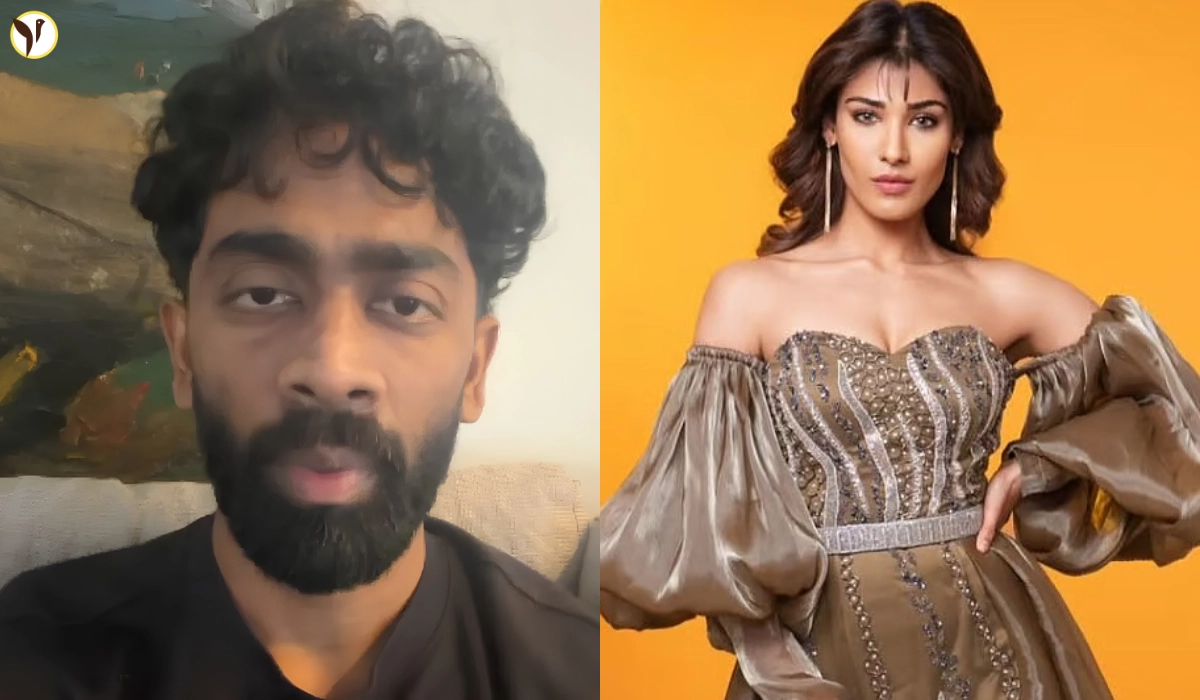


The Miss Diva Universe 2018 and Bigg Boss 19 contestant breaks her silence on the biryani controversy — acknowledging the wrong, but arguing that Pranit More's public apology has earned him the right to be left alone. The NCW, which rejected his apology on June 22, disagrees.
Three weeks after a viral stand-up clip detonated a national conversation about misogyny, consent, and the responsibilities of performers, another voice from the Bigg Boss 19 house has entered the debate — and it comes with a plea for restraint. Nehal Chudasama, the former Miss Diva Universe 2018 and one of the season's most prominent contestants, told Bollywood Bubble in an exclusive interview that comedian Pranit More has been subjected to enough public punishment and that the hatred directed at him online should now stop.
The statement arrived on June 24, 2026 — two days after the National Commission for Women publicly rejected More's apology, making Chudasama's defence both timely and notably out of step with the legal and institutional trajectory of the case.
"Pranit encouraging him was also wrong, and not stopping him was absolutely wrong. But I feel like he has been punished enough on social media with all the hatred that he is going through."— Nehal Chudasama, in an exclusive interview with Bollywood Bubble, June 24, 2026
What Nehal Chudasama Actually Said — And What She Didn't
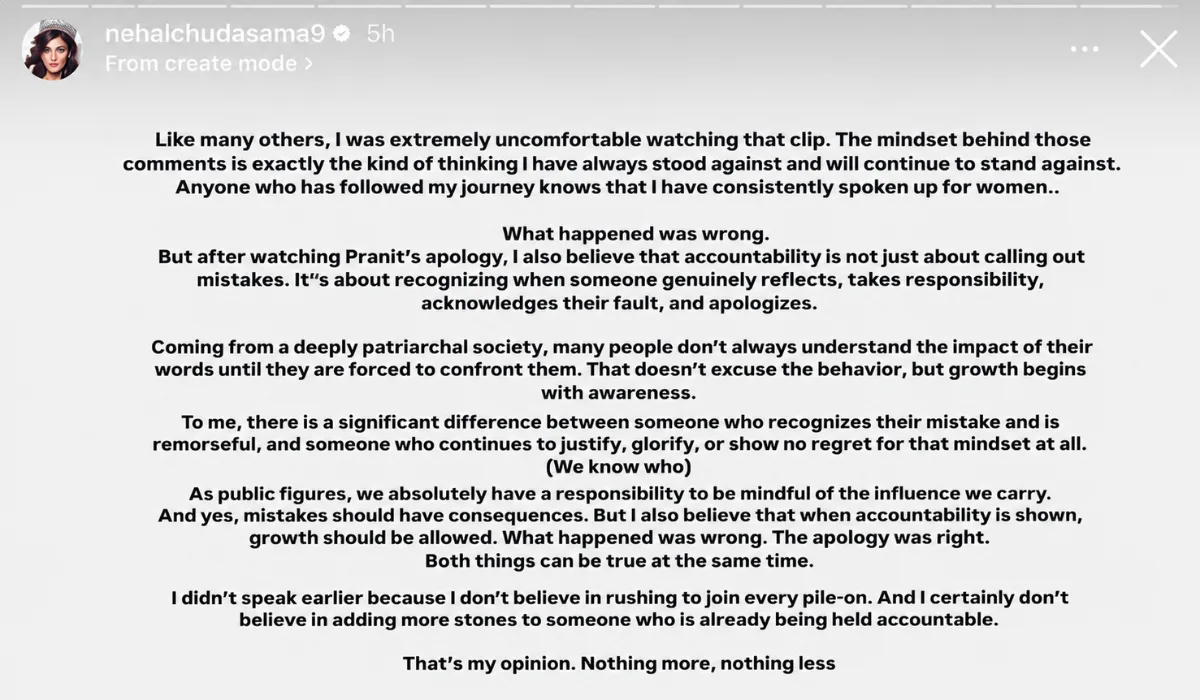
Chudasama's statement is layered in a way that most of the social media commentary surrounding it has missed. She was explicit that both Himanshu Jangra's original remarks and Pranit More's failure to stop them were wrong. She did not excuse the incident, minimise its content, or question the appropriateness of legal or institutional scrutiny. What she argued, instead, was a distinction between accountability and indefinite punishment.
"I have a problem with people not realising and not taking accountability for what they do wrong. But Pranit has," she said, adding that because More apologised, self-reflected, and owned his mistake, continuing to pile on him crosses a line she is uncomfortable with. She also noted that she had chosen not to speak earlier — a deliberate decision, she explained, because she wanted to understand the full situation before commenting publicly.
"I didn't speak earlier because I don't believe in rushing to join every pile-on. And I certainly don't believe in adding more stones to someone who is already being held accountable."— Nehal Chudasama, Free Press Journal interview
Her closing note — "we are all humans, and we all tend to make mistakes" — drew the predictable criticism online that she was normalising the incident. But a closer read suggests she was making a specific argument about the lifecycle of accountability, not excusing the act itself. It is a distinction worth keeping in mind.
The Controversy That Got Here: A Full Timeline
For readers coming to this cold, here is how the Rs 370 biryani controversy unfolded — because without that context, the strength and limits of Chudasama's argument cannot be properly assessed.
|
|
|
|
|
|
|
|
|
|
|
|
|
|
|
|
|
|
|
|
|
|
|
|
|
|
|
|
|
|
|
|
The NCW's Position — And Why It Matters Here
There is an important tension at the heart of Chudasama's argument that the article should name clearly. She is speaking to the court of social media opinion, not the court of law. NCW Chairperson Vijaya Rahatkar has been unambiguous that the commission's inquiry is not about adding to a social media pile-on — it is a formal institutional examination of whether the content violated laws protecting women's dignity.
The NCW's rejection of all three apologies on June 22 signalled that the commission does not consider personal contrition sufficient resolution when the broader pattern of such content, normalising sexual coercion in comedy, is at issue. The commission extended Haryana Police's investigation timeline, suggesting a comprehensive evidence review is ongoing.
This is not an argument against Chudasama's position. It is, however, a reason why her call to "put an end to it" applies selectively — it might reasonably extend to mob harassment, death threats, or career destruction, while leaving space for formal accountability processes to continue.
Who Else Is Speaking Up — Voices Around the Controversy
- Kunickaa Sadanand
Bigg Boss 19 co-contestant. Called More "a good boy with right values" and acknowledged that crowd work can carry performers away when they see an audience reacting positively. Noted she hopes "people forgive him" and that attitudes toward women change.
- Vijaya Rahatkar, NCW
The commission's chairperson expressed "profound anguish" over content that normalises coercive conduct being packaged as entertainment. Firmly stated that creative freedom does not cover normalising violations of women's bodily autonomy.
- Himanshu Jangra
The audience member at the centre of the original clip. Issued an apology claiming the remarks were intended to entertain and did not reflect his beliefs. Lost his job in Gurugram. NCW rejected his apology at the June 22 hearing.
- Uorfi Javed
Content creator and public figure who called the original clip "disgusting" on Instagram Stories and was among the first prominent voices to amplify the criticism.
What This Tells Us About Celebrity Accountability in India's Digital Era
Chudasama's statement sits inside a wider pattern that has become familiar in India's entertainment discourse: a celebrity incident goes viral, institutional scrutiny begins, and the subject's personal network mobilises to argue that the punishment has already been served. It happened during India's Got Latent controversy, it recurred here.
What makes the Pranit More case slightly different is the specificity of the NCW's objection. The commission is not arguing that More is irredeemable — it is arguing that a performer who amplifies and shares content that trivialises sexual coercion bears a public responsibility that a simple Instagram apology does not discharge. The question the commission is asking is structural: what is the standard of care that stand-up performers owe their audiences when crowd work produces harmful content?
Nehal Chudasama's defence, whatever its limits, does something useful: it insists that accountability and perpetual public flogging are not the same thing. That argument is worth having. But it sits most comfortably in the social media register, not in the formal institutional one. Both registers are currently active in the More case — and confusing one for the other is where most of the debate goes sideways.
What Happens Next
The immediate picture is clear. Haryana Police are continuing their investigation under the BNS and IT Act. The NCW has set a fresh hearing date. Maharashtra Cyber's case against More, Jangra, and others remains active. Pranit More has returned to social media after briefly deactivating his account.
Whether Nehal Chudasama's public statement moves the needle on social media sentiment is uncertain — the controversy has been in circulation long enough that audiences have largely sorted themselves into camps. What it does confirm is that within the Bigg Boss 19 community, there is a clear and growing push to close the social media chapter of this story, even as the institutional chapter continues.
Other Articles to Read: