

He didn't follow cricket, didn't want Kolkata, and nearly refused to write the cheque. Lalit Modi's newly revealed account of how Shah Rukh Khan came within a Rs 20 crore hesitation of never buying KKR — and the Nokia deal that fixed everything in a single evening. When Shah Rukh Khan wrote that cheque for ₹20 crore at midnight on the day of the IPL franchise auction in 2008, he was taking a gamble that could have ruined his savings. But a single phone call he made to a mobile handset company changed everything—securing a $5 million advance sponsorship that essentially made KKR free for the King of Bollywood.
What if Shah Rukh Khan had said no?
It is a question that sounds almost absurd now — in 2026, when KKR's purple and gold banners drape three IPL titles and the franchise operates a global Knight Riders network spanning the Caribbean, American, and UAE T20 leagues. But in late 2007, when IPL founder Lalit Modi first called his old schoolmate to pitch the idea of owning a cricket team, the answer that nearly came back was a polite, financially anxious refusal.
A Schoolmate's Gamble
The IPL's architecture was always about more than cricket. Lalit Modi understood that Bollywood and cricket needed each other, and that celebrity co-ownership would transform a sport league into a mass entertainment event — pulling in women, children, and casual viewers who had never sat through a Test match in their lives. His pitch to the film industry was straightforward: own a team, wear the jersey, show up at the stadium.
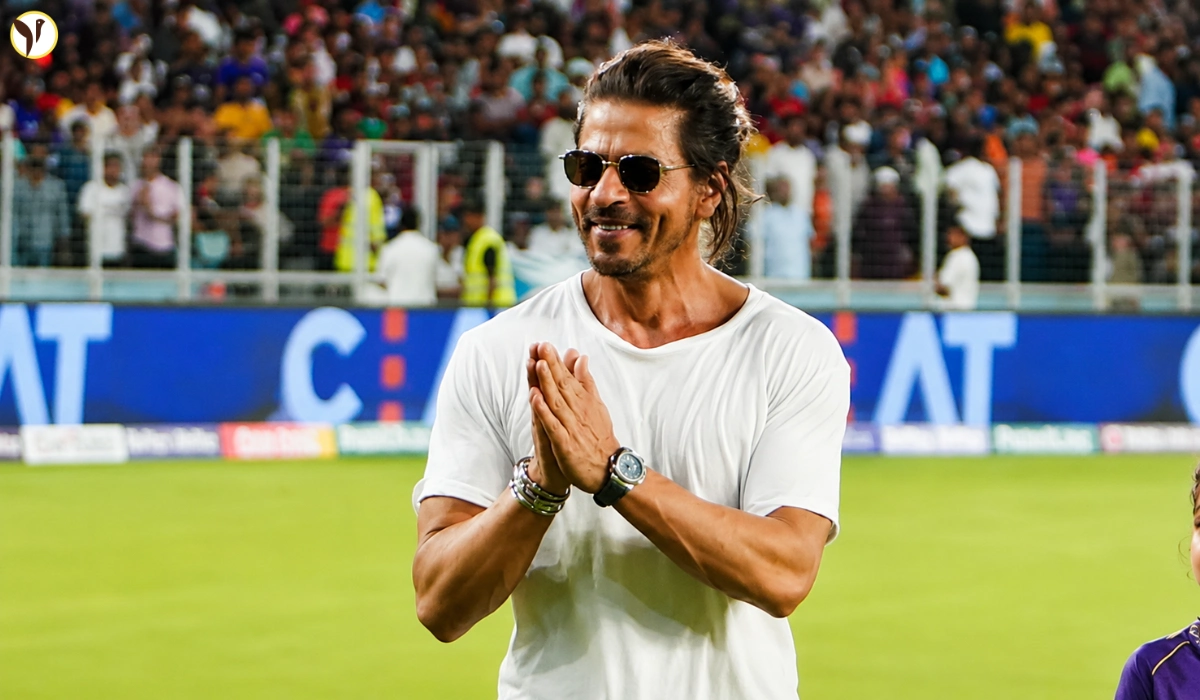
Shah Rukh Khan was an obvious first call. Modi and SRK had gone to the same school — they were old friends long before the IPL existed — and Modi used that personal equity when he approached him about joining the inaugural season.
The response was complicated. According to Modi, SRK initially hesitated when approached to buy an IPL franchise in 2008. The superstar admitted he neither followed nor understood cricket and was more passionate about football. Modi reassured him that the entire cricketing infrastructure — coaching, squad selection, match management — would be handled professionally, and that SRK's role was fundamentally brand, not sport.
But there was a second, harder objection.
The Rs 20 Crore Problem
When SRK asked what the franchise would cost, Modi told him the down payment would be Rs 20 crore. SRK's reply was unambiguous: "But that's a big part of my savings account."
This detail tends to surprise people who encounter it today. By 2007, Shah Rukh Khan was unambiguously Bollywood's biggest star — but the entertainment economy of that era operated on entirely different scales. Blockbuster films had not yet entered the Rs 100 crore club as a matter of routine; OTT windfalls were a decade away; and celebrity endorsement fees, while substantial, did not produce the kind of liquid wealth that makes a Rs 20 crore outlay feel casual.
Modi needed a commercial solution, not a personal one. He found it in a phone call to Nokia.
"Shah Rukh put in the money, and a mobile company backed it up. At 12 o'clock, Shah Rukh wrote a cheque. By the evening, a mobile company wrote another cheque to sponsor the KKR consortium."
The $5 Million Call That Made KKR Possible
Nokia, at the time, was the dominant mobile brand in India and actively seeking high-visibility celebrity associations. Modi saw the alignment immediately. He proposed to Nokia that if SRK acquired a franchise, Nokia could become the front-of-shirt sponsor — and since SRK would naturally be seen wearing the team's jersey and cap carrying the Nokia logo, the company agreed to provide a sponsorship advance reportedly worth $5 million.
The arithmetic was suddenly transformed. According to Modi, "It was a win-win for a mobile company if Shah Rukh owned a team. It was a win-win for Shah Rukh if a mobile company became the front-shirt sponsor. He basically bought it for free."
The timeline was almost cinematically compressed. SRK wrote his cheque at noon; by evening, Nokia had written theirs. "That fell into place very well," Modi said.
It is worth pausing on what that sentence contains. One of India's most valuable sports franchises — a team that would go on to win IPL titles in 2012, 2014, and 2024, that would expand into a global Knight Riders ecosystem, whose brand value would multiply more than forty times over — came together inside a single working day, held together by a mobile logo on a jersey.
Kolkata Was Never Plan A
There is one further wrinkle to the founding story: SRK did not even want Kolkata. According to Modi, Shah Rukh's first choice was Mumbai — but Mukesh Ambani's Reliance Industries had already secured that franchise. Kolkata was, in Modi's words, "his eventual pick."
Mumbai emerged as the most expensive franchise at the 2008 auction, costing $111.9 million. SRK's Red Chillies Entertainment and the Mehta Group won the Kolkata bid at $75.09 million. In hindsight, the second-place choice delivered second-place economics only in acquisition cost — not in legacy or return.
Timeline
- 2007 — Pre-Auction
Lalit Modi approaches SRK via personal school friendship. SRK expresses interest in Mumbai franchise; pushes back on financial commitment. Rs 20 crore down payment cited as concern.
- Jan 2008 — The Nokia Deal
Modi arranges Nokia front-of-shirt sponsorship advance worth ~$5 million. SRK's franchise investment is effectively offset. The deal closes in a single day — cheque written at noon, sponsorship confirmed by evening.
- Jan 24, 2008 — Franchise Auction
Mumbai Indians sell to Reliance for $111.9 million. Red Chillies Entertainment + Mehta Group acquire Kolkata Knight Riders for $75.09 million — IPL's second-highest franchise cost.
- April 18, 2008 — KKR's First Match
KKR beat RCB by 140 runs in Bengaluru. Brendon McCullum hits an unbeaten 158 off 73 balls. The purple army is born.
- 2012 & 2014 — Title Wins
KKR wins back-to-back IPL titles under Gautam Gambhir. Franchise becomes one of the most commercially dominant teams in the league.
- 2024 — Third Title
KKR claims its third IPL trophy under Shreyas Iyer, with Gambhir returning as mentor. The dynasty is confirmed.
- 2026 — Near-Full Ownership
Reports indicate SRK is in talks to acquire additional stake from the Mehta Group, potentially raising his ownership to ~90% for an estimated Rs 4,000 crore — paying 200× the original sponsorship offset to own what the $5M call made possible.
Lalit Modi reveals initially #ShahRukhKhan hesitated to buy #KKR by telling "‘Rs 20 cr is a big part of my savings’" 🤔
— Always Bollywood (@AlwaysBollywood) June 3, 2026
Modi said #SRK ’s one of the concerns was financial.
“He asked me, ‘If I happen to win a team, how much is it going to cost?’ I told him the down payment… pic.twitter.com/3LzF1669eH
The Return on a Single Afternoon
The financial arc of this story is, frankly, staggering when laid out plainly. SRK's original Rs 165 crore investment (his approximate share of the $75.09 million franchise fee) has grown by a factor that exceeds almost any comparable sports investment in the country's history.
|
|
|
|
|
|
|
|
|
|
|
|
|
|
|
|
|
|
|
|
|
|
|
|
|
|
|
|
|
|
|
|
|
|
|
What This Story Actually Tells Us About the IPL
Strip the celebrity glamour away and what you have is a masterclass in deal architecture. Modi's genius was not just in designing a cricket league — it was in understanding that the league's celebrity backers needed a commercial structure that made the investment feel safe before it felt exciting. The Nokia deal was not charity; it was elegant incentive alignment. SRK got financial cover; Nokia got the most valuable brand ambassador in India attached to their logo for an entire cricket season. Both parties won, and the IPL got the star it needed.
There is also something clarifying about SRK's honesty in the moment. He did not pretend the Rs 20 crore was trivial. He said plainly that it was a large part of his savings — and that candour captures something true about the pre-IPL era of Indian celebrity economics. The league did not just change cricket; it fundamentally expanded the financial ceiling for entertainment-adjacent investment in India.
The Bigger Picture: What Happens Next
The story is far from static. Reports from early 2026 indicate SRK is set to acquire approximately 35% additional stake from the Mehta Group — raising his ownership to around 90% and cementing near-total control of the franchise, at an expected cost of Rs 4,000 crore.
Consider the symmetry: the man who once worried that Rs 20 crore was too much of his savings is now reportedly spending Rs 4,000 crore to consolidate ownership of the same team. The asset that a Nokia advance helped him afford has become one of the most coveted sports properties in Asia.
As for that $5 million call — it did not just change one deal. It established the template for how celebrity ownership would function in the IPL: not as vanity investment, but as commercially engineered participation. Every franchise co-owned by a film star since 2008 carries some trace of the model Lalit Modi improvised in a single afternoon in 2007, standing between his old schoolmate's hesitation and the league he needed to build.
Other Articles to Read: