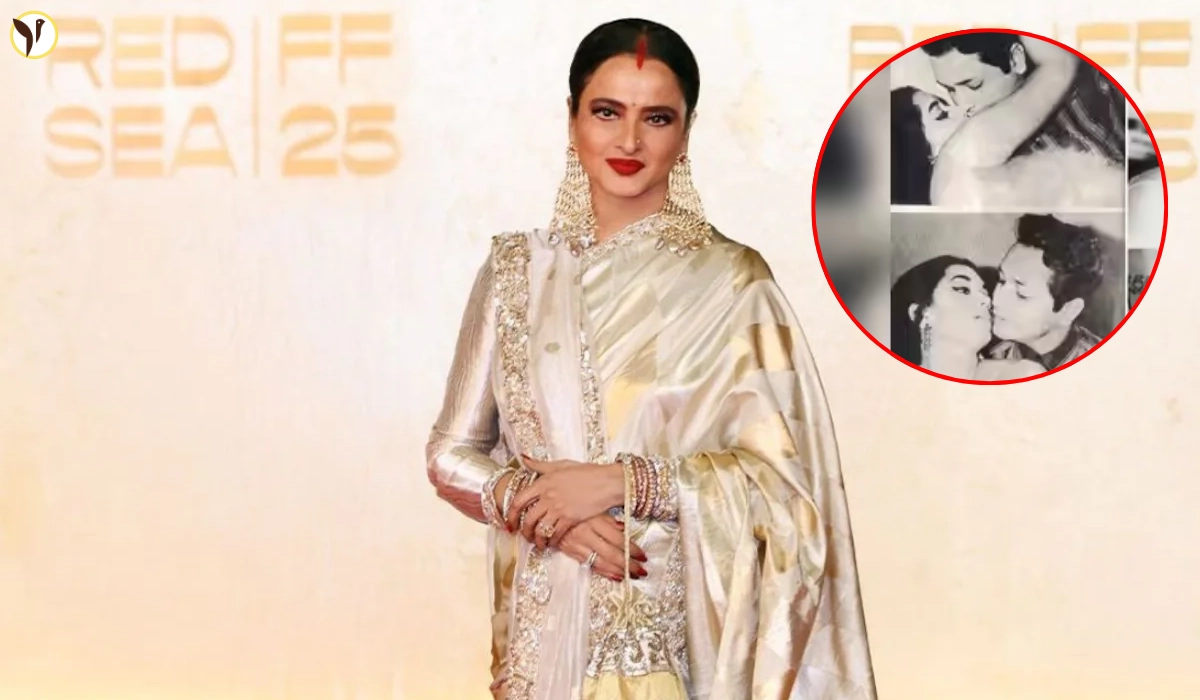


There are stories from Bollywood that never quite disappear. They surface in book chapters, resurface in viral interviews, and quietly reshape how we understand an era we once romanticised. The story of Rekha — one of Hindi cinema's most enduring icons — being kissed on camera without her knowledge or consent is one such story.
It is not new. But it is newly relevant.
As conversations around consent, on-set power dynamics, and the accountability of film crews gain traction in India's entertainment industry, the incident documented in Yasser Usman's 2016 biography Rekha: The Untold Story has re-entered public discourse with renewed urgency.
What Happened: The Incident on the Set of Do Shikari
In the late 1960s — when Rekha was just a teenager, barely fifteen or sixteen years old and new to Hindi cinema — she was cast in a film originally titled Anjana Safar, which was later released in 1979 as Do Shikari.
According to Yasser Usman's meticulously researched biography, director Kuljeet Pal, actor Biswajeet Chatterjee, and cinematographer Raja Nawathe had planned to shoot a kissing scene without informing Rekha beforehand. When the cameras rolled, Biswajeet kissed Rekha on the lips without warning — the act was captured on film, leaving the actress completely unaware that any such scene was being shot.
The scene lasted approximately five minutes. Rekha was very young at the time, and this unexpected act left her stunned. What was most shocking was that neither the director nor the film unit attempted to stop the incident.
Later, Biswajeet admitted that Rekha felt "betrayed and furious" over this, but he insisted that he wasn't to blame. In the book, he was cited as saying, "It was not for my enjoyment, but important for the film."
The age gap made the incident all the more troubling. Biswajeet Chatterjee was 32 years old at the time, while Rekha was half his age. Such behaviour by a seasoned actor was mentally devastating for her. At the time, Rekha didn't know who to talk to or how to protest.

The Contested Narrative: Director's Counter-Claim
The incident, while deeply distressing to Rekha, was not left entirely uncontested. Director Kuljeet Pal later asserted that Rekha was aware of the kissing scene and had given her consent. He claimed that Rekha had no objections to the scene and was informed that such scenes were rare for Hindi film heroines during that time.
This conflicting claim — the actress saying she had no prior knowledge, the director asserting she did — is a pattern that has appeared in other Bollywood consent disputes. Without court proceedings or contemporaneous documentation, the truth rests on the credibility of testimonies.
Rekha's own words, however, have been consistent.
A Second Incident: Rekha and Kamal Haasan in Punnagai Mannan (1986)
The Do Shikari incident was not the only time Rekha found herself the subject of an on-screen kiss she says she did not consent to.
Decades later, another account emerged — this time involving Tamil cinema legend Kamal Haasan, on the sets of director K. Balachander's acclaimed 1986 Tamil film Punnagai Mannan.
In an interview with The News Minute, Rekha stated: "The audience still doesn't believe that it happened without my permission. Only he (Kamal Haasan) and the unit that was there can confirm what I've said. Balachander sir is no more. Only those who were there at the shoot know that the kiss happened without my consent."
When asked if the director or the actor apologised to her, she said: "Why would they apologise, the film was a superhit!" She added that she would not have agreed to the kiss at that age and that the scene was done suddenly without prior discussion. "It's over now and I don't want to revisit it," she said, adding that she became more cautious after that.
The kissing scene in Punnagai Mannan became one of the most talked-about moments in Tamil cinema history. That it was done without the actress's consent is a dimension that most popular accounts of the film's legacy have overlooked entirely.
A Timeline of Events
|
|
|
|
|
|
|
|
|
|
|
|
|
|
|
|
|
|
|
|
|
|
|
|
Why This Matters Beyond the Gossip Cycle
It would be easy — and wrong — to file this story under the category of "old Bollywood gossip." The significance here runs considerably deeper.
1. It documents what was normalised. What happened to Rekha was not aberrant in the context of the era's film sets. The absence of any crew member stopping the scene, the director's casual justification, the actor's deflection — all of it reflects a systemic acceptance of power imbalance that defined how female actors, especially young newcomers, were treated.
2. It demonstrates the cost of silence. Rekha, who eventually became one of Hindi cinema's most celebrated and fiercely independent personalities, has spoken about these incidents — but only in fragments, across decades. The industry offered neither recourse nor acknowledgement. Silence was the only option available.
3. It adds historical context to India's #MeToo conversation. When India's #MeToo wave arrived in 2018, many asked whether the film industry's reckoning went deep enough. Cases like Rekha's remind us that the issue of on-set misconduct stretches back generations — and that the women who experienced it rarely had platforms, legal protections, or unions to support them.
4. Rekha's experience is corroborated and documented. Unlike rumour or conjecture, this story carries the weight of a published, extensively researched biography by a Ramnath Goenka Award-winning journalist, testimonies from multiple parties, and Rekha's own repeated public statements. This is not allegation — it is documented history.
The Book That Broke the Silence: Rekha: The Untold Story
Rekha: The Untold Story was published on 29 August 2016 by Juggernaut Books. Written by Yasser Usman, it chronicles Rekha's birth to renowned South Indian actors Gemini Ganesan and Pushpavalli, her well-publicised marriage to Delhi-based industrialist Mukesh Agarwal, and her fifty-year-long acting career.
Yasser Usman is an Indian television journalist, author, and biographer who received the Ramnath Goenka Excellence in Journalism Award. He has been recognised by the media as one of India's most successful film biographers, and his books are noted for meticulous research into stars' personal lives and careers.
The Rekha biography was nominated for the Crossword Book Award and remains one of the most comprehensive accounts of the actress's life — one that she has neither publicly endorsed nor legally challenged.
बेंगलुरु: किराए के घर में भवानी की संदिग्ध मौत, परिचित चंद्रशेखर पर हत्या का मामला दर्ज
— राष्ट्र प्रेस (@rashtra_press) June 14, 2026
बेंगलुरु में 13 जून को किराए के घर में भवानी एस. मृत मिलीं; पिता की शिकायत पर परिचित चंद्रशेखर के खिलाफ हत्या व साक्ष्य मिटाने का मामला दर्ज।https://t.co/57GRyMWgaV pic.twitter.com/qIHQp6Mg2I
Rekha — The Actress Behind the Incident
Understanding this incident also requires understanding who Rekha was at the time it occurred: a teenager from a financially struggling household, thrust into an industry she barely understood.
Born as Bhanurekha to renowned Tamil actor Gemini Ganesan and actress Pushpavalli, she faced financial difficulties and started acting to support her family. Despite being the daughter of a legendary actor, she didn't find it easy to secure roles in Hindi films.
She had no industry godfather, no powerful family connections in Bollywood, and no awareness of what recourse — legal or otherwise — she might have had. The men who planned that kiss knew exactly what they were doing. The young actress did not.
That she went on to build one of Hindi cinema's most formidable careers — starring in films like Umrao Jaan, Silsila, Khoobsurat, Khoon Bhari Maang, and Muqaddar Ka Sikander — speaks to extraordinary personal resilience. But resilience should never be confused with justice.
What Happens Next: Where Does Accountability Stand?
The original incident occurred over five decades ago. Biswajeet Chatterjee is now in his eighties. Director Kuljeet Pal and cinematographer Raja Nawathe belong to a generation largely removed from contemporary discourse. K. Balachander, the director of Punnagai Mannan, passed away in 2014.
There will be no legal proceedings. There was no formal complaint lodged when it mattered.
What remains is documentation, and the moral weight that documentation carries.
The film industry in India has since seen significant — if incomplete — changes. The Sexual Harassment of Women at Workplace (Prevention, Prohibition and Redressal) Act, 2013 (POSH Act) brought legal structure to workplace harassment claims. Streaming platforms and independent producers have increasingly implemented on-set intimacy coordinators. The #MeToo movement of 2018 created a public forum for accountability, even where courts offered none.
But Rekha's story — and the countless others like it that remain undocumented — sits outside all of these frameworks. It is a reminder that progress is measured not only by the protections we build today, but by our willingness to honestly reckon with the harm that went unaddressed yesterday.
Final Thought
Rekha once said about the Punnagai Mannan kiss: "I've said this a hundred times."
The fact that she had to say it a hundred times — and still be doubted — is perhaps the most telling part of this entire story.
Other Articles to Read: