
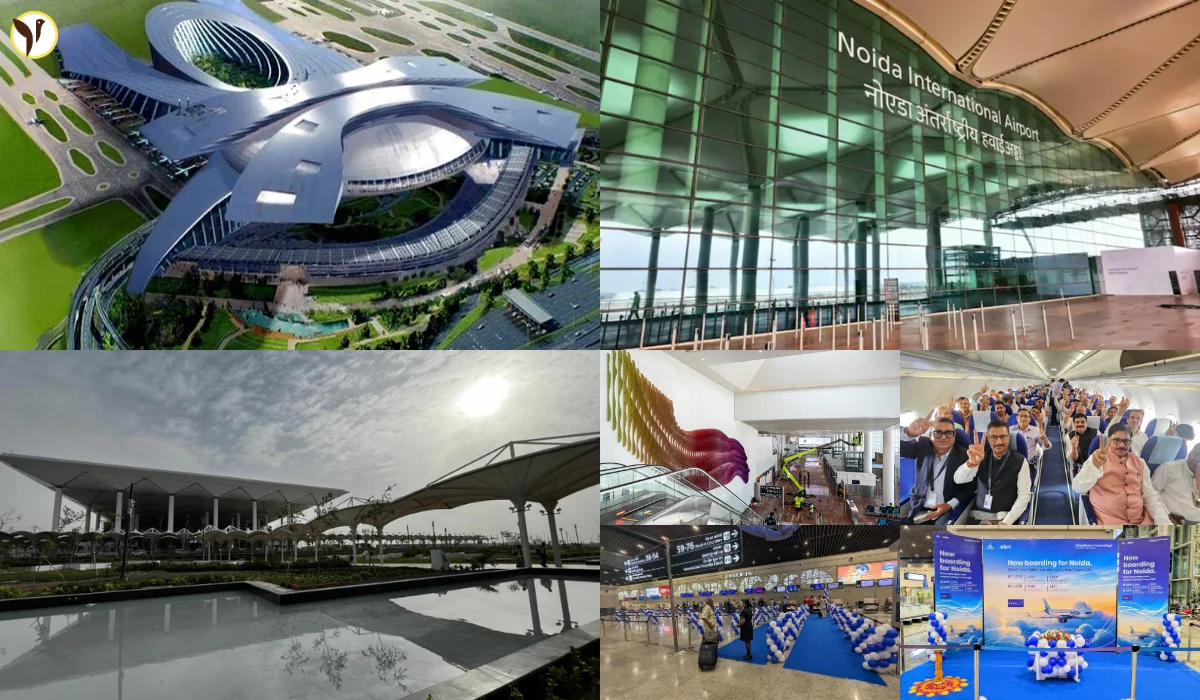


At a little past 8 AM on Monday, an IndiGo aircraft carrying flight number 6E-2278 rolled onto the tarmac of Noida Jewar Airport, having flown in from Lucknow. Within the hour, the same aircraft turned around and took off again — this time for Bengaluru. With that, Noida International Airport (NIA), Uttar Pradesh's fifth international airport and one of India's largest greenfield aviation projects, formally entered commercial service. For the lakhs of residents across Noida, Greater Noida, and the wider Yamuna Expressway belt who have watched this airport rise from farmland over the past several years, June 15, 2026, is the day the wait actually ended — not with another ribbon-cutting, but with a boarding pass.
From Ribbon-Cutting to Take-Off: Why It Took Three Months
If you've felt confused about whether this airport "opened" in March or June, you're not alone — and the distinction actually matters. Prime Minister Narendra Modi formally inaugurated Phase 1 of Noida International Airport on March 28, 2026, in a ceremony that also saw the foundation stone laid for a 40-acre Maintenance, Repair and Overhaul (MRO) facility. But an inauguration is a political and symbolic milestone; it is not the same as regulatory clearance to fly paying passengers.
Between March and June, two critical approvals had to come through. The Directorate General of Civil Aviation (DGCA) granted the aerodrome licence on March 6, 2026, confirming that runway systems, navigational aids and emergency response protocols met all-weather commercial standards. Separately, the Bureau of Civil Aviation Security (BCAS) had to sign off on the airport's Aerodrome Security Programme — the framework covering screening, access control and security staffing. That clearance came through only in the weeks before launch, which is why the commercial start date kept shifting before finally landing on June 15.
|
|
|
|
|
|
|
|
|
|
|
|
|
|
|
|
|
|
|
|
|
|
|
|
|
|
|
"No Traffic, No Stress": What First Flyers Are Saying
The most telling reactions on day one didn't come from officials — they came from ordinary passengers walking through a terminal that, for most of them, was opening for the first time exactly as they were boarding their first flight from it.
Several travellers heading out on the early Bengaluru-bound service described a strikingly stress-free start to their journey: a short, signal-free drive down the Yamuna Expressway, easy parking, and a walk to the terminal that took less time than the security queue at Delhi's IGI Airport usually does. More than one flyer specifically contrasted this with their usual experience battling traffic near Mahipalpur to reach Terminal 3 — for residents of Greater Noida, Pari Chowk and the Yamuna Expressway corridor, that drive has historically eaten up well over 90 minutes each way.
"The building looked finished, not half-built — that surprised me more than anything," one passenger travelling to Bengaluru told reporters, describing the terminal as modern and noticeably uncrowded compared to Delhi's airports.
The day's most symbolic flight, however, wasn't carrying business travellers at all. The first commercial departure — an IndiGo service to Lucknow — carried around 172 local residents, including 20 women, whose families had given up agricultural land for the airport project, along with Jewar's local MLA, Dhirendra Singh. The group was travelling to meet Chief Minister Yogi Adityanath in Lucknow. For many of them, this was their first time on a plane, and several described the airport — built on land that once belonged to their families — as a source of pride and a marker of opportunity for the next generation, even as they acknowledged the disruption the land acquisition process had caused their farming livelihoods.

|
|
|
|
|
|
|
|
|
|
|
|
|
|
|
|
|
|
Noida Jewar Airport's First-Week Flight Schedule
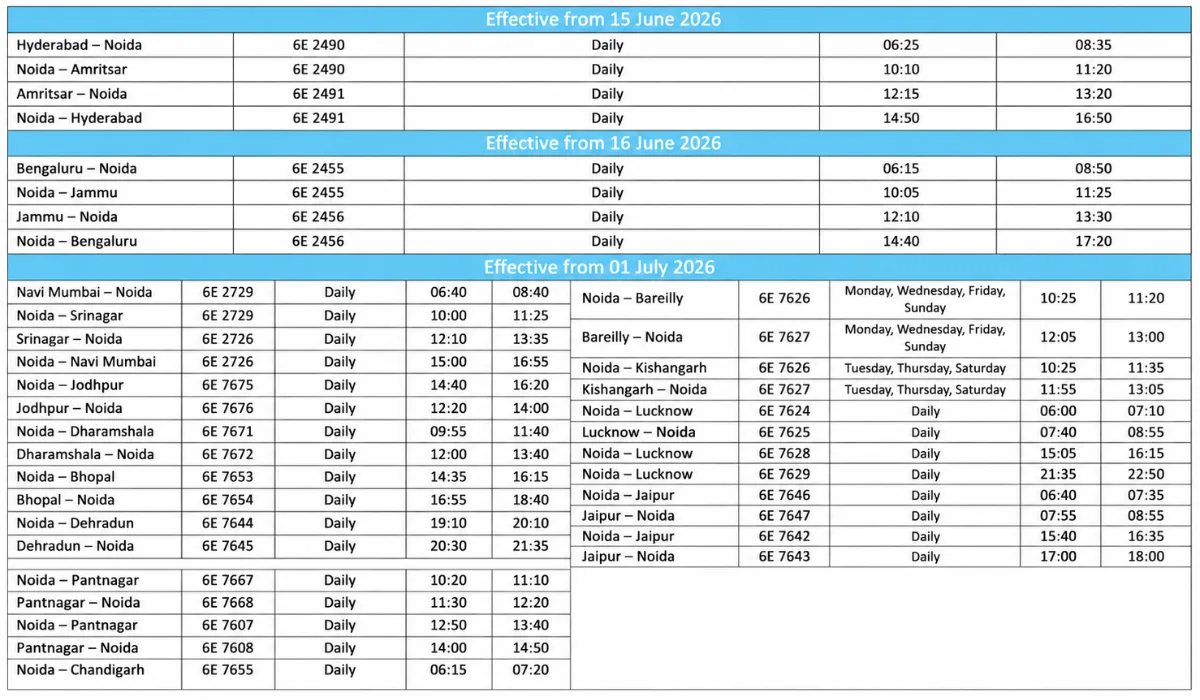
For travellers planning trips in the coming days, here's what's actually flying. Between June 15 and June 19, 2026, the airport will handle 62 scheduled flight movements across six destinations — a deliberately limited launch network that airport operators say will expand quickly once initial operations stabilise.
|
|
|
|
|
|
|
|
|
|
|
|
|
|
|
|
|
|
|
|
|
|
|
|
|
|
|
|
|
|
|
|
IndiGo has said it eventually intends to connect Noida International Airport to more than 16 destinations across India, which would also enable one-stop connections between smaller city pairs that currently have no direct links at all — routes like Amritsar–Jodhpur, Bareilly–Bhopal, and Chandigarh–Pantnagar, for instance, become technically possible by routing through Jewar. Air India Express has also been named by YIAPL as a launch partner airline, though its specific first flights had not been independently confirmed at the time of publication.
The Cost Question: Is Flying from Jewar Actually Cheaper?
This is where the story gets more complicated — and where a lot of first-day excitement runs into some practical arithmetic. According to the Airports Economic Regulatory Authority's approved tariff order for Noida International Airport, the User Development Fee (UDF) on domestic departures has been set at approximately Rs 490 — roughly four times the Rs 129 UDF charged at Delhi's IGI Airport.
The UDF is a fixed charge added to every ticket, largely to help recover the cost of building new airport infrastructure — a standard mechanism used across India's greenfield airports in their early years. For a family of four flying out together, that difference works out to roughly Rs 1,400 extra purely in UDF charges compared to flying the same route from IGI, before any difference in base airfare is even considered.
|
|
|
|
|
|
|
|
|
|
|
|
|
|
|
|
What this means in practice: for flyers based in Greater Noida, Pari Chowk, or along the Yamuna Expressway, the time saved on the road is likely to outweigh the higher UDF — especially for early-morning or last-minute flights where missing a connection because of Delhi traffic carries its own cost. But for someone based in West Delhi or near IGI already, the calculus may not favour switching just yet, particularly until route options widen and fares become more competitive through airline-side promotions. This is less a verdict on the airport and more a reminder that "new" doesn't automatically mean "better for everyone" — at least not on day one.
The airport is expected to boost the National Capital Region’s (NCR) capacity over a longer term. However, initially, there will be challenges as the airport is quite far from major city areas and lacks connectivity.https://t.co/TJ4wduEBli
— Firstpost (@firstpost) June 15, 2026
Getting to Jewar: Your Options on Day One
One of the most-asked questions ahead of today's launch has been about ground connectivity — and the honest answer is that it's a work in progress. At present, the Yamuna Expressway remains the only direct road route to the airport from the Delhi-NCR side as well as from Agra and Mathura. There is no metro or Regional Rapid Transit System (RRTS) link operational yet, though both have been discussed as future-phase connectivity projects.
|
|
|
|
|
|
|
|
|
|
|
|
|
|
|
|
|
|
Why This Airport Matters Beyond Noida
It's tempting to frame this purely as a Delhi-NCR aviation story, but the geography tells a bigger one. During his March inauguration speech, PM Modi specifically named Agra, Mathura, Aligarh, Ghaziabad, Etawah and Faridabad as districts of western Uttar Pradesh that stand to benefit from the new airport — regions that have historically depended on road or rail journeys of several hours to reach IGI Airport for any flight connection.
There's also a decongestion angle that's easy to overlook: Delhi's IGI Airport has been operating well above its comfortable capacity for years, and every domestic route that shifts — even partially — to Jewar eases pressure on Terminal slots, runway scheduling, and approach airspace shared by both airports. Noida International Airport has also been positioned as a net-zero emissions facility, built using low-carbon construction materials and renewable energy partnerships, which adds an environmental dimension that's relatively unusual for an airport of this scale in India.
What Happens Next at Noida Jewar Airport
Today's launch is deliberately conservative — six destinations, one primary carrier, and a connectivity network that's still being built out in real time. Over the coming weeks and months, expect three things to move quickly. First, Akasa Air's entry from June 16 and the eventual clarification of Air India Express's schedule will widen the route map noticeably. Second, IndiGo's stated goal of reaching 16-plus destinations means several tier-2 and tier-3 cities — think Bareilly, Kishangarh, Dharamshala, Pantnagar — could gain meaningful air connectivity through Jewar for the first time, via one-stop itineraries.
Third, and longer-term: the masterplan envisions scaling from today's 12 million passengers a year to as many as 70 million by 2040, alongside the 40-acre MRO facility whose foundation was laid in March, and an integrated cargo terminal being developed separately by Air India SATS. International flights remain a later-phase ambition rather than a near-term promise — Phase 1's focus, for now, is squarely domestic.
For travellers in Delhi-NCR and western UP, the practical takeaway from day one is this: Noida Jewar Airport is real, it is operational, and for a specific set of routes and a specific set of travellers — particularly those based along the Yamuna Expressway corridor — it is already a better option than IGI. For everyone else, it's a airport worth watching closely over the next two to three months as routes, fares and connectivity all start to mature.
Other Articles to Read: