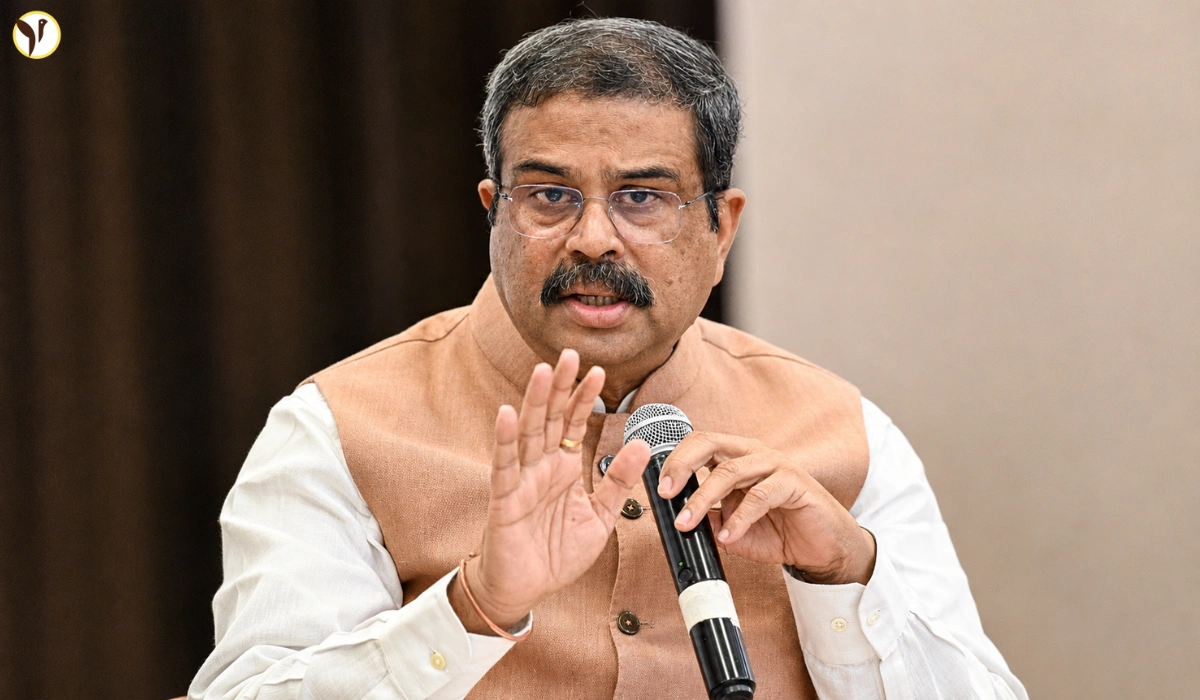


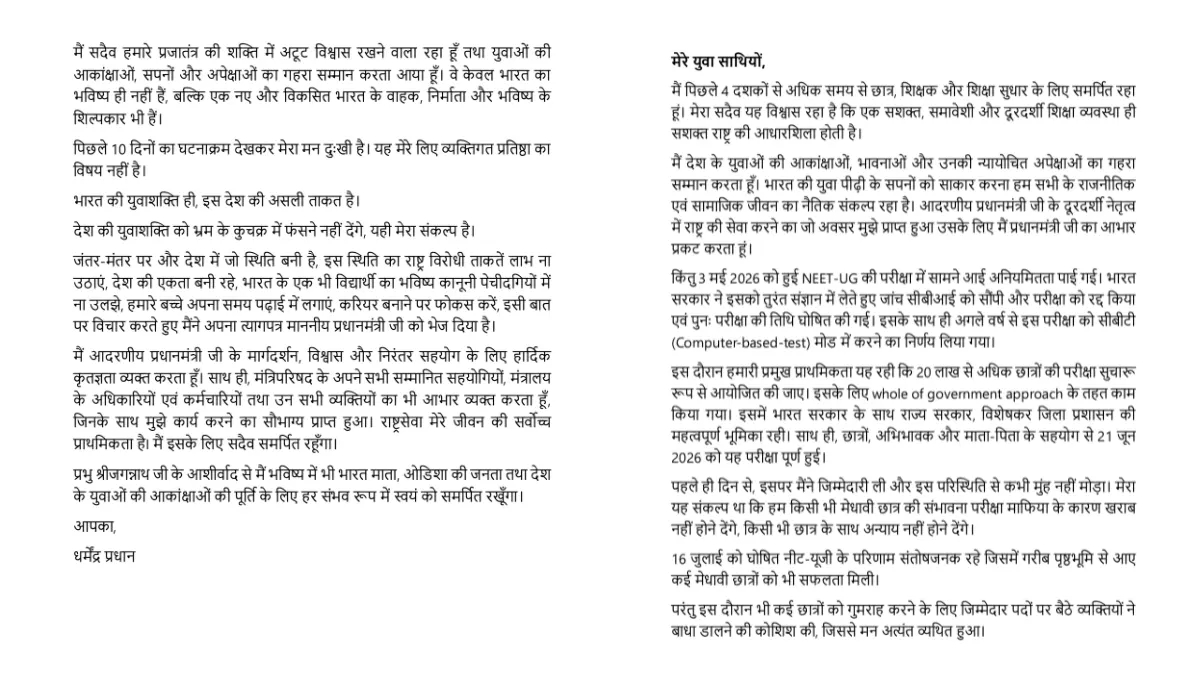
In a sudden political development that has sent ripples through academic and administrative circles, Education Minister Dharmendra Pradhan Resigns, leaving behind a pivotal legacy of student-centric reforms at a critical juncture. The announcement, confirmed by official sources earlier today, comes just as the Ministry of Education is accelerating the complex rollout of the National Education Policy (NEP) 2020.
For millions of students, parents, and educators across India, the immediate question is not merely political—it is deeply personal. With Pradhan’s departure, what happens to the promised overhaul of the examination system? Will the transition from rote learning to competency-based education lose its momentum?
This analysis moves beyond the political headlines to examine the institutional impact of this transition, evaluating the state of Indian education before the resignation, the immediate risks, and the critical roadmap the next leadership must follow to keep the "students priority" mandate alive.
The Anatomy of the Departure: Context Over Speculation
In the high-stakes environment of Indian governance, cabinet reshuffles and ministerial exits are not uncommon. However, Pradhan’s tenure at the Ministry of Education was characterized by an unusual degree of active, ground-level policy execution rather than mere administration.
Taking charge during the depths of the COVID-19 pandemic in 2021, Pradhan inherited an education system in distress—digital divides were stark, exams were being canceled, and the ambitious NEP 2020 was largely a theoretical document. Over the next three years, he positioned himself as the chief evangelist for the policy, driving initiatives that directly impacted classroom dynamics.
While the exact internal political machinations leading to his resignation remain behind closed doors, from an institutional perspective, the departure represents a classic "transition risk." Major policy overhauls require sustained political will to push through bureaucratic inertia. Pradhan provided that will. The core challenge now is ensuring that the structural pillars he set up do not falter during the handover.
The 'Students First' Legacy: A Data-Driven Review
To understand why this resignation matters, one must look at the sheer scale of initiatives launched under Pradhan’s tenure that directly affected students. His overarching philosophy was frequently summarized by the phrase "students priority"—a shift from a system designed around institutional convenience to one built around student outcomes.
Below is an original analysis of the key student-centric initiatives driven during his tenure and their current implementation status.
|
|
|
|
|
|
|
|
|
|
|
|
|
|
|
|
|
|
|
|
|
|
|
|
|
|
|
|
|
|
Why This Resignation Matters Right Now
The CUET Conundrum
The Common University Entrance Test (CUET) is perhaps the most visible student-facing reform. It fundamentally altered how a student applies to college. However, the 2024 edition saw significant logistical challenges, including server crashes and delayed results. Pradhan’s office was directly involved in micromanaging the National Testing Agency’s (NTA) response. A new minister inheriting this will have to immediately decide how to stabilize the NTA ahead of the 2025 cycle. Students cannot afford another year of administrative uncertainty.
The Textbook and Curriculum Bottleneck
A massive part of the "students priority" mandate was the rewriting of textbooks by the National Council of Educational Research and Training (NCERT) to align with NEP 2020’s rationalized curriculum. While new textbooks for classes 3, 6, 9, and 11 are being rolled out for the 2024-25 academic year, the transition has sparked debates over historical contextualization and content reduction. The new minister will have to navigate these intellectual and political debates carefully, ensuring students receive finalized, error-free books without further delays.
The State-Center Divide
Education is a concurrent subject, but the center drives the narrative. Pradhan spent significant time lobbying state education ministers to adopt the NEP framework. While states like Karnataka, Madhya Pradesh, and Uttar Pradesh have signed on, the pace of actual classroom-level adoption varies wildly. A leadership change at the center risks states slipping back into their old administrative rhythms, delaying the harmonization of Indian education.
The Road Ahead: What Happens Next?
Bureaucratic systems are designed to survive individual leaders, but political leadership provides the necessary velocity. In the absence of Dharmendra Pradhan, the trajectory of student-centric reforms will depend on three immediate factors:
The Bureaucratic Continuity Plan: The actual execution of NEP 2020 is handled by a highly competent bureaucratic core, including the Secretaries of Higher Education and School Education, and the chairs of UGC, AICTE, and NCERT. The immediate test of the new minister will be whether they empower this bureaucracy or attempt to reinvent the wheel, which would cost valuable time.
The Approach to the NTA: The National Testing Agency is currently the most stressed educational body in India, handling CUET, JEE, NEET, and NET exams. The new minister's first major crisis management test will likely involve overhauling the NTA’s operational framework to restore student trust.
Balancing Tradition and Modernity: Pradhan frequently emphasized Indian knowledge systems and mother-tongue instruction in early grades. The new leadership will have to decide how aggressively to continue this integration without isolating students who require global-standard STEM education and English proficiency for international mobility.
Joy in CJP Camp and Jantar Mantar As Union Education Minister Dharmendra Pradhan Submits His Resignation #DharmendraPradhan #AbhijeetDipke #CJP #NEET pic.twitter.com/9O0ISG9ZJJ
— News18 (@CNNnews18) July 25, 2026
The Successor’s Blueprint: Three Non-Negotiables for Student Welfare
To ensure that the "students priority" ethos is not lost in the transition, the incoming leadership must treat the following points as non-negotiables:
- Decouple Exam Logistics from Academic Policy: The crisis of the last year has shown that when a ministry is busy putting out exam-fire after exam-fire, policy work suffers. The NTA needs an independent, tech-driven overhaul—perhaps modeled on corporate-scale proctoring and testing firms—so the Ministry can return to focusing on pedagogy.
- Focus on the Missing Middle: While IITs and central universities get the headlines, the bulk of India's 35 crore+ students are in state board schools and tier-2/3 colleges. The next leader must redirect focus to teacher training in rural areas and upgrading state universities, which produce the majority of the workforce.
- Institutionalize the Student Feedback Loop: NEP 2020 talks about a holistic, student-centric approach, but students rarely have a formal channel to report how policies (like multidisciplinary choices or credit transfers) are actually working for them on the ground. Creating a centralized, anonymized student feedback mechanism should be an immediate priority.
Expert Framing: An Institutional Perspective
Speaking broadly on the nature of educational transitions, senior policy analysts often note that “Policies do not fail because of bad ideas; they fail because of interrupted execution.”
Dharmendra Pradhan’s tenure was defined by an aggressive pursuit of execution. Whether one agreed with every aspect of the NEP 2020 or the rationalized syllabus, the direction of travel was unmistakable: moving away from a rigid, colonial-era education system toward something more flexible.
The resignation is not a systemic failure, but it is a systemic vulnerability. For a student currently in class 6, entering the new 5+3+3+4 system, their entire academic future is tied to the consistent application of this policy over the next decade. They cannot afford a two-year pause while a new minister "settles in."
Conclusion
The news that Education Minister Dharmendra Pradhan Resigns marks the end of a highly active, sometimes contentious, but undeniably transformative era for Indian education. He took the "students priority" mandate from a slogan to a series of actionable, albeit complex, realities.
However, the true measure of his legacy will not be the policies he launched, but how robustly they survive his departure. The Indian education ecosystem is like a massive aircraft mid-flight; changing the pilot requires absolute precision to avoid turbulence. The students of India—preparing for their CUET exams, adapting to new textbooks, and trying to navigate multidisciplinary degrees—are sitting in the cabin. They are watching, and they cannot afford a bumpy ride.
Other Articles to Read: