


When the Brahmaputra swells, it does not merely overflow its banks; it swallows livelihoods, displaces millions, and tests the resilience of India’s disaster management machinery. As Assam grapples with yet another devastating monsoon season, the response to the crisis has shifted. While traditional institutional aid forms the backbone of relief operations, a new, highly agile layer of support has emerged from an unexpected quadrant: India’s digital creator economy.
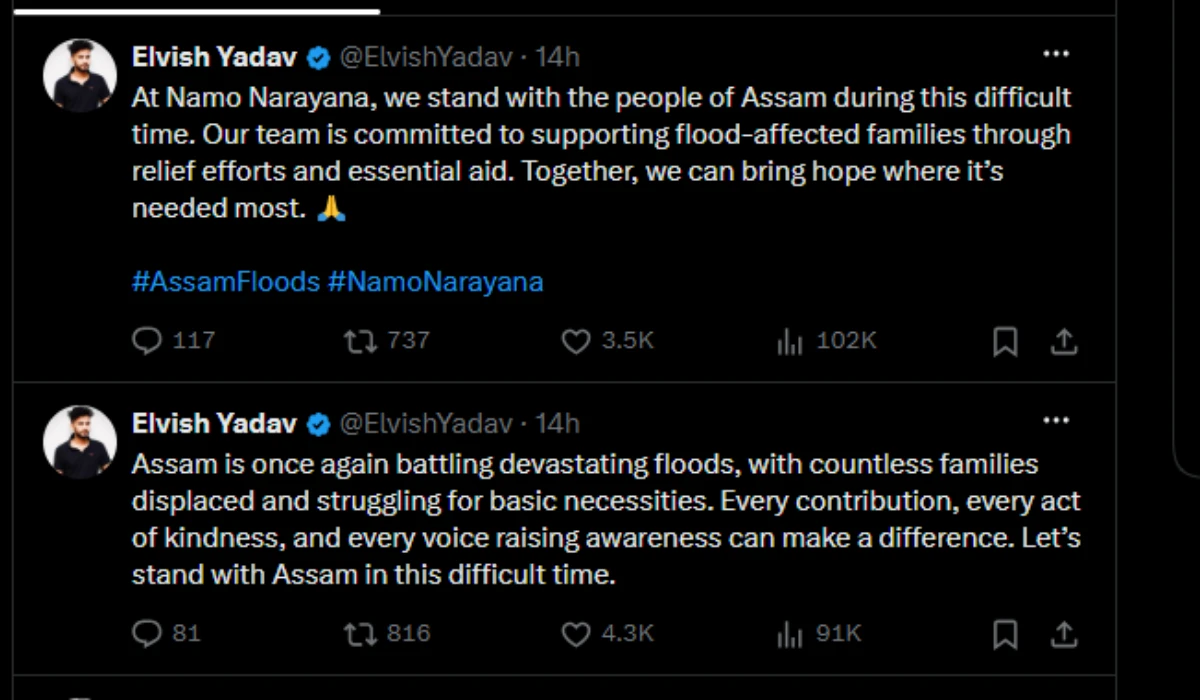
At the center of this shift is Elvish Yadav. The Bigg Boss OTT 2 winner and YouTube sensation recently announced concrete steps to support flood-affected families in Assam. For Yadav, whose digital persona is built on raw, unfiltered connectivity with tier-2 and tier-3 Indian youth, stepping into the disaster relief space is not merely a publicity exercise—it is a strategic deployment of the "trust economy."
This is not just a story about a celebrity writing a check. It is an examination of how digital influence is transforming into ground-level logistical support, bypassing traditional bureaucratic delays to deliver immediate aid to Assam's most vulnerable.
Understanding the Scale of the Assam Crisis
To comprehend the significance of Elvish Yadav’s intervention, one must first understand the sheer scale of the annual ecological tragedy in Assam. The state’s geography, characterized by the Brahmaputra and its tributaries carrying massive sediment loads from the Himalayas, makes catastrophic flooding an inevitable annual recurrence.
However, understanding the baseline data reveals why immediate, non-bureaucratic aid is critical in the first 72 hours of the crisis.
Assam Monsoon Flood Impact Profile
|
|
|
|
|
|
|
|
|
|
|
|
|
|
|
|
|
|
|
|
|
|
|
|
Elvish yadav Specific Intervention
Elvish Yadav’s move to stand with Assam did not begin with a sudden press release. It originated within his digital ecosystem—his YouTube community and Instagram following. Recognizing the viral circulation of distressing footage from Assam, Yadav leveraged his platform to mobilize resources.
Rather than simply pledging money, which often gets trapped in administrative bottlenecks, Yadav’s approach has been twofold:
- Direct Financial and Material Aid: Allocating a substantial portion of his recent brand engagement revenues to procure essential non-food items (NFIs) and dry rations.
- Network Leveraging: Collaborating with local micro-influencers and ground-level volunteers in Assam to ensure the supplies bypass district-level red tape and reach specific, marooned villages.
This method reflects a mature understanding of disaster logistics. In flood relief, the last mile is always the hardest. By tapping into local nodes of his fan base in Assam, Yadav has essentially created a crowdsourced, decentralized supply chain.
The "Trust Economy" in Disaster Relief
It is easy to be cynical about influencer philanthropy. For years, the public has witnessed "photo-op charity"—celebrities arriving at camps for a few minutes, handing out a few packets, and leaving before the cameras stop rolling.
Yadav’s intervention matters because it highlights a structural shift in how India’s youth respond to crises. To understand this, we must look at the mechanics of the "Trust Economy."
Traditional charities often struggle with transparency. A donor gives money to an NGO but rarely sees the exact impact of their rupee. Yadav, conversely, operates in a parasocial ecosystem. His audience feels a personal connection to him. When he documents the procurement of relief materials, shows the trucks loading, and provides geo-tagged proof of distribution via his local contacts, he provides a level of micro-transparency that large NGOs cannot match at scale.
Traditional Institutional Aid vs. Creator-Led Aid
Comparative analysis based on disaster response timelines and logistical frameworks
|
|
|
|
|
|
|
|
|
|
|
|
|
|
|
|
|
|
|
|
|
|
|
|
Beyond the Metro Bubble
There is a deeper sociological undercurrent to Elvish Yadav’s support for Assam. Mainstream Indian media and Bollywood have historically operated within a "metro bubble." When floods hit Assam, Bihar, or Odisha, the response from Mumbai-based celebrities is often delayed, primarily because these regions fall outside their primary demographic imagination.
Yadav’s digital empire, however, is heavily rooted in the Hindi heartland and non-metro India. His audience in Uttar Pradesh, Haryana, Rajasthan, and Bihar shares socio-economic realities with the flood victims in Assam. When Yadav speaks about the loss of a farmer’s crop in Golaghat, his audience in rural Punjab or Madhya Pradesh intuitively understands the gravity of that loss.
This shared cultural lexicon makes his call to action significantly more potent than a generic tweet from a mainstream film star. It bridges the geographical divide between North India and the Northeast, fostering a sense of pan-Indian grassroots solidarity that traditional media often fails to cultivate.

The Challenges and Criticisms of Influencer Intervention
1. The "Blind Spot" of Needs Assessment: Professional organizations like the Red Cross or UNICEF conduct rapid needs assessments before deploying aid. They determine if a camp needs oral rehydration salts (ORS) more than it needs blankets. Influencer-led drives, driven by emotional urgency, often end up dumping generic "relief kits" (rice, dal, biscuits) that might not align with the specific epidemiological or nutritional needs of a specific camp at that exact moment.
2. Verification of Ground Contacts: Yadav relies on local volunteers to execute his plans. In the chaotic aftermath of a flood, verifying the credibility of every local contact is nearly impossible. There is an inherent risk of resources being misappropriated by middlemen posing as volunteers.
3. The Sustainability Question: Floods in Assam last for weeks, but the recovery takes years. Once the hashtag stops trending and the YouTube views normalize, the influx of creator-led funding dries up. Rebuilding homes, restoring soil fertility, and addressing the psychological trauma of displaced children require sustained, multi-year institutional funding that an individual creator cannot provide.
The Future of Creator Philanthropy
Elvish Yadav standing with Assam is a watershed moment for India's digital creator economy. It proves that the industry is maturing beyond entertainment and brand endorsements into civic engagement.
However, for this model to evolve from a reactive, emotional response into a robust supplementary disaster relief mechanism, structural changes are required:
- Partnerships over Solo Runs: The next logical step for creators like Yadav is to partner with verified, specialized logistics NGOs (e.g., Goonj, Rapid Response). The creator provides the capital and the reach; the NGO provides the ground intelligence and needs assessment.
- Setting up Dedicated DAOs (Decentralized Autonomous Organizations): Influencers could establish transparent crypto or fiat-based community funds that are strictly ring-fenced for disaster response, allowing for year-round accumulation of resources rather than panic-driven fundraising.
- Shifting Focus to Rehabilitation: As the immediate waters recede in Assam, the true test of Yadav’s commitment will be whether he uses his platform to highlight the long-term rehabilitation needs of the state, keeping the pressure on state and central governments.
Conclusion
Elvish Yadav’s decision to support flood-affected families in Assam is a compelling case study in modern philanthropy. It strips away the traditional gatekeeping of disaster relief, democratizing the ability to help through the sheer force of digital reach and parasocial trust.
While it cannot—and should not—replace the colossal logistical might required by the state to manage a disaster of this magnitude, it serves as a critical, high-velocity stopgap. It delivers food, shelter, and, perhaps more importantly, the psychological comfort to Assam’s displaced that the rest of India has not forgotten them.
In an era where digital influence is often criticized for promoting consumerism and superficiality, its deployment to navigate the muddy, perilous waters of Assam’s floodplains offers a glimpse into a more responsible, deeply human utility for the creator economy.
Other Articles to Read: