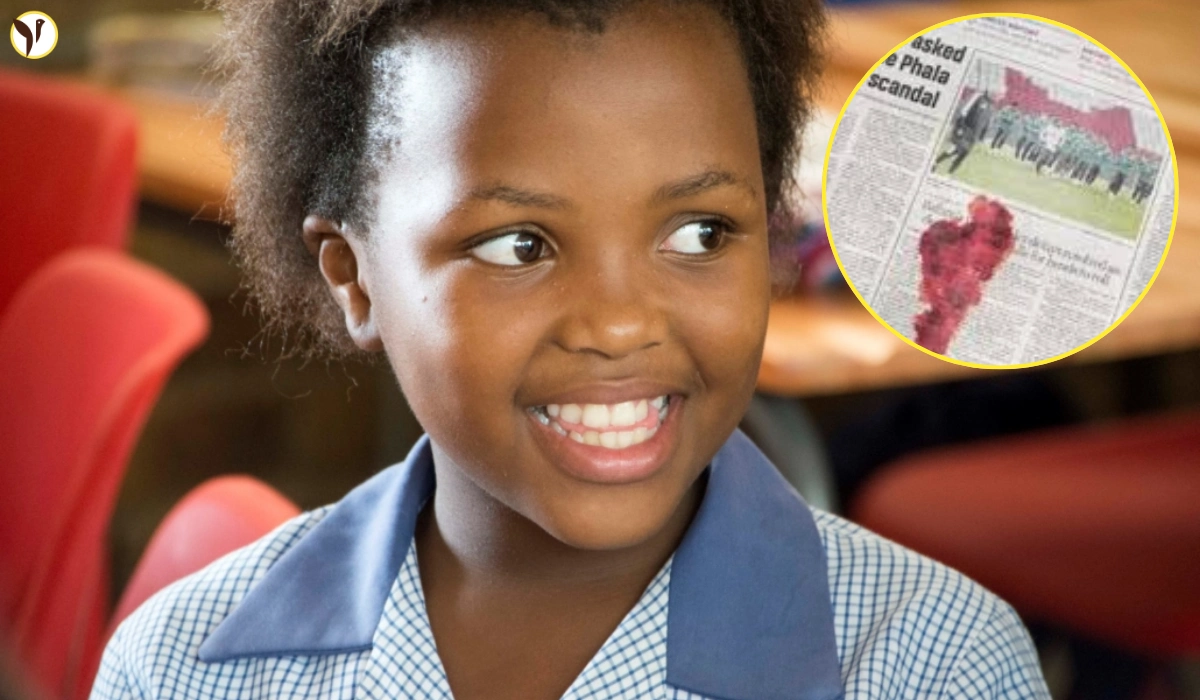


In Aurora Girls High School in Soweto, 300 Grade 8 learners received a lifeline last August when the City of Johannesburg held a sanitary pad drive. But this intervention revealed a darker truth: four million girls across South Africa still lack access to sanitary products. When periods arrive, many resort to crumpled newspapers, cloth rags, or even cow dung—unhygienic alternatives that endanger their health and force them out of classroom.
This isn't merely a hygiene problem. It's an education emergency that costs girls 25% of their annual class attendance—equivalent to one week missed every month.
When "Front-Page News" Becomes Literal
For nearly four million schoolgirls in South Africa, the daily newspaper is no longer just something their fathers read at breakfast — it has quietly become a substitute sanitary pad. This uncomfortable reality is at the centre of a new awareness campaign that has turned three of the country's biggest newspapers into a stark visual protest against period poverty, a crisis that continues to push girls out of classrooms every single month.
The campaign, launched around World Menstrual Hygiene Day, isn't just another corporate social responsibility stunt. It's a deliberate, uncomfortable mirror held up to a problem that has existed for years but rarely makes headlines — until now, when it literally became the headline.
What Happened: Newspapers Printed With "Period Stains"
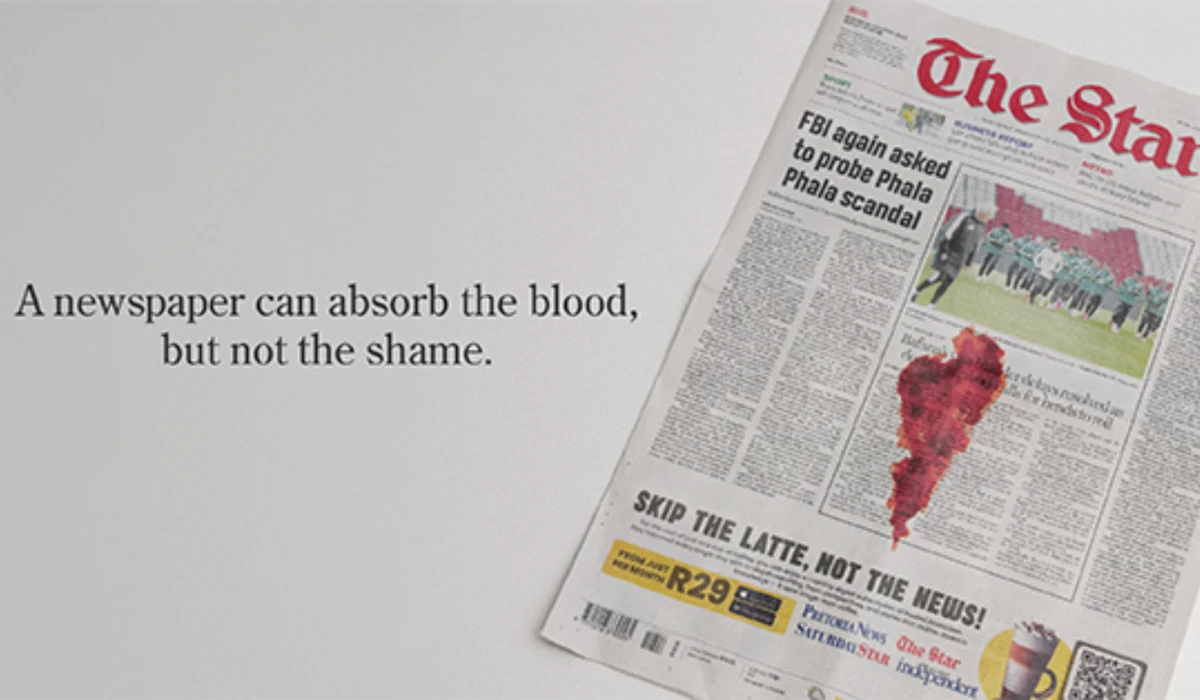
On the morning the campaign broke, readers across South Africa picked up their copies of The Star, The Mercury and Cape Times and found something deeply unsettling — what appeared to be period blood stains bleeding through the front page and onto the pages beneath, as if the newspaper itself had been used as a sanitary pad.
The campaign, called "Period Paper," was created by advertising agency Joe Public in partnership with the MENstruation Foundation and Independent Media. Its central message was blunt: a newspaper can absorb the blood, but not the shame.
This wasn't an accident or a printing error. Joe Public's creative team spent months developing realistic stain artwork, refining it through photography and retouching, then running multiple printing tests with Independent Newspapers across newsprint and high-speed presses to get the effect exactly right.
The shock value was the point. As MENstruation Foundation co-founder Siv Ngesi put it, the goal was to make period poverty "front-page news" — quite literally.
Why It Matters: The Numbers Behind the Headlines
Strip away the campaign's theatrics, and the underlying statistics are sobering. South African organisations working on the ground describe a crisis that affects health, education, and dignity simultaneously.
|
|
|
|
|
|
|
|
|
|
|
|
|
|
|
|
|
|
|
|
|
|
|
|
|
|
|
|
The gap between the scale of the problem (millions) and the scale of current solutions (tens of thousands) is the uncomfortable truth this campaign is trying to close. Even a foundation that calls itself the largest free-pad distributor on the continent is reaching roughly 2.5% of the girls who need help.
The Human Cost Nobody Puts on a Spreadsheet
Numbers tell part of the story, but the lived experience is harder to quantify. Many girls and women are forced to choose between buying food and buying sanitary products — and food almost always wins, leaving them to deal with the health and social consequences of going without. Those who do attend school while menstruating without proper products often face teasing from classmates, compounding the shame that the campaign's slogan directly addresses.
This isn't unique to South Africa, but the scale here is unusually visible because of how directly it intersects with education outcomes. Globally, the conversation has shifted in recent years — menstrual health is increasingly recognised not as a hygiene inconvenience but as a health, human rights, and gender equality issue. South Africa's newspaper campaign fits squarely into that global reframing, but it's notable for taking the message directly to ordinary readers rather than confining it to policy reports.
Government Is Paying Attention — Slowly
It would be inaccurate to say the South African government has ignored this. The Department of Basic Education, alongside the Department of Women, Youth and Persons with Disabilities and the Department of Social Development, has been working on menstrual health management strategies, with discussions calling for a stronger multisectoral approach, better provincial spending, and closer monitoring. A national Sanitary Colloquium was held in Parliament, Cape Town, on 1 April 2026, specifically to address gaps in the rollout of sanitary product programmes.
This matters because it signals that period poverty is no longer treated purely as an NGO problem — it's increasingly recognised as a public health and education policy issue requiring coordination across government departments, including those responsible for school infrastructure and water access.
Who's Doing What: A Quick Comparison
|
|
|
|
|
|
|
|
|
|
|
|
|
|
|
|
|
|
|
|
The pattern that emerges is one of fragmented, well-intentioned efforts operating at a scale far smaller than the problem itself — which is precisely why a high-visibility campaign that disrupts the morning routine of millions of newspaper readers is generating so much conversation.
What Happens Next
The immediate effect of the "Period Paper" campaign is visibility — it's already being discussed well beyond South Africa's borders, with international outlets picking up the story. But visibility alone doesn't put pads in school bathrooms.
Three things are worth watching in the coming months:
First, whether donor and corporate response translates into expanded dispensing machine coverage beyond the current 100,000-girl reach. The foundation has been explicit that it has the manufacturing capacity but needs corporate sponsors to scale up further.
Second, whether the government's Sanitary Colloquium discussions produce concrete budget commitments at the provincial level, where implementation has historically lagged behind national policy intent.
Third, whether the campaign shifts public conversation enough to reduce the stigma that keeps many girls silent about their periods in the first place — a cultural shift that, longer term, may matter as much as the products themselves.
A Story That Deserved to Be Told Differently
What makes this campaign notable from a media-literacy standpoint is the choice of medium. Instead of a billboard or a social video that people scroll past, the message was delivered inside the very object readers were holding — forcing a moment of physical discomfort that mirrors the discomfort millions of girls experience monthly. As Candice Chiwra, a South African menstruation educator, put it, the stained newspaper "is not a pad," but for millions of girls, women and people who menstruate in South Africa every month, it effectively is. That's the uncomfortable point of the whole exercise — and it's one that's hard to unsee once you've seen it.
Other Articles to Read: