


The brutal murder of Ketan in Delhi’s Rohini sector not only exposed a tangled web of personal relationships but also introduced the city’s police to an unusual level of open hostility from the suspects. As investigators pieced together the events leading to the young man's death, it was a fleeting, provocative gesture that dominated headlines: Siya Goyal's middle finger to police during a transit or court appearance.
While a single obscene gesture might seem trivial against the backdrop of a homicide, in the realm of criminal justice and investigative psychology, it is far from inconsequential. This incident offers a critical lens through which to examine suspect behavior, the legal concept of "character evidence," and the complex dynamics of high-profile murder probes in India.
Here is a deep dive into what actually happened, the legal weight of such actions, and what this defiance means for the future of the Ketan murder trial.
Unraveling the Ketan Murder Case
To understand the gravity of the defiance displayed by the accused, one must first understand the severity of the allegations against them. In mid-2024, the Rohini district of Delhi was shaken by the murder of Ketan (name used as per standard reporting of the victim). The primary accused, Saumya Goyal, was known to the victim, and the murder allegedly stemmed from a volatile personal dispute.
Siya Goyal, Saumya’s sister, was swiftly apprehended as a co-accused. Law enforcement alleged that Siya was not merely a bystander but an active participant in the aftermath of the crime, facing severe charges including conspiracy, destruction of evidence, and aiding in the commission of a murder.
When individuals are accused of such grave offenses, the standard procedural expectation is that they will maintain a low profile, often seeking legal counsel to navigate the judicial process quietly. Siya Goyal’s interaction with the media and police subverted this expectation entirely.
What Happened: The Incident in Question
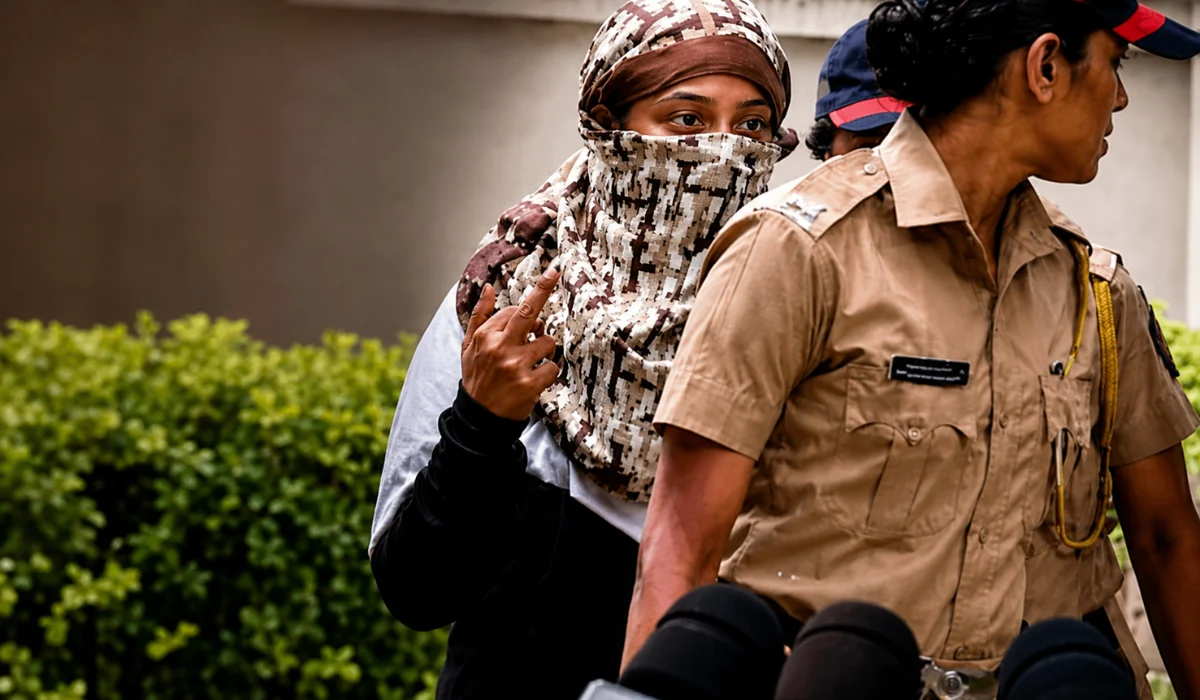
During a routine transit from a detention facility to a court hearing—moments heavily scrutinized by the waiting media—cameras captured Siya Goyal raising her middle finger. While the exact target of the gesture (whether directed at the press, a specific officer, or the investigative team as a whole) was immediately debated, the visual was unequivocal.
In an era where every second of a high-profile accused's movements is recorded, the image went viral. For the Delhi Police, an agency already dealing with the complexities of a murder that lacked a clear, easily provable motive on paper, the gesture was a public relations challenge and an investigative anomaly.
Why It Matters: The Psychology of Custody Defiance
To the average observer, the gesture might be dismissed as immature or merely a product of stress. However, forensic psychologists and criminal profilers view such actions through a different prism. When a suspect displays open contempt for law enforcement while in custody, it typically stems from one of three psychological states:
- Grandiosity and Entitlement: The suspect may genuinely believe they are above the law or that their social standing will insulate them from the consequences of a murder charge.
- Misplaced Defiance as a Defense Mechanism: Facing the reality of a potential life sentence, some individuals resort to aggression to mask profound fear. It is a method of reclaiming agency in a situation where they have absolutely none.
- Calculated Intimidation: In some organized crime scenarios, suspects use the media to project power, signaling to witnesses that they are not afraid.
The Legal Weight of Siya Goyal's Middle Finger to Police
Does flashing an obscene gesture actually carry legal consequences in India? Yes. While it pales in comparison to a murder charge under the Bharatiya Nyaya Sanhita (BNS), it is not a legally neutral act.
Under Section 294 of the BNS (which mirrors Section 294 of the Indian Penal Code), any person who does any obscene act in any public place, to the annoyance of others, can be punished with imprisonment up to three months, a fine, or both.
Furthermore, there is the issue of outraging the modesty of women or causing intentional insult, depending on who the gesture was perceived to be directed toward (e.g., female police officers or journalists). While it is unlikely that the police would dedicate primary resources to prosecuting the middle finger independently, it becomes a part of the charge sheet. It paints a picture of the accused’s character that the prosecution will strategically utilize.
How Character Evidence Plays a Role in Indian Courts
Under Section 53 of the Indian Evidence Act, in criminal proceedings, the fact that the accused has a bad character is irrelevant unless evidence has been given that they have a good character, or unless the bad character itself is a fact in issue.
However, there is a crucial exception: Recent Conduct. Evidence of the disposition, temperament, or recent behavior of the accused is admissible to explain their conduct at the time of the alleged offense. A prosecution lawyer can argue to the court: "Look at the blatant disrespect and aggression this accused shows toward authority figures when merely in transit. Is it so hard to believe this same aggressive temperament manifested in a fatal altercation with the victim?"
Comparative Analysis: Custody Defiance in High-Profile Indian Cases
Siya Goyal’s behavior is not entirely unprecedented, but it sits on a specific spectrum of suspect demeanor. Below is an analytical comparison of how different suspects' behaviors in custody have impacted their public perception and legal trajectories.
|
|
|
|
|
|
|
|
|
|
|
|
|
|
|
|
|
|
|
|
|
|
|
|
|
What Happens Next: The Forward-Looking Insight
As the Ketan murder investigation moves from the realm of police custody to the judicial halls, the viral moment of defiance will fade from public memory, but its legal residue will remain.
1. The Bail Hearing Hurdle
In cases involving murder, securing bail is notoriously difficult in India. The primary argument against bail is that the accused might tamper with evidence or influence witnesses. When an accused demonstrates open hostility toward law enforcement, magistrates are inherently less likely to grant bail. Siya Goyal’s legal team will have to work significantly harder to convince a judge that she will cooperate with the trial process.
2. The Prosecution's Narrative
Expect the public prosecutor to weave this incident into the opening statements of the trial. By establishing Siya as an aggressive, uncooperative individual, the prosecution builds a peripheral narrative that supports the primary allegation: that she possessed the temperament to participate in a violent crime and its subsequent cover-up.
3. The Defense Strategy
The defense will likely attempt to contextualize the gesture. They may argue that their client was subjected to intense media harassment, lewd comments by onlookers, or procedural harassment by the police, prompting a reflexive reaction of self-defense in a psychologically distressed state. While this does not excuse the murder allegation, it attempts to neutralize the "aggressive temperament" argument by reframing the gesture as a trauma response rather than an expression of dominance.
Pune, Maharashtra: Siya Goyal, accused in the Ketan Agarwal murder case, was taken by Pune Rural Police to her Market Yard residence for investigation. After the investigation was completed, while leaving the house, Siya Goyal allegedly made obscene gestures and showed the middle… pic.twitter.com/mHnQKlfRrq
— IANS (@ians_india) July 2, 2026
The Bigger Picture: Media, Law Enforcement, and the Spectacle of Crime
The incident involving Siya Goyal highlights a growing friction point in India's criminal justice system: the media trial. The constant presence of cameras outside police stations and courts creates a highly pressurized environment. Suspects are no longer processed in the quiet anonymity of the state apparatus; they are paraded before a hyper-judgmental public.
While the police have a duty to maintain the dignity of the accused until proven guilty, the accused also have a legal obligation to not obstruct the peace. When a suspect breaks this unspoken social contract with an obscene gesture, it shifts the media narrative from "Did they do it?" to "Look at how arrogant they are." This shift makes it incredibly difficult for the defense to secure a fair, unbiased jury—or in India's case, an unbiased public discourse leading up to a fair trial by a judge.
Conclusion
The Ketan murder case is ultimately built on forensic evidence, circumstantial timelines, and witness testimonies. A middle finger will not be the deciding factor in a murder conviction. However, Siya Goyal's middle finger to police during the investigation is a masterclass in what not to do when facing severe criminal charges.
It provided the prosecution with a free piece of character evidence, alienated the court of public opinion, and gave law enforcement a tangible example of the suspect's disregard for authority. As the legal battle unfolds, this fleeting moment of defiance will serve as a persistent reminder that in the criminal justice system, how an accused behaves is often scrutinized just as intensely as what they are accused of doing.
Other Articles to Read: