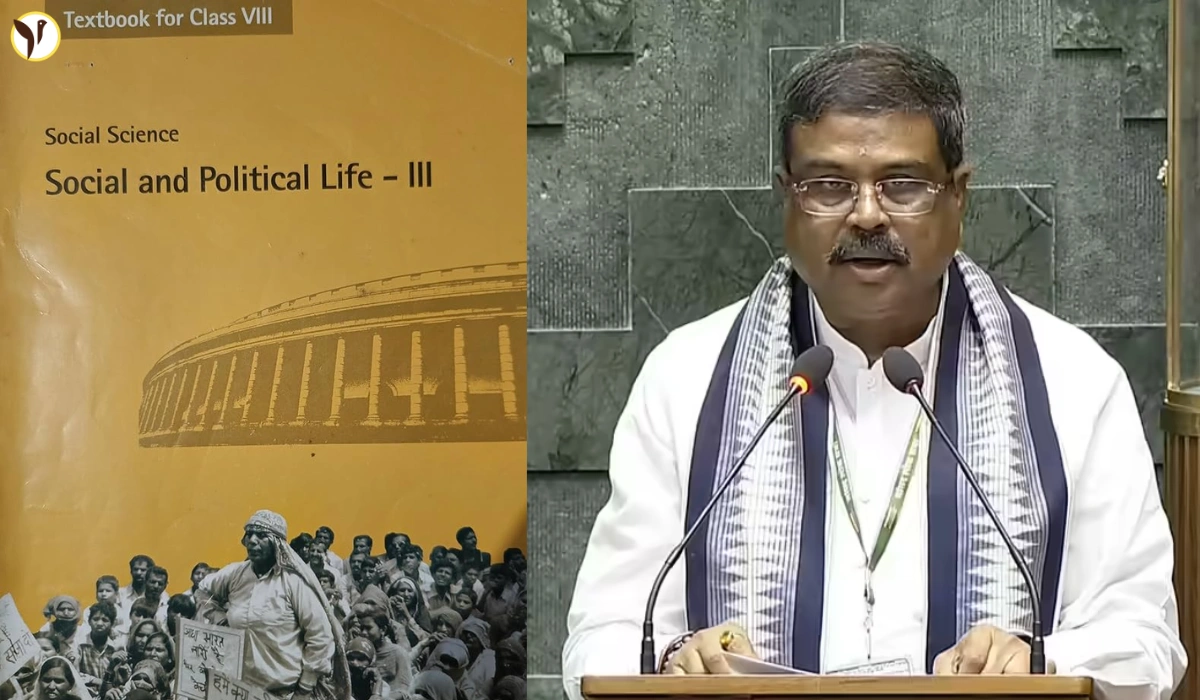


Think about that one page of your child's Class 8 Social Science textbook, starting a national uproar: the Supreme Court has declared the entire NCERT book to be illegal because it refers to the corruption of the judiciary as a "gunshot wound to the judiciary in India." Education Minister Dharmendra Pradhan has vowed that there will be strict action taken against anyone responsible for allowing it to be published. Chapter 4 of the NCERT's book entitled, "The Role of the Judiciary in Our Society," contains many facts regarding corruption in the judiciary, a backlog of about 81,000 Supreme Court cases, and a shortage of judges; as a result, the Supreme Court is now holding suo motu hearings, sending show-cause notices to the top officials of the National Council of Educational Research and Training (NCERT), and recalling all 38 copies sold to schools.
What started as a quiet curriculum glitch now demands Ministry assurances and court-mandated transparency in revisions, straight from CJI Surya Kant's bench. For 25 crore students in CBSE and state board schools, this isn't abstract debate. It disrupts classrooms mid-term, forces teachers to scramble for alternatives, and shapes how a generation grasps civics amid real stakes like pending 47 million lower court cases.
Exact Content Highlights from Reports
Reports describe the text as highlighting "corruption in the judiciary" alongside issues like complicated procedures and poor infrastructure causing delays. It cites over 81,000 pending Supreme Court cases, 6.24 million in High Courts, and 47 million in lower courts. The book also quotes former CJI "B R Gavai" from a 2025 hearing: corruption and misconduct harm public confidence, but transparency and accountability rebuild trust.
This framing drew Supreme Court ire for defaming the institution without balance on reforms like legal aid
Clearly @dpradhanbjp is not in control of Education Department.. He needs to go.. He does not know who drafted NCERT textbook chapter nor does he know anything about UGC guidelines impact.. Sic!! A liability for centerhttps://t.co/xe2cGaKdVx
— ⓇⒶⒿ🇮🇳🙏ꤶ (@rajaneesh_u_a) February 26, 2026
Why the Court Objected Strongly
CJI Surya Kant called it a "gunshot wound" making the judiciary "bleed," a "calculated and conscious step," and "deep-rooted conspiracy." The bench banned the book, ordered takedowns, and demanded accountability, viewing it as contemptuous for young students. NCERT withdrew it, apologized, and plans a rewrite. No full verbatim text is publicly available post-ban, but these summaries capture the essence from court proceedings and news.
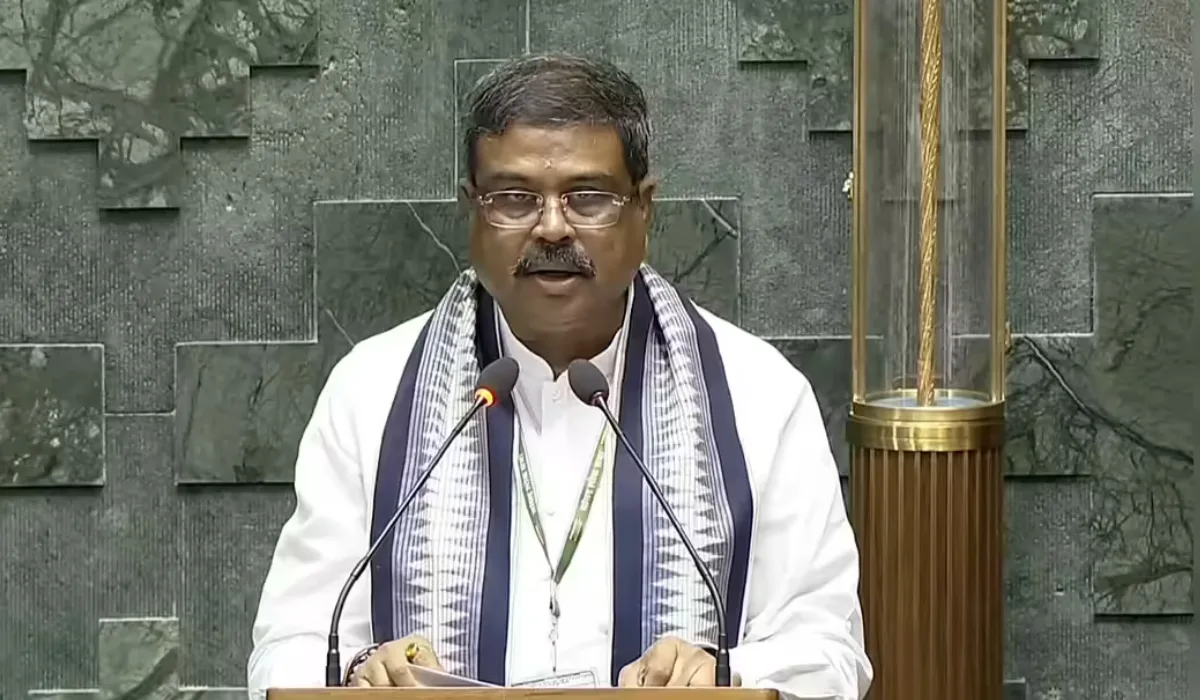
Education Minister Stated: “Accountability Will Be Fixed”
In response to the growing debate, the Education Minister Mr. Pradhan publicly stated that if any procedural or substantive lapses are found, responsibility will be determined. This is a significant political signal.
The assurance suggests three key points:
- The government acknowledges that the matter is serious enough to merit scrutiny.
- There may be internal review mechanisms underway.
- The Ministry is aware that textbook credibility affects public trust in the education system.
However, the statement stops short of admitting fault or confirming any specific error. It also leaves open the question of how accountability would be defined. Would it involve academic reviewers, editorial boards, or administrative officials? And would consequences be corrective, disciplinary, or simply procedural reform?
For educators, this uncertainty matters. Textbooks influence examination patterns, classroom discussions, and teacher training modules. If a chapter’s framing changes abruptly, teachers must adjust lesson plans, and students may struggle with inconsistencies between older and newer editions.
NCERT's Role and Recent Track Record
The National Council of Educational Research and Training crafts textbooks for CBSE schools and influences millions of students nationwide. Under Pradhan's watch, NCERT has pushed National Education Policy 2020 goals, like mother-tongue instruction, cheaper books, and ramping print capacity from 5 crore to 15 crore copies yearly. New textbooks aligned with the updated National Curriculum Framework roll out progressively, with classes 9-12 versions set for 2026-27.
Yet this fiasco highlights vulnerabilities in the review process. Textbooks pass through committees of experts, but slips like this raise questions about oversight amid rapid revisions. Past controversies, such as deletions on historical events in 2023, drew political heat, but none triggered a full court ban before.
Why This Hits Families and Schools Hard Right Now
With February nearing the end of many school terms, teachers rely on these standard texts for lessons on civics and governance. The ban disrupts that flow. Parents in places like Pimpri-Chinchwad scramble for alternatives, fearing gaps in their kids' learning or added costs for private books. Schools must now pivot to supplementary materials, straining resources in government institutions where budgets run tight.
For students, the real lesson might stick deeper. They see institutions clash publicly, learning about accountability firsthand. But it risks eroding faith if not handled transparently. This matters because 25 crore kids study under NCERT frameworks, shaping future voters who need balanced views on democracy's pillars
Other Articles to Read:
- Smiling Friends: Is This Really the End After Season 3?
- Bhooth Bangla Ram Ji Aake Bhala Karenge Teaser Out — When Is the Full Song Dropping?
- Kim Kardashian Co-Founds Update Energy Drink with Paraxanthine
- Project Hail Mary Reactions: Gosling Shines in 2026 Sci-Fi Epic
- Bill Gates Opens Up Apologises to Staff Over Epstein Files Connection
- Love & War Budget Reaches ₹425 Crore Amid Shoot Extension
Background: Textbook Revisions and Rationalisation
The Ministry of Education and NCERT have previously described textbook rationalisation as a necessary step following disruptions such as the pandemic. The stated aim was to reduce academic load and remove repetitive material across classes.
This is not the first time textbook content has sparked controversy in India. Over the past two decades, successive governments have faced criticism over how history, sociology, and political science are framed. Each episode has raised the same core question: where does academic revision end and ideological influence begin?
Saffronisation Row (2002–2003)
What happened: Changes in NCERT curriculum under the then-BJP/NDA government sparked allegations of “saffronisation” — critics argued the revised syllabus elevated Hindutva-oriented cultural narratives and downplayed secular frameworks.
Rationalisation After Covid-19 (2021–2022)
What happened: NCERT carried out a large-scale syllabus rationalisation across subjects after pandemic disruptions, aiming to trim content. However, deletions were seen by critics as unevenly targeting sections on Islamic history, communal violence, caste struggles, and scientific concepts.
You can Read more here: NCERT textbook controversies