
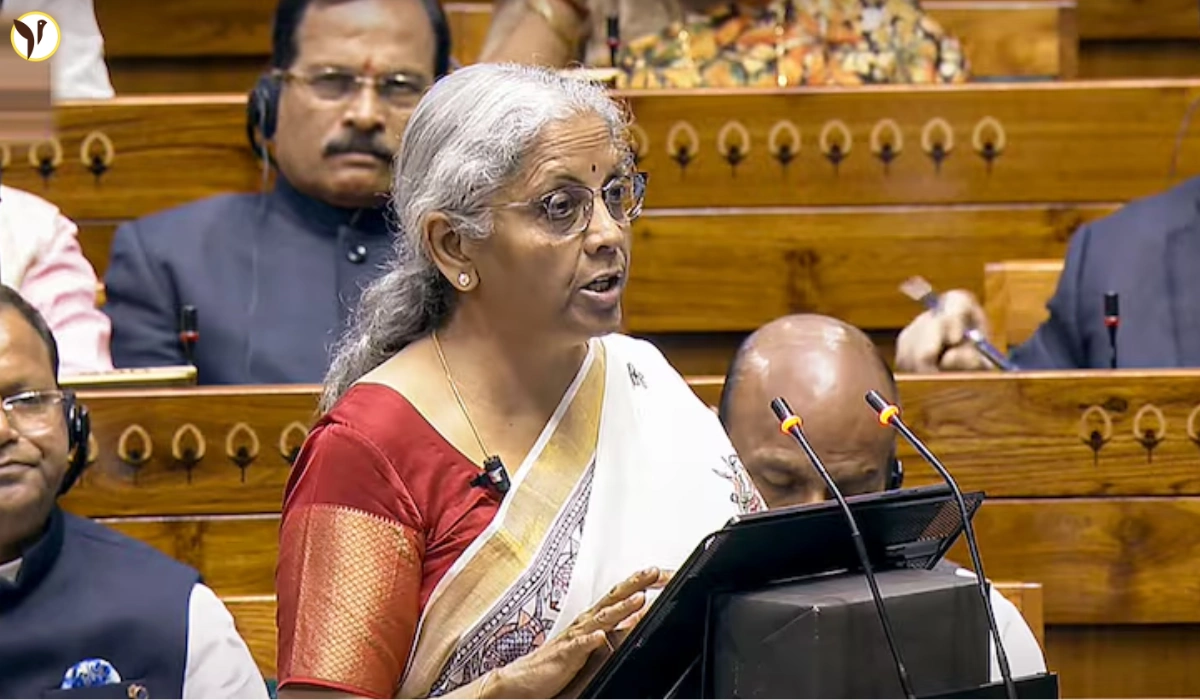


When Finance Minister Nirmala Sitharaman rises to present the Union Budget 2026 on February 1, the sharpest attention will not be on headline growth numbers or fiscal math alone. For millions of salaried Indians filing income tax returns every year, this budget is being watched for something far more personal: breathing room.
With India’s economy projected to grow at around 6.5–7%, the government enters Budget 2026 from a position of relative strength. Yet, household finances tell a more complicated story. Rents have climbed sharply in cities, school and college fees continue to rise, healthcare costs remain unpredictable, and EMIs consume a larger share of monthly income. Against this backdrop, even modest changes in income tax rules can meaningfully alter how families plan, spend, and save.
Budget 2026 taxes are therefore expected to focus less on dramatic giveaways and more on calibrated relief — particularly through slab adjustments, higher deductions, and a cleaner tax framework.
Income Tax Takes Centre Stage Again
Income tax policy has become one of the most emotionally resonant elements of recent budgets. Over the past two years, the new tax regime has steadily gained dominance, now accounting for roughly 72% of all individual tax filers. Lower rates and simplified structures have driven adoption, but many taxpayers argue the system still does not fully reflect today’s cost of living.
That tension defines Budget 2026 expectations. The objective is not to undo past reforms, but to refine them — smoothing slab transitions, widening relief for salaried earners, and improving clarity ahead of the proposed rollout of the new Income Tax Act from April 2026.
Slab Changes Likely to Stay Measured
One of the most discussed possibilities is a shift in the income threshold for the highest tax bracket.
Currently, the 30% tax slab begins at ₹24 lakh under the new regime. There is growing anticipation that Budget 2026 could push this threshold to the ₹35–40 lakh range. For urban professionals facing high rental and education expenses, such a change would offer meaningful relief without reducing headline tax rates.
Importantly, experts do not expect a sweeping slab overhaul. The post-2025 tax framework emphasises stability, and any slab rationalisation is likely to be incremental rather than disruptive. The emphasis appears to be on making the new regime feel fairer at higher income levels, not rewriting it entirely.
Standard Deduction Emerges as the Quiet Star
Few tax provisions generate as much attention relative to their size as the standard deduction.
Under the new tax regime, the standard deduction currently stands at ₹75,000. Budget 2026 expectations increasingly point toward a hike to ₹1 lakh. For salaried employees, this single change could translate into immediate, visible relief — especially when combined with slab tweaks.
In the old regime, discussions around raising the Section 80C limit from ₹1.5 lakh to ₹2 lakh have also gained momentum. While the long-term direction still favours the new regime, such a move would soften the transition for taxpayers who continue to rely on traditional savings instruments.
Taken together, these adjustments could push effective tax-free income close to ₹14 lakh for certain profiles, depending on structure and regime choice.
Capital Spending Signals Confidence Beyond Taxes
While income tax captures public imagination, Budget 2026 is also expected to reinforce growth through a sharp rise in capital expenditure.
Capex allocations are projected to increase from around ₹11 lakh crore to ₹12–12.5 lakh crore, with heavy emphasis on roads, railways, urban infrastructure, and logistics. Defence spending is expected to see a 15–20% jump, focusing on modernisation and indigenous manufacturing.
This matters for taxpayers in a less obvious way. Sustained capex fuels job creation, stabilises wages, and supports sectors such as steel, cement, engineering, and transport — all of which feed back into household income security.
Budget 2026 Tax Expectations
|
|
|
|
|
|
|
|
|
|
|
|
|
|
|
|
|
|
|
|
|
|
|
|
Investors Track Capital Gains Stability
Retail investors are also watching Budget 2026 closely for clarity on capital gains.
There is broad expectation that the long-term capital gains exemption limit could rise from ₹1.25 lakh to ₹2 lakh, offering relief to small and medium investors. Equity short-term capital gains tax is widely expected to remain unchanged at 20%, reinforcing predictability.
Debt fund investors, meanwhile, continue to push for the return of indexation benefits — a demand that reflects inflation realities rather than speculative appetite.
Joint Filing and Compliance Ease Enter the Conversation
Among the quieter but potentially impactful ideas circulating is the concept of joint tax filing for married couples. Such a system could allow combined slabs or shared deductions, simplifying compliance and aligning tax policy more closely with household-level finances.
Even if not implemented immediately, the discussion reflects a broader push toward simplification — fewer errors, easier filing, and reduced administrative burden for both taxpayers and the tax department.
Inflation Pressures Shape Relief Expectations
The underlying theme across all tax discussions is inflation.
Urban households have seen disposable incomes squeezed by rising rents, private education costs, and healthcare spending. Budget 2026 tax tweaks are widely viewed as a way to offset these pressures indirectly, potentially increasing disposable income by 5–7% for certain salaried segments.
This additional headroom could support consumption — a critical lever for sustaining growth as global demand remains uncertain.
How Markets and Sectors Are Reading the Budget
Beyond households, market participants are already positioning around likely budget priorities. Defence manufacturing, infrastructure, clean energy, and AI-linked digital infrastructure are being closely tracked.
For investors, the message is less about short-term rallies and more about policy continuity. A budget that reinforces capex while maintaining tax stability is generally seen as supportive for long-term equity participation.
What to Watch on Budget Day
As the finance minister delivers her speech at 11 am on February 1, taxpayers should focus on three signals:
-
Whether slab thresholds change meaningfully
-
The size and structure of standard deduction revisions
-
Clarity on the transition toward the new Income Tax Act
These elements will define how Budget 2026 taxes influence personal finances over the next few years.
Conclusion
Budget 2026 is unlikely to transform India’s tax system overnight. Instead, it appears poised to fine-tune it — easing pressure points without compromising fiscal discipline.
For salaried Indians, the promise lies in quieter gains: slightly higher take-home pay, simpler rules, and greater predictability. In a period marked by rising living costs and cautious optimism, that balance may be exactly what the economy needs.