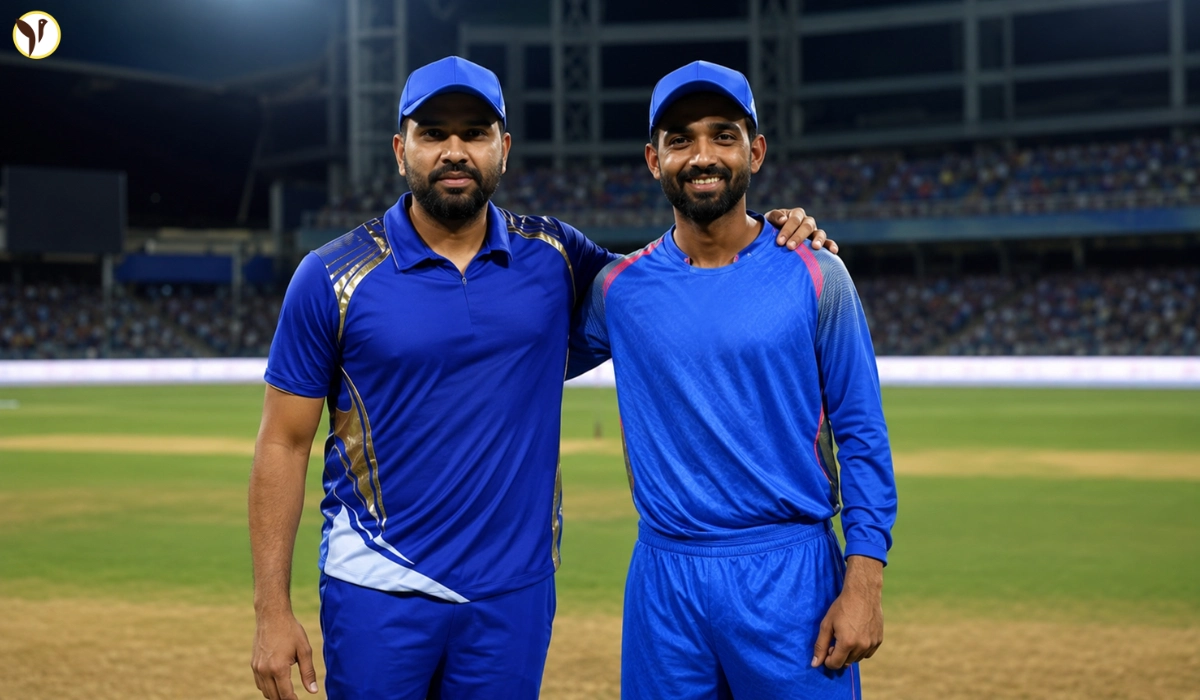


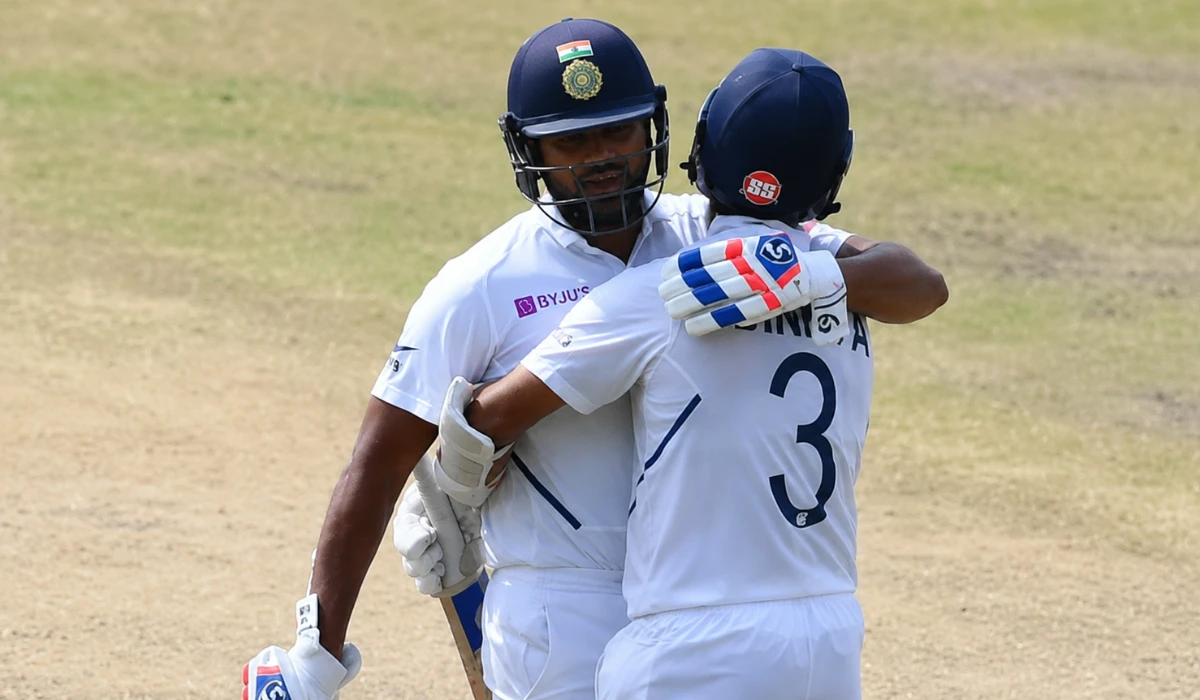
In the sterile, air-conditioned confines of a press conference room—where cricketers typically trade in measured clichés and diplomatic deflections—Rohit Sharma did something unexpected. His voice cracked. His eyes moistened. And for a brief, unguarded moment, India's captain let the world see what Ajinkya Rahane means to him, not just as a teammate, but as a symbol of everything cricket demands and so rarely rewards.
"Sometimes, hard work doesn't show immediately," Rohit said, pausing to collect himself. "But what Ajinkya has done... people don't see the hours. They only see the results. I've seen those hours."
It was not a rehearsed soundbite. It was not a captain managing his squad's optics. It was, quite simply, a friend acknowledging another friend's invisible labor.
For anyone who has followed Indian cricket's recent trajectory, this moment landed with unusual weight. Because Ajinkya Rahane's story is not merely about cricket. It is about what happens when talent meets adversity, when the system forgets you, and when the only currency left is stubborn, unglamorous persistence.
Why This Tribute Matters Beyond the Headlines
To understand why Rohit's emotional acknowledgment resonated so deeply, one must first understand what Rahane represents in the broader ecosystem of Indian cricket.
The Anti-Narrative Cricketer
In an era defined by Instagram highlights, strike rates, and franchise cricket millions, Rahane has always been a throwback—a cricketer whose value cannot be captured in a single statistic. His defining innings, the 137 at the Melbourne Cricket Ground in December 2020, did not just save a series. It salvaged Indian cricket's dignity after the Adelaide humiliation.
But here is what made that innings extraordinary: it came when Rahane himself was fighting for relevance. He was not the designated star. He was not the poster boy. He was a 32-year-old batsman carrying the weight of a shattered team, playing on a ground where India had not won a Test in 37 years.
Rohit's tribute, years later, was essentially an acknowledgment of this: that Rahane's contributions have consistently arrived at moments when nobody else could deliver them.
The Numbers That Don't Tell the Full Story
|
|
|
|
|
|
|
|
|
|
|
|
|
|
|
|
|
|
|
|
|
|
|
|
Two Cricketers, Two Journeys, One Bond
Rohit Sharma and Ajinkya Rahane's friendship is not the kind that dominates social media or generates clickbait. It is quieter, older, and rooted in shared experiences that predate their stardom.
Both made their international debuts in the late 2000s—Rohit in 2007, Rahane in 2011. Both were anointed as "the next big thing" at various points. Both experienced the peculiar cruelty of Indian cricket fandom, where adulation can turn to abuse within a single innings.
But their paths diverged in fascinating ways.
A Tale of Two Trajectories
|
|
|
|
|
|
|
|
|
|
|
|
|
|
|
|
|
|
|
|
|
|
|
|
|
|
|
|
What binds them, according to multiple team sources who have spoken over the years, is a mutual understanding of pressure that transcends the typical teammate dynamic. Rohit has often spoken about how Rahane's calm under crisis influenced his own approach to leadership.
When Rohit says he has "seen those hours," he is not speaking metaphorically. He has been in dressing rooms where Rahane would arrive hours before schedule, batting against bowlers half his age, grinding out form that the selection committee had already decided he had lost.
What Led to This Moment
To fully appreciate Rohit's emotional tribute, it is essential to reconstruct the timeline that led to it.
The Dropping (2022-2023)
After the South Africa tour in January 2022, Rahane was dropped from the Test team. The official reasoning was form-related. The unofficial reasoning, according to multiple reports, was that the selectors wanted to "move on" and invest in younger talent.
The decision was not inherently wrong. Indian cricket has always struggled with transition. But the manner of Rahane's omission troubled many observers. Here was a player with 12 overseas Test centuries—more than Virat Kohli at that point—being discarded without a farewell, without a press conference, without even a formal announcement.
The Silent Rebuild
What happened next is what Rohit was referencing in his emotional moment.
Rahane did not retire. He did not stage public protests. He did not leverage his status as a World Cup winner (he was vice-captain of the 2023 World Cup-winning squad, though he did not play a single game) for sympathy.
Instead, he went back to domestic cricket. Ranji Trophy. Duleep Trophy. Irani Cup. Matches that most established cricketers treat as optional.
The numbers he accumulated in this period were staggering:
|
|
|
|
|
|
|
|
|
|
|
|
|
|
|
|
|
|
|
|
|
|
|
|
The Recall
When the selectors eventually reconsidered—driven by injuries, form collapses, and the immutable logic that experience cannot be manufactured overnight—Rahane was ready. Not rusty, not bitter, not seeking revenge. Just ready.
His performances upon return, while not always statistically dominant, carried the unmistakable signature of a player who had earned his place through suffering rather than selection.
What Rohit's Emotion Reveals About Modern Cricket Leadership
Rohit Sharma's public display of emotion was significant for reasons that extend beyond his personal relationship with Rahane.
The Human Element in Data-Driven Cricket
Modern cricket has become increasingly mechanized. Players are selected through algorithms. Performance is measured through metrics that would have seemed alien a decade ago. Communication happens through WhatsApp groups and performance management software.
In this environment, a captain publicly acknowledging the emotional dimension of a teammate's struggle is almost subversive. It is a reminder that behind every data point is a human being who sacrifices, doubts, and endures.
Rohit's tears were not weakness. They were a form of leadership communication that no tactical document could replicate.
A Contrast in Leadership Styles
It is worth noting that Rohit's predecessor, Virat Kohli, had a notably different public relationship with Rahane. While there was never any open conflict, Kohli's captaincy era was marked by a certain performative intensity that left little room for vulnerable moments.
Rohit, by contrast, has consistently shown a willingness to display emotion publicly. This is not necessarily better or worse—it is simply different. And for Rahane, whose entire career has been defined by quiet persistence rather than loud assertion, Rohit's approach may feel more validating.
What Rahane's Journey Says About Indian Cricket
Rohit Sharma's tribute to Ajinkya Rahane is ultimately not just about two cricketers. It is a mirror held up to Indian cricket's relationship with its own players.
The System's Treatment of Senior Players
Indian cricket has a documented pattern with its senior players:
- Elevation: The player is anointed as the future.
- Expectation: Massive public and institutional pressure builds.
- Inevitable Slump: Form dips (as it does for every player).
- Ostracization: The player is dropped, often unceremoniously.
- Memory Erasure: The system acts as if the player's contributions never existed.
Rahane followed this pattern with almost painful precision. His 12 overseas centuries—achieved on pitches where many Indian greats struggled—became footnotes rather than highlights.
The Age Discrimination Question
There is an uncomfortable question that Indian cricket has never adequately addressed: Does the system have an age bias?
Consider the following comparison at the time of Rahane's dropping:
|
|
|
|
|
|
|
|
|
|
|
|
|
|
|
|
|
|
|
|
Meanwhile, in other cricketing nations:
|
|
|
|
|
|
|
|
|
|
|
|
|
|
|
|
|
|
|
|
The Domestic Cricket Paradox
Perhaps the most troubling aspect of Rahane's saga is what it reveals about domestic cricket's perceived value.
When Rahane scored 634 Ranji runs in 2022-23, it was treated as a curiosity rather than a compelling case for recall. When younger players score heavily in domestic cricket, it is hailed as "pushing for selection." When established players do the same, it is often dismissed as "bullying domestic bowlers."
This double standard undermines the very purpose of domestic cricket as a selection pathway.
The Forward-Looking Analysis
Rohit Sharma's emotional tribute, while moving, also raises practical questions about the immediate future.
Rahane's Role in the Current Setup
At his current age and stage of career, Rahane is unlikely to be a long-term solution. But his value lies in three specific areas:
- Mentorship: Young batters can learn from his technique and temperament in ways no coaching manual can teach.
- Crisis Management: In overseas conditions, particularly in SENA nations, having a batter who has conquered these pitches before is strategically invaluable.
- Cultural Continuity: Rahane represents a link to the era when India learned to win abroad. Severing that link entirely risks losing institutional memory.
The Succession Question
The real challenge for Indian cricket is not whether Rahane plays another Test. It is whether the system can identify and develop the next Rahane—a player who values grit over glamour, substance over style.
Current candidates like Shubman Gill, Yashasvi Jaiswal, and Ruturaj Gaikwad are enormously talented. But talent and temperament are different currencies. Rahane's legacy should be a template, not a tombstone.
Rohit's Leadership Evolution
This moment also signals something important about Rohit's evolution as a leader. A captain who can publicly honor a teammate's invisible labor is a captain who understands that management is not just about tactics and selections. It is about making people feel seen.
In a high-performance environment where insecurity is endemic, this quality is rare and valuable.
What the Cricket Community Is Saying
To provide additional context, here are perspectives from across the cricketing spectrum:
Sanjay Manjrekar (Former India Batter and Commentator): "What people forget about Rahane is that his best innings have come when the team was in crisis. That is the hardest skill in cricket. Anyone can score when the pitch is flat and the pressure is off. Rahane's catalogue is almost entirely high-pressure knocks."
Harsha Bhogle (Journalist and Commentator): "Rohit's emotion was real because he understands what it takes. Both he and Rahane have had periods where the system doubted them. That shared experience creates a bond that transcends normal teammate relationships."
A Senior BCCI Official (Speaking on Condition of Anonymity): "Look, selections are never personal. But the way a player is communicated to, the way they are treated during the transition—that's where we could have done better with Ajinkya. Rohit's words were probably overdue, but they were genuine."
We've shared the dressing room for so many years and I know how much hard work has gone into everything you've achieved. Your commitment and professionalism have always set you apart.
— Rohit Sharma (@ImRo45) July 30, 2026
Congratulations on a wonderful career. Best wishes! @ajinkyarahane88 pic.twitter.com/r7eXb1yrUz
Why Rahane's Story Makes People Uncomfortable
There is a reason Rohit's tribute generated such intense reaction. It is not just about cricket. It is about a truth that extends far beyond the boundary:
Hard work does not always equal recognition.
Rahane did everything right. He scored runs in difficult conditions. He led the team to victory in its darkest hour. He accepted dropping with dignity. He rebuilt his career through domestic grind. He returned without complaints.
And yet, his legacy remains contested. There are still fans who dismiss him as "lucky" or "overrated." There are still commentators who focus on his limitations rather than his contributions.
Rohit's tears were, in part, a response to this injustice. A recognition that the cricketing world's reward systems are fundamentally broken—that they celebrate flair over substance, style over sacrifice.
Beyond the Press Conference
In the final analysis, Rohit Sharma's emotional tribute to Ajinkya Rahane will be remembered not for what it said about cricket, but for what it said about human resilience.
Rahane's career is a testament to the proposition that some people are built differently—not necessarily better, just different. They do not need the spotlight to function. They do not need validation to perform. They simply keep going, inning after inning, session after session, until either the world notices or they run out of time.
Rohit noticed. And in noticing, he reminded all of us that the most important stories in sport are rarely the loudest ones. They are the quiet ones—the ones about invisible hours, silent suffering, and the stubborn belief that if you keep working, eventually, someone will see.
Ajinkya Rahane may or may not play another Test for India. But his story has already transcended the format. It is now a parable about perseverance, about the gap between effort and recognition, and about the rare, precious moment when someone in a position of power chooses to acknowledge that gap instead of ignoring it.
Rohit Sharma made that choice. And Indian cricket is slightly richer for it.
Other Articles to Read: