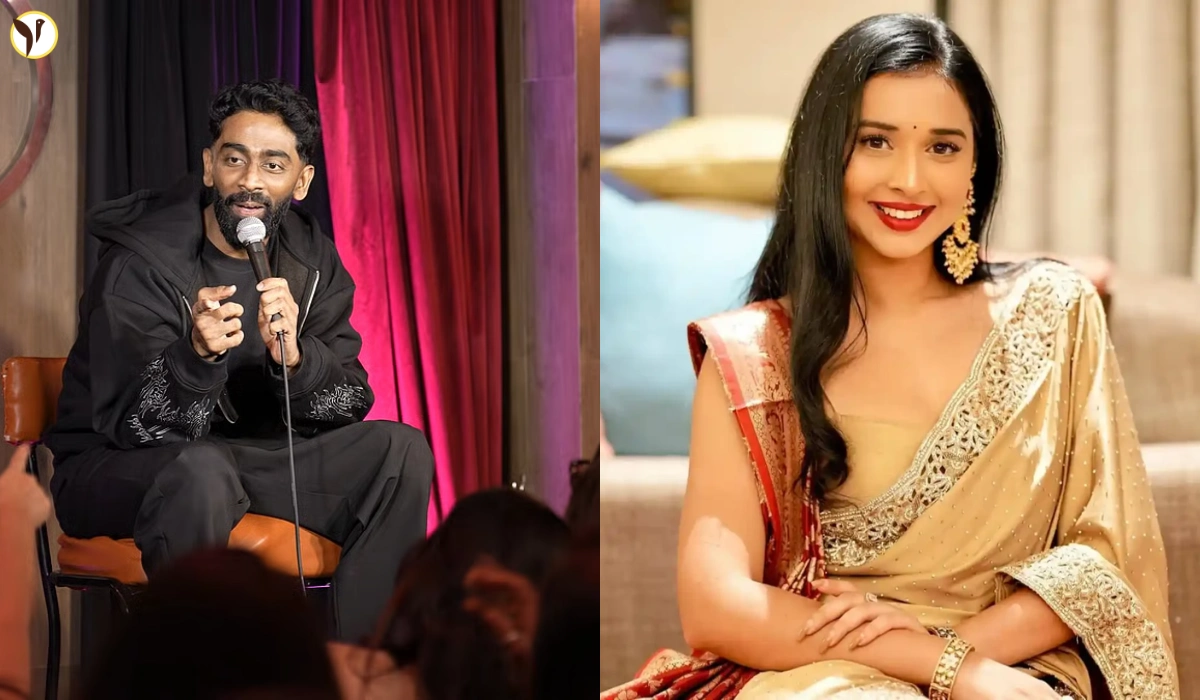


The Bigg Boss 19 finalist, who openly clashed with Pranit on national TV, delivered a nuanced reaction to the viral controversy — acknowledging the comedian's lapse while drawing a hard line against internet pile-ons.
India's most explosive stand-up comedy controversy of 2026 has now pulled in an unexpected voice — and one with credibility precisely because she has no love lost for the man she is, in part, defending. Tanya Mittal, the social media influencer who finished as third runner-up on Bigg Boss 19 and spent weeks publicly feuding with comedian Pranit More on that show, has spoken out on the Rs 370 biryani row. Her reaction? Measured, layered, and — according to a large section of the internet — exactly what the conversation needed.
What Happened: The Controversy at a Glance
The incident that set off weeks of outrage began at one of Pranit More's live crowd-work shows in Gurugram. During the segment, a 23-year-old audience member, Himanshu Jangra, recounted a date during which he spent roughly Rs 370 on chicken biryani and water — and then claimed he expected "something in return" from the woman, using the phrase "wasool toh karunga." He also described taking her to a dark park despite what he characterised as her reluctance.
Pranit More, instead of challenging the comments, laughed along and called the moment "Peak Gurgaon content" — a response that critics argued amounted to platforming and endorsing a mindset that trivialises women's consent.
The clip was uploaded to Instagram by More himself, went viral almost immediately, and triggered a chain of consequences that escalated far beyond any apology could contain.
The Full Fallout: A Timeline of Key Events
|
|
|
|
|
|
|
|
|
|
|
|
|
|
|
|
|
|
|
|
|
|
|
|
|
|
|
|
|
|
|
|
|
|
|
|
Tanya Mittal's Statement: Every Word Counts
What makes Tanya's reaction particularly striking is its context. This is not an industry friend offering cover, nor a stranger with no skin in the game. During Bigg Boss 19, Tanya and Pranit had a contentious relationship — she openly called him out for using mockery as a weapon and said he was not someone she liked. That history gives her words weight that a neutral commentator simply would not have.
When asked about the controversy, Tanya was unflinching in her personal stance: "Mujhe Pranit pasand nahi hai kyunki usne mere saath bahut bura-bura kiya hai." She made no attempt to revise her feelings about him. But that is where the straightforwardness ended and the nuance began.
"Usse galti hui, usne maafi mangi, toh ek time ke baad social media toxic nahi hona chaiye. Sab ko yeh sochna chaiye ki kal hum bhi uski jagah ho sakte hai."
She went further, reminding her audience that everyone involved in a public controversy is a person with a family: "Bura bolo, but after a point, just stop. Itna karo ki uska parivar bhi samaj mein reh paye."
Her position, in short, is a two-track argument: the conduct was wrong and deserved criticism, but the sustained pile-on after an apology crosses from accountability into cruelty. It is a distinction that is easy to articulate in principle and very hard to maintain in the heat of a viral moment — which is perhaps why her statement landed so strongly.
What the Law Says: The FIR and Its Implications
The legal dimension of this controversy is substantive and cannot be reduced to social media noise. Maharashtra Cyber Police registered FIR No. 36/2026 on June 11, 2026, at the Nodal Cyber Police Station against Pranit More, Himanshu Jangra, Dr. Sejal Pawar, and others. The charges were filed under Sections 75(1)(iv), 75(3), 294, and 353(2) of the Bharatiya Nyaya Sanhita (BNS) 2023, alongside Section 67 of the Information Technology Act, 2000 — provisions related to obscene content and material that outrages public decency.
The National Commission for Women (NCW) took suo motu cognizance of the matter, condemned the remarks as glorifying sexual coercion, and summoned both More and Jangra to appear before the Commission on June 22, 2026. The Maharashtra Home Department went further still, ordering a review of all of Pranit More's uploaded video content — not just the one clip that sparked the controversy.
|
|
|
|
|
|
|
|
|
|
|
|
|
|
|
|
|
|
|
|
|
|
|
|
The Bigger Debate: Where Does Internet Justice End?
Tanya Mittal's statement arrives at a moment when the contours of the controversy were already shifting. Initially, the anger was concentrated on the remarks themselves — on what they implied about consent, entitlement, and the social dynamics of dating in urban India. That critique was, by most accounts, entirely legitimate. The clip was not taken out of context; Pranit More himself posted it, which is why his defence was always going to be difficult.
But as the controversy stretched across weeks — gathering FIRs, job terminations, departmental probes, and parliamentary-style summons — a secondary debate began to emerge: at what point does accountability tip into disproportionate punishment, and who gets to decide that threshold?
Tanya's intervention does not answer that question, but it names it clearly. Her credibility on this specific point is considerable: she is not someone who could be accused of sympathy towards Pranit More as a default position. When she says the pile-on has gone too far, she is not providing cover for a friend. She is making an argument about how online communities ought to function when someone — having acknowledged wrongdoing — asks for a second chance.
Tanya Mittal has come out in support of Pranit More amid the ₹370 biryani controversy. While she says criticism was justified, she believes the trolling and online hate have crossed the line.
— The Filmy Charcha (@thefilmycharcha) June 18, 2026
"Ek point ke baad ruk jana chahiye," she said, urging people to show empathy and stop… pic.twitter.com/Y1cMI3ZRY4
Pranit More's Apology: What He Actually Said
For context, More's second public apology — delivered via Instagram video after his account was reinstated — was direct and self-aware rather than defensive. He said he "got carried away" by the crowd's laughter, acknowledged that he gave an offensive person a platform he should have denied them, admitted that the criticism he received was fair, and confirmed he was cooperating with legal proceedings. He said, "I deserve this hate," and asked for one chance to be a better person. He also committed to working more carefully on his content going forward.
Critically, Himanshu Jangra later admitted that parts of the story he told at the show had been improvised for entertainment and were not entirely accurate — a detail that neither exonerates the attitudes expressed nor erases the impact of the viral spread, but does complicate the picture of what exactly transpired.
What Happens Next
The NCW hearing on June 22, 2026 will be a significant moment: it will determine whether the Commission recommends further legal action or accepts the apologies offered. The Maharashtra Home Department's review of Pranit More's broader video catalogue is ongoing and could result in additional charges if other content is deemed objectionable under the BNS.
For More himself, the professional road back is uncertain. Event organisers in Mumbai have reportedly begun asking comedians to agree to guidelines around crowd-work content. His Instagram following remains large — his channel has over 2 million subscribers with more than 774 million cumulative views — but the reputational cost of this controversy will follow his brand for the foreseeable future.
Tanya Mittal, for her part, has come out of this moment with her standing considerably enhanced. By refusing to weaponise a controversy against someone she openly dislikes, she has demonstrated something increasingly rare in the social media ecosystem: the ability to hold two things as true at the same time. Pranit More was wrong. And prolonged online cruelty is also wrong. Those two sentences do not cancel each other out.
Other Articles to Read: