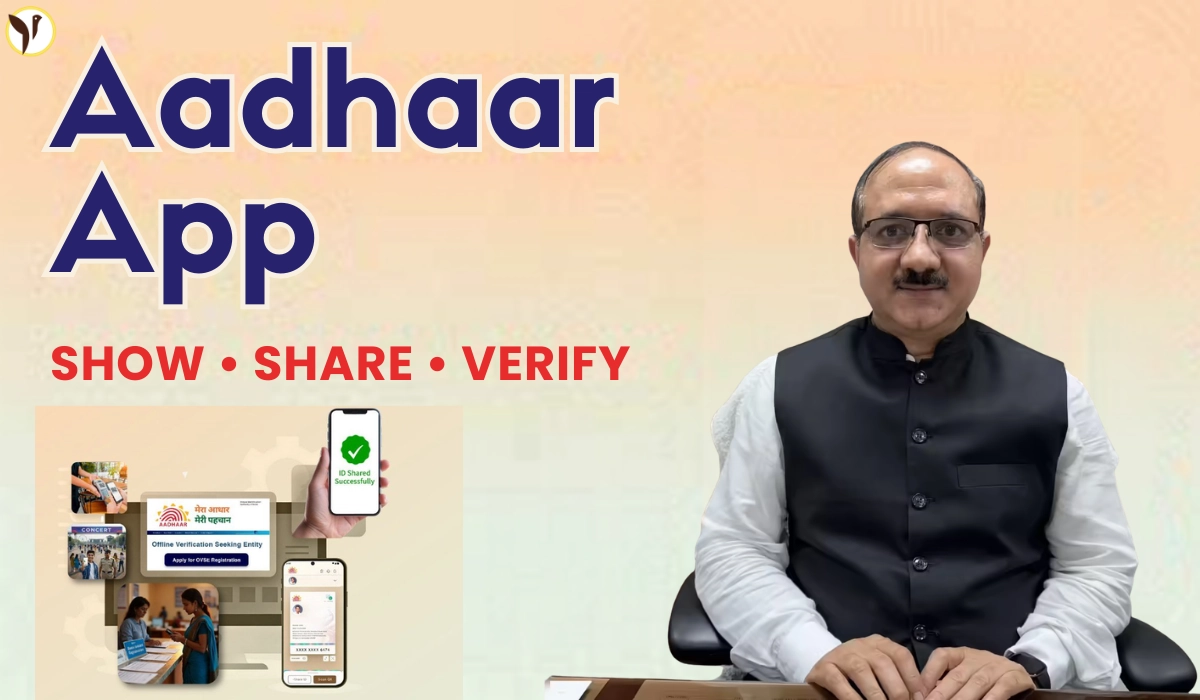


Two massive developments collided this week in India's digital infrastructure landscape, and most news outlets are treating them as separate stories. They're not. The Unique Identification Authority of India officially announced that its CEO Bhuvnesh Kumar will also lead the IndiaAI Mission, while simultaneously confirming the mAadhaar app will retire soon with users forced to migrate to a redesigned Aadhaar application.
This isn't just bureaucratic reshuffling or a routine app update. It's a coordinated pivot that reveals how India plans to use digital identity as the foundation for its artificial intelligence ambitions.
The Leadership Consolidation That Changes Everything
Bhuvnesh Kumar, IAS, who took over as UIDAI CEO in early 2025, now holds dual responsibility for both India's identity infrastructure and its national AI strategy. The IndiaAI Mission operates with a ₹10,372 crore budget approved in March 2024, focusing on building sovereign AI capabilities, creating computing infrastructure with over 10,000 GPUs, and developing India-specific foundation models.
Here's what most reports missed: This dual appointment signals that the government views trusted digital identity as the critical bottleneck for AI deployment at scale. You cannot build AI systems serving India's next 500 million digital citizens without resolving identity verification, data privacy, and authentication trust simultaneously.
Abhishek Singh, the previous IndiaAI Mission CEO, was recently appointed Director General of the National Testing Agency in a bureaucratic reshuffle on March 31, 2026, clearing the path for Kumar's takeover.
mAadhaar will discontinue soon. Download the new Aadhaar App and experience faster access, smarter features & enjoy services at your fingertips.
— Aadhaar (@UIDAI) May 25, 2026
It is designed to make your Aadhaar experience simpler, and more convenient than ever!
Download Aadhaar App now -… pic.twitter.com/6XFLGU7KlK
mAadhaar App Phase-Out: What Users Must Know Before It's Too Late
The existing mAadhaar app will be discontinued soon, though UIDAI hasn't announced an exact shutdown date. This is not a gentle upgrade, it's a forced migration with critical implications.
The migration reality most people don't understand:
-
No automatic data transfer: Information in the old mAadhaar app will not move to the new Aadhaar app. Users must manually set up their profiles again
-
Family profiles require individual setup: Each family member's Aadhaar must be added separately using their unique Aadhaar number and OTP verification
-
The app supports up to 5 profiles under one registered mobile number, but setup is not intuitive
New features that actually matter:
| Feature | What It Does | Why It Changes Things |
|---|---|---|
| QR-based Aadhaar sharing | Share identity via QR code instead of displaying full details | Prevents identity data from being visible during verification at hotels, hospitals, counters |
| Biometric lock/unlock controls | Lock fingerprint, face, and iris authentication directly from phone | Users must actively unlock biometrics before authentication, a deliberate friction point for security |
| Face-based authentication | Live facial scan during setup and verification | Adds verification layer but creates accessibility issues for elderly and rural users |
| Authentication history tracking | View past authentication events | Users can now see who accessed their identity data |
| Selective data sharing | Share only specific details (age, gender) instead of full Aadhaar | Privacy-first design that limits exposure |
The new app is available on Google Play Store (Android 9+) and Apple App Store (iOS 16+) under the name "Aadhaar" with the Pehchaan logo.
What Major News Coverage Is Missing
Most articles stop at feature lists and download links. Three critical gaps deserve attention:
1. Privacy paradox in app design
The new app intentionally trades convenience for security. Biometric lock features mean users must actively unlock fingerprints or face authentication before each verification. While this reduces unauthorized use, it creates friction that will frustrate millions of daily users accustomed to passive authentication. Rural users with slower phones and elderly citizens will feel this most acutely.
2. Shockingly low adoption despite mandatory shift
The new Aadhaar app launched in November 2025 but has registered very low installation numbers even as UIDAI prepares to retire mAadhaar. Most people are still using the old app and may face service disruptions when shutdown occurs.
3. Smartphone manufacturers pushed back hard
In April 2026, the government abandoned plans to pre-install the Aadhaar app on all new smartphones after Apple and Samsung raised serious security and privacy concerns. Tech giants warned pre-installation would require dedicated India production lines, increase costs, and create compatibility issues. This rejection exposes the tension between universal digital identity access and platform control.
The Hidden Connection: How Aadhaar Powers India's AI Ambitions
Connect these dots: UIDAI just unveiled "Aadhaar Vision 2032," a framework integrating AI, blockchain, quantum computing, and advanced encryption to future-proof digital identity. The same week Kumar takes IndiaAI Mission leadership, the government extends free online Aadhaar document updates until June 14, 2027.
This is not coincidence. The IndiaAI Mission's core strategy involves leveraging India Stack's trusted data for AI applications while maintaining privacy guards. Bhuvnesh Kumar has explicitly stated at the Mint Sovereign AI Summit that "Aadhaar continues to be central to India's digital public infrastructure, and questions around data and trust remain top of mind".
The mission is already building India's first voice-based LLM for cybercrime detection, with Kumar hinting at the application during his fireside chat. For AI systems to verify identities, authenticate users, and prevent fraud at population scale, they need the foundational layer UIDAI controls.
Real User Concerns Nobody Is Addressing
Digital rights experts and users have raised specific issues that official communications ignore:
Biometric lock anxiety: Many rural users worry about accidentally locking biometrics and being locked out of essential services. The app's PIN setup requirement happens immediately after installation, before profile addition, a sequence that confuses non-technical users.
Facial authentication failures: Reportedly, live facial scan requirements during setup fail frequently in low-light conditions common in rural households, creating barriers at the entry point.
No migration support infrastructure: With no automatic data transfer and complex manual setup, millions face service gaps when mAadhaar shuts down. UIDAI has not announced help desks or assisted migration programs.
Privacy experts' silence concerns: Apar Gupta of the Internet Freedom Foundation called government pushes toward controlled digital identity "problematic" and indicative of growing intent to control smartphone ecosystems. Yet mainstream coverage treats privacy enhancements as uniformly positive without questioning the surveillance infrastructure beneath them.
Other Articles to Read:
What This Means for Your Digital Identity
Immediate action required: If you use mAadhaar, download the new Aadhaar app now from official app stores. Do not wait for the shutdown announcement.
Setup sequence matters:
-
Install the app and choose from 13 available Indian languages
-
Create a security PIN or enable fingerprint/face unlock immediately
-
Then add each Aadhaar profile using OTP verification
-
Uninstall old mAadhaar only after confirming all profiles work
Free updates extended: UIDAI extended the free online Aadhaar document update facility until June 14, 2027, so you have time to correct details before the app transition completes.
Document everything: The new app's authentication history tracking feature lets you audit who accessed your data. Use it regularly.
The bigger picture: India stands at a crossroads between building the world's largest AI-powered digital identity system and maintaining citizen trust. The leadership consolidation and app redesign reveal a strategy prioritizing security and privacy over frictionless convenience. Whether this works depends on execution, specifically whether 1.4 billion citizens can navigate the transition without being excluded from essential services they now depend on.
The next six months will show if Bharat can scale AI on trusted identity or if the friction built into the new system will stall momentum before it begins.
This article synthesizes official UIDAI announcements, government press releases, and independent reporting to provide context beyond surface-level facts. Readers should verify critical steps through official UIDAI channels before taking action.