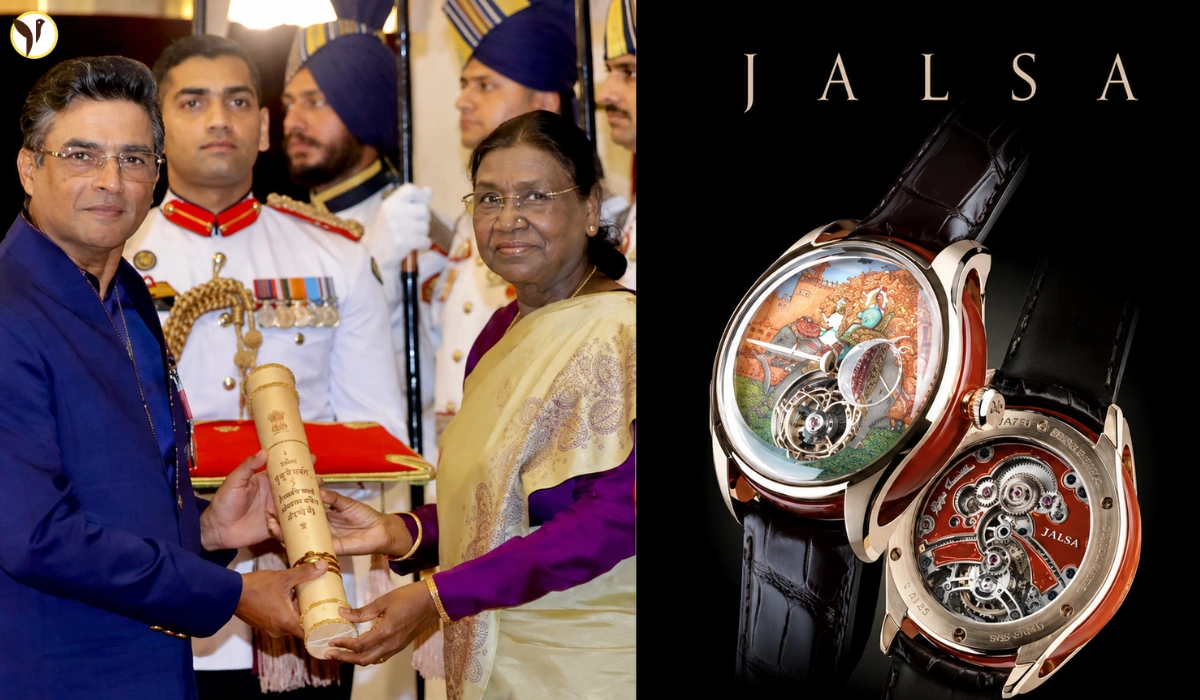


When R Madhavan walked into Rashtrapati Bhavan on June 23 to receive the Padma Shri from President Droupadi Murmu, the actor wore a watch that quietly told its own story — a ₹40.5 lakh Indian timepiece, one of only 10 in the world, painted by a Padma Shri awardee, on the wrist of a Padma Shri awardee.
There are moments in public life that carry more than one meaning. The Civil Investiture Ceremony at Rashtrapati Bhavan is, by design, sombre and protocol-driven — a formal acknowledgment of contribution to the nation. But on the afternoon of June 23, 2026, something on actor R Madhavan's left wrist quietly folded two different chapters of India's creative legacy into one image.
Madhavan was dressed in a classic navy blue bandhgala. His family — wife Sarita and son Vedaant — sat in the front row. As he stepped onto the stage and President Droupadi Murmu pinned the Padma Shri on his lapel, sharp-eyed observers noticed the timepiece on his wrist: the Titan Nebula Jalsa Flying Tourbillon, one of only 10 pieces ever produced, priced at ₹40,50,000.
The Watch That Carries Two Padma Shris on One Wrist
What made the moment genuinely unusual — even poetic — was the layered significance of the watch itself. The dial of every Titan Nebula Jalsa was hand-painted by Padma Shri Syed Shakir Ali, one of India's most celebrated miniature artists. So when Madhavan arrived at the ceremony as a Padma Shri recipient, he was wearing the handiwork of another Padma Shri recipient — without a word being spoken about either.
The imagery on the dial is drawn from Rajasthan's architectural history: a royal procession with Maharaja Sawai Pratap Singh riding an elephant before the Hawa Mahal — the Palace of Winds in Jaipur — which the Maharaja himself commissioned in 1799. The year 2025 marked the Hawa Mahal's 225th anniversary, and the Jalsa watch was created to mark that milestone.
"A Padma Shri awardee, wearing the art of a Padma Shri awardee, receiving the honour from the President of India. That convergence was not staged — it simply happened."
Inside the Titan Nebula Jalsa: What ₹40 Lakh Buys You
The Titan Nebula Jalsa is not a watch that tries to imitate Swiss luxury. It is, by any reasonable measure, competing with it. Built by Nebula — Titan's high-end watchmaking sub-brand, part of the Tata Group — the Jalsa was three years in the making and entered at the Grand Prix d'Horlogerie de Genève (GPHG) 2025, the world's most prestigious watchmaking competition.
The dial itself is unlike anything produced by most watchmakers anywhere. Shakir Ali paints on thin slices of polished white marble — not brass, not enamel — using natural pigments sourced from gemstones like indigo, turmeric, and lac. His primary tool is a brush made from a single strand of squirrel-tail hair. Each dial takes between 120 and 130 hours to complete. Because every painting is original, no two Jalsa dials look identical, and the caseback of each piece is engraved with the word "unique" — not as marketing language, but as fact.
|
|
|
|
|
|
|
|
|
|
|
|
|
|
|
|
|
|
|
|
|
|
|
|
|
|
|
|
|
|
|
|
|
|
|
|
|
|
|
|
|
|
|
|
|
Why the Minute Hand is the Most Clever Detail
Technically, the Jalsa does something that makes it unusual even by Swiss standards. The counterweight of the minute hand is a sapphire cyclops lens — a small magnifying glass that rotates around the dial every hour. As it completes its circuit, it passes over different sections of Shakir Ali's miniature painting, amplifying detail that would otherwise be invisible to the naked eye. Once per hour, the lens frames the flying tourbillon cage at 6 o'clock directly — creating a choreographed moment where mechanical precision and painted artistry literally converge.
It is a detail that rewards the wearer, not the audience. Which, for a ₹40 lakh watch worn quietly at a state ceremony, seems entirely appropriate.
Warm handshake with PM Modi as R. Madhavan gets honoured with Padma Shri! pic.twitter.com/oqcezCh3GZ
— sona (@Sonaj_Sin) June 25, 2026
R Madhavan at the Ceremony: A Career Recognised
For Madhavan himself, the Padma Shri represented more than two decades of cross-language cinema. He entered Tamil films in 2000 with Mani Ratnam's Alai Payuthey, transitioned to Hindi with Rehna Hai Tere Dil Mein in 2001, and built a filmography that spans Rang De Basanti, 3 Idiots, Tanu Weds Manu, and his National Award-winning directorial debut Rocketry: The Nambi Effect.
In January 2026, his name appeared in the Padma Shri list. On June 23, he received it at Rashtrapati Bhavan's Civil Investiture Ceremony-II, with Sarita and son Vedaant present. In his Instagram post, Madhavan wrote: "I accept the Padma Shri with profound gratitude and humility. This honour, bestowed upon me, is beyond my wildest dreams." He described it not as an award but as a responsibility.
The Larger Story: Is India Finally Making a Mark in Luxury Watchmaking?
The Jalsa's appearance at a state ceremony is, in context, a meaningful signal. The Indian luxury watch market has historically been synonymous with imported Swiss names. Titan changed parts of that story decades ago as a volume watchmaker, but the Jalsa — and its GPHG entry — represents something categorically different: a credible bid for space in global haute horlogerie.
|
|
|
|
|
|
|
|
|
|
|
|
|
|
|
C K Venkataraman, Managing Director of Titan Company, put it plainly at the watch's launch: "With JALSA, we are not just launching a watch — we are presenting a cultural artefact." The Jalsa is, among other things, Titan's clearest argument that Indian watchmaking can speak the language of international luxury — not by imitating it, but by grounding it firmly in India's own artistic heritage.
Madhavan wearing it at Rashtrapati Bhavan — without announcement, without press release — did more for that argument than any advertisement could have.
What Happens Next
All 10 pieces of the Titan Nebula Jalsa have been produced, and given the watch's limited nature, availability in the secondary market will only become more restricted over time. For collectors, its provenance — tied now to a specific Padma Shri ceremony on June 23, 2026 — adds an additional layer of cultural documentation to an already singular object.
For Titan, the Jalsa's quiet visibility at one of India's highest civilian honour ceremonies is the kind of placement that money rarely buys. The brand's next steps in the haute horlogerie space remain to be seen, but the Jalsa has established a benchmark: this is what Indian luxury can look like when craft, heritage, and storytelling are treated as the same discipline.
Other Articles to Read: