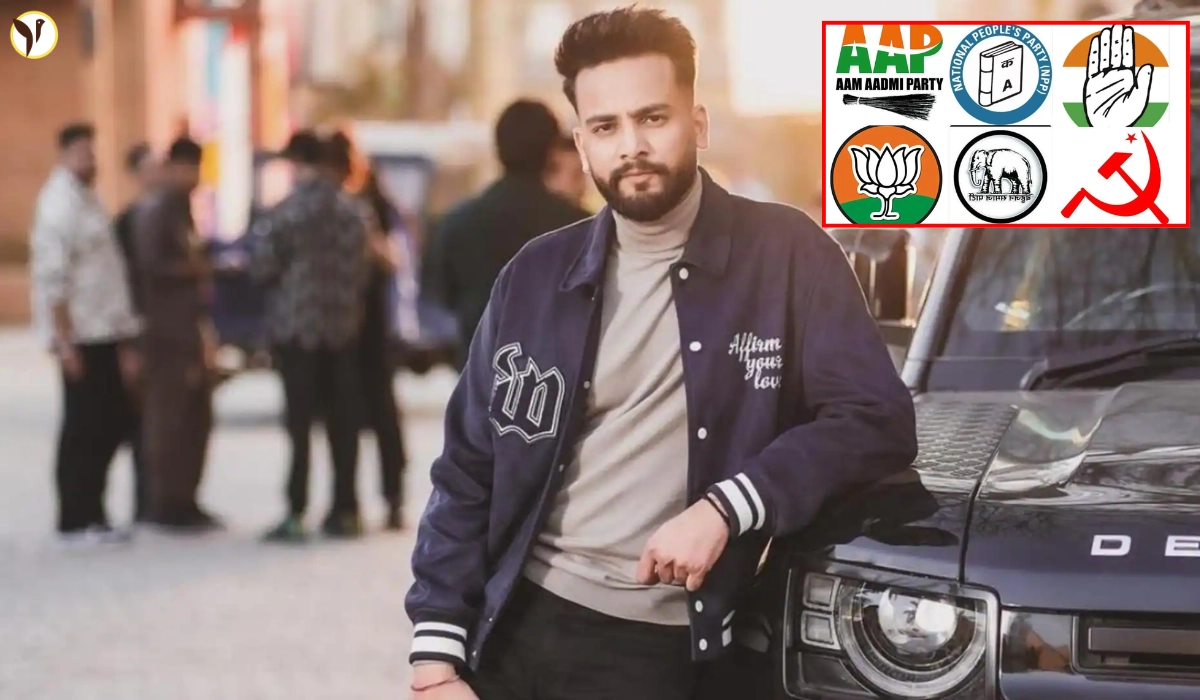


For months, a section of social media had quietly slotted YouTuber and reality television star Elvish Yadav into a familiar box: the influencer who picks his battles, stays politically vague, and avoids anything that could be read as taking sides on India's most contentious debates. On June 11, 2026, that assumption ran into a wall. In a pair of posts on X, Elvish addressed the criticism head-on — and in doing so, revealed a position that was sharper, more specific, and considerably less "neutral" than his critics had assumed.
This is not a story about a celebrity making a political U-turn. It is a story about how India's most-watched digital creators are increasingly being pulled into ideological scorekeeping — and what happens when one of them refuses to play along on someone else's terms.
What Elvish Yadav Actually Said About Anti-India Narratives
The trigger was a wave of posts accusing Elvish of staying silent on the NEET paper leak controversy, student suicides linked to exam pressure, and CBSE-related grievances — even as he had recently commented on the viral "Rs 370 biryani" remark involving comedian Pranit More. One user's post, widely shared, read roughly: "Elvish Yadav posts on NEET Paper Leaks: 0. Posts on students who died by suicide: 0. CBSE issue: 0. But he is doing what he does best."
Elvish's response came in two parts, and the distinction between them matters.
First, on the substantive issue: he stated that he had raised concerns about the NEET paper leak two years earlier and was doing so again, adding that he is "completely against paper leaks" and believes everyone involved, regardless of rank, should face thorough investigation.
Second — and this is the part that has drawn the most attention — he drew a line between supporting genuine student activism and what he described as people using that activism as cover for something else entirely. "I support students and their genuine concerns, but I will always oppose anyone trying to push anti-India agendas under the cover of student activism. I have raised my voice against such things before, and I will continue to do so," he wrote.
"I know the difference between right and wrong." — Elvish Yadav, X post, June 11, 2026
The BJP Question: "No Personal Attachment"
The second half of Elvish's statement directly tackled a label that has followed him for months — that his comments make him a de facto BJP supporter. His response leaned on his own history with the party, not abstract distancing.
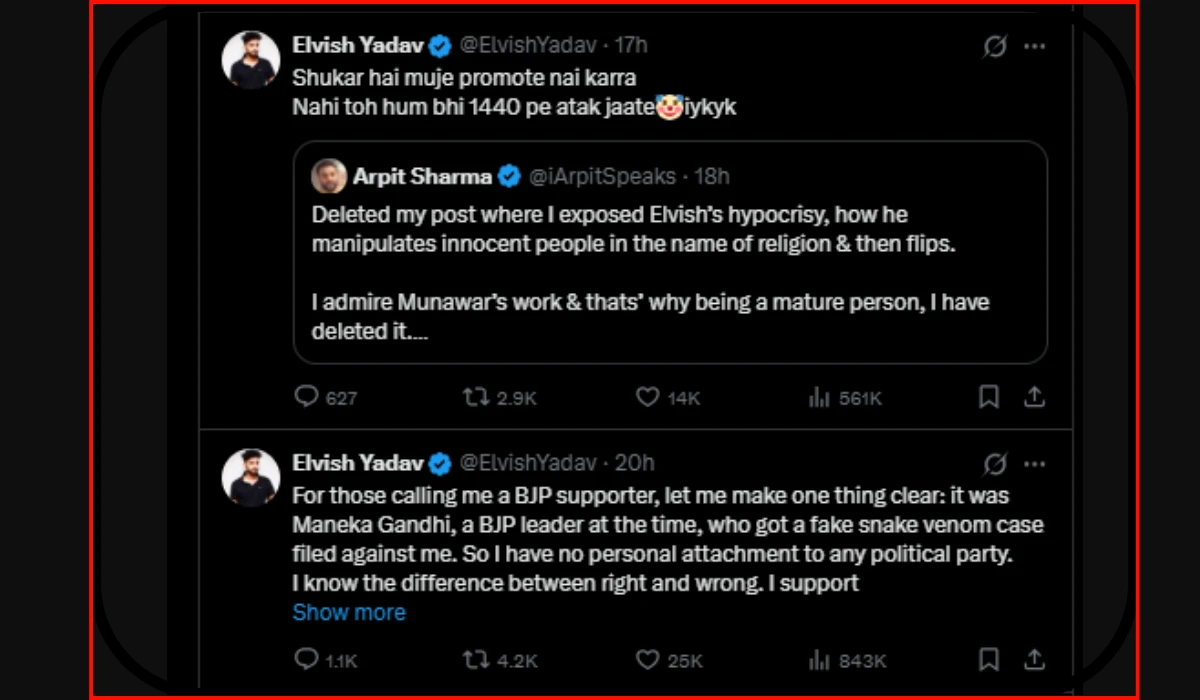
He pointed out that it was Maneka Gandhi, a BJP Member of Parliament, who was central to the 2023 snake venom case that led to his arrest in March 2024. "For those calling me a BJP supporter, let me make one thing clear: it was Maneka Gandhi, a BJP leader at the time, who got a fake snake venom case filed against me. So I have no personal attachment to any political party," he wrote.
It's a notable rhetorical move. Rather than simply denying a political label, Elvish used his own legal ordeal — one that put him in Luksar Jail for roughly a week before he secured bail — as evidence that his views can't be reduced to party loyalty. Whatever one makes of the framing, it complicates the "BJP supporter" narrative that had been building around him.
Why This Moment Matters for India's Creator Economy
Elvish Yadav is not a political commentator by trade. He is a YouTuber-turned-television personality, the winner of Bigg Boss OTT Season 2 and Roadies Double Cross, and currently a face on Laughter Chefs 3. His core audience tunes in for comedy, vlogs, and reality TV drama — not policy debates. Yet this episode illustrates a pattern that has become increasingly common for India's top creators: audiences no longer accept silence as neutrality.
When a creator comments on one viral moment (the Pranit More biryani row) but not another (the NEET paper leak), the gap itself becomes the story. Elvish's response — that selective outrage from his critics is "obsession," not "activism" — pushes back on the idea that creators owe commentary on every news cycle to retain credibility.
At the same time, by explicitly naming "anti-India agendas" as something he opposes, Elvish has staked out a position that goes beyond simply defending his right to silence. He has effectively told his nearly 30-million-strong following where he stands on a specific, polarising framing — even while insisting he isn't aligned with any party.
Timeline: Elvish Yadav's Path From Reality TV Winner to Political Talking Point
|
|
|
|
|
|
|
|
|
|
|
|
|
|
|
|
|
|
|
|
|
|
|
|
|
|
|
|
The Reaction: A Divided Comment Section
The response to Elvish's clarification has been split along predictable lines. Supporters have praised him for "finally addressing" the criticism directly and for distinguishing between legitimate student concerns and what he sees as opportunistic framing. Critics, meanwhile, argue that selectively commenting on some issues while staying quiet on others — even with an explanation — doesn't fully answer why certain topics get airtime and others don't.
What's clear is that the exchange has reopened a broader conversation: should public figures with massive reach be expected to comment on every major national issue, or is it reasonable for them to engage only on topics where they feel they have something specific to add? Elvish's own answer, in his words, is that "obsession isn't activism" — a line aimed squarely at those who track his posting patterns as a measure of his politics.
What Happens Next: The Future of Content Creator Accountability
Don't expect this to be the last word. Elvish Yadav remains one of India's most-followed digital personalities, and statements like this one tend to generate follow-up questions rather than close debates — particularly from accounts that track creator commentary on political and social issues. Three things are worth watching:
1. Brand and platform implications: Creators who wade into politically charged territory, even briefly, sometimes see shifts in brand partnership conversations. Whether this affects Elvish's existing endorsement deals or his upcoming Laughter Chefs 3 promotional cycle remains to be seen.
2. Further clarification or escalation: Given the pattern of his past responses to controversy — including his comments on the snake venom case and the biryani row — Elvish has shown a tendency to address criticism directly rather than let it sit. A follow-up post or interview addressing specific follow-up questions wouldn't be surprising.
3. The wider creator-politics conversation: This episode adds to a growing list of instances where Indian influencers have been pushed to clarify political positions they didn't originally volunteer. How creators navigate this — without alienating large, ideologically mixed audiences — will likely shape how the next generation of digital stars approaches public commentary.
This clarification sets a precedent for how Indian content creators navigate political scrutiny. Yadav's approach—citing factual evidence (Maneka Gandhi's case), emphasizing principle-based positions, and explicitly opposing anti-national agendas—offers a template others might follow.
The impact extends beyond Yadav's personal reputation. His clap-back at critics who labeled him "anti-India" while he actually exposed Dhruv Rathee's alleged "anti-India agenda" in June 2024 shows consistency in his nationalist stance. At that time, Elvish accused Rathee of being "involved in anti-India activities" with connections to "anti-national groups and Muslim friends to brainwash his audience with a hidden agenda".
The Bottom Line
Elvish Yadav didn't set out to make a political statement. He set out to answer trolls. But in doing so, he drew a clearer line than most expected: he is not aligned with the BJP, he says, and he is not "neutral" on the question of anti-India framing either. For an influencer whose career has been defined by reality TV wins and viral vlogs, that combination — independence from party politics paired with a firm stance on a specific national-identity issue — is the most precise public positioning he's offered to date.
Other Articles to Read: