


When Kangana Ranaut made her Bollywood debut with Gangster in 2006, critics and audiences celebrated her breakthrough performance. But at home, the reaction was painfully different—her parents were left heartbroken, not because of her acting, but because of their deep concern about societal judgment.
"I was so heartbroken that that's how they perceived that film, because they were thinking what society would think." — Kangana Ranaut, in a recent interview while promoting Bharat Bhhagya Viddhaata
In a recent promotional interview while pushing her upcoming film Bharat Bhhagya Viddhaata, the actor-politician opened up about this emotional chapter, revealing how her family's muted response nearly broke her confidence early in her career.
The Confession That Stopped Fans Mid-Scroll
Kangana Ranaut has never been short of revelations. But the one she dropped recently — quietly, without drama — struck a different kind of nerve. While promoting her upcoming production Bharat Bhhagya Viddhaata, the actress revisited something that clearly still lingers: the moment her parents watched her debut film Gangster (2006) and responded not with pride, but with silence and worry.
Her father said nothing at all. Her mother's only observation was that the scenes were inappropriate for someone her age. And Kangana, a teenager who had risked everything to make it in Mumbai — no connections, no English, no film family — found herself crushed not by a critic's pen, but by the people she most wanted to impress.
This is not just a celebrity anecdote. It's a story about the widening cultural gap between small-town India and Bollywood's bold storytelling — and how one young woman navigated it entirely alone.
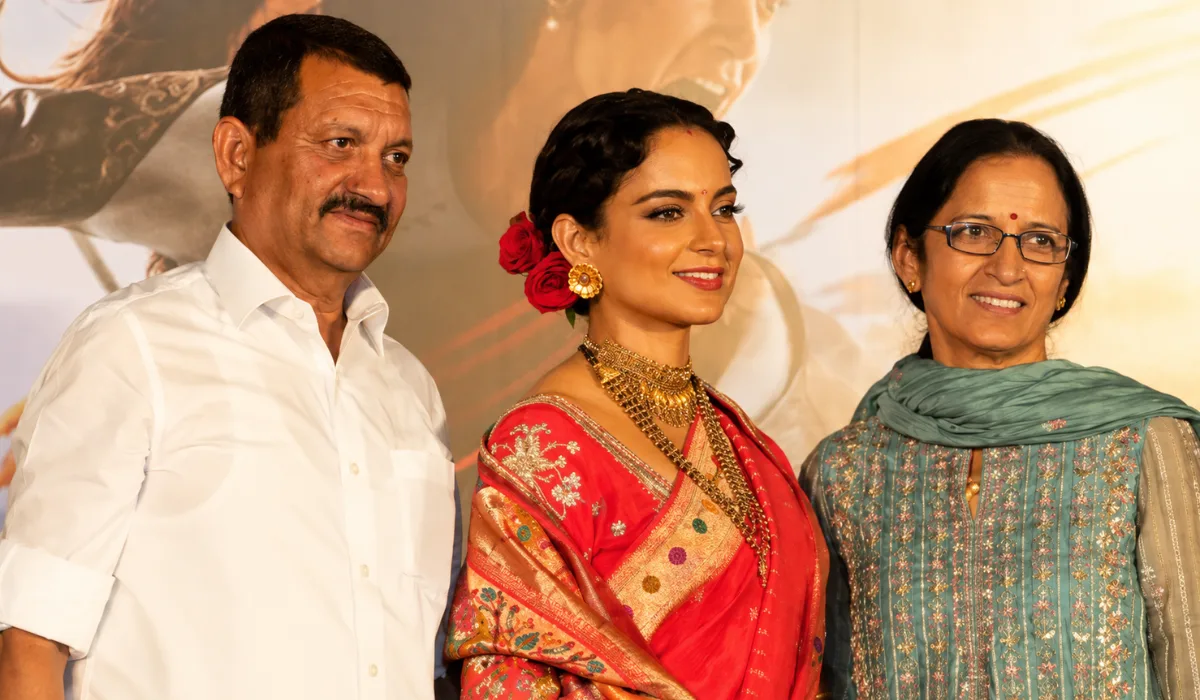
Background: Who Was Kangana Before Gangster?
To understand why her parents' reaction hit so hard, you need to understand where Kangana came from.
She grew up in Bhambla, a small village in Himachal Pradesh. Her family had no connection to the film world. In her own words on social media, she "did not know a single word of English" when she arrived in Mumbai. She had left home under difficult circumstances, at odds with her father and grandfather, and was barely 17 or 18 years old when she began auditioning.
Before Gangster, she had come dangerously close to making her debut in what she later described as a "very shady film" — a project that felt wrong the moment she showed up for the shoot. She walked away from it, which landed her in trouble with a producer. But fate intervened: she got Gangster instead.
Gangster (2006): What the Film Was, and Why It Mattered
|
|
|
|
|
|
|
|
|
|
|
|
|
|
|
|
|
|
|
|
|
|
|
|
|
|
|
The film was not a soft, safe debut. Gangster demanded emotional rawness and physical vulnerability from its lead actress. Kangana delivered both — so convincingly that critics sat up and took notice. She won the Filmfare Award for Best Female Debut. Industry insiders began talking.
But at home, the film landed very differently.
The Parents' Reaction: Silence and Society's Gaze
Kangana has now openly described what happened when she asked her parents for their feedback.
Her father gave no response whatsoever. That silence, for a daughter who had sacrificed so much to earn her first major role, was devastating in its own way.
Her mother's response was more direct — but no less painful. Speaking in Hindi, she told Kangana: "Nahi hamara samajh mein thoda ye hai ki aap chhotey bhi ho, underage bhi ho… iss tarah se scene aap se karwa liye" — roughly translated: "You are underage, and they made you do these scenes."
Kangana's reply cut to the heart of the disconnect: "You only saw those scenes in this entire film?"
The answer, implicitly, was yes. Her parents — people who had never grown up watching cinema as art — filtered the film entirely through the lens of social respectability. What would the neighbours say? What would relatives think? Their daughter, young and away from home, had appeared in intimate scenes on a national screen.
For them, that was the story. For Kangana, it was the least important part.
"I was so heartbroken that that's how they perceived that film," she recalled. "After that, I thought I would never expect any review of my films from my parents because they have never seen films."
A Wider Mirror: The Small-Town India vs. Bollywood Divide
Kangana's experience is not unique to her — it reflects a broader cultural tension that thousands of aspiring actors from non-film families navigate in silence.
In many parts of India, particularly in smaller towns and villages, cinema is still viewed with suspicion — associated in popular imagination with moral looseness, underworld connections, and a world far removed from "respectable" professions. Kangana herself noted that her family believed the film industry had links to the underworld, which coloured everything they saw on screen.
For parents in this context, watching their daughter in intimate or emotionally intense scenes is not an aesthetic experience — it is a social one. It triggers anxiety about judgment, honour, and community perception. Their discomfort was not a failure of love. It was a failure of frame of reference.
Kangana understood this — eventually. But at 18 or 19, fresh off her debut and hoping for validation, the understanding came too late to soften the blow.
The Turning Point: A National Award Changes Everything
The story, thankfully, does not end in estrangement.
Kangana won her first National Film Award for Best Actress for Fashion (2008) — just two years after Gangster. It was the moment everything shifted.
"When I received the National Award, they were very happy. They felt that their daughter had been honoured by the President. That was a turning point for them," she said.
The logic is telling. What changed was not the content of her films — it was institutional validation from the highest level of the Indian state. A National Award, presented by the President of India, signalled to her parents that what their daughter was doing was not shameful but worthy of national recognition.
"After I received the Padma Shri, that became an even bigger turning point," she added. "They felt that even by doing such films, people can receive civilian honours."
It took the President of India to convince her parents what she had known since day one.
What Amitabh Bachchan Saw That Her Father Couldn't
One of the most quietly poignant moments in Kangana's account comes when she mentions Amitabh Bachchan sending her a personal letter praising her performance in Queen (2014).
"When Mr Bachchan sent me a beautiful letter about my performance in Queen, I thought — how Mr Bachchan can perceive it, my father cannot perceive it. And I cannot have a grudge against my father for that, because he is not an artist. His work is different."
This is Kangana at her most self-aware — neither bitter nor naïve. She is drawing a distinction not between better and worse people, but between those with the vocabulary to receive artistic work and those without it. Her father's silence was not coldness. It was the silence of someone who lacked the tools to respond.
That distinction matters. It reframes the heartbreak from rejection to miscommunication.
Kangana Ranaut recalled being heartbroken after the release of her debut film, Gangster. Her father went completely silent, and her mother criticized the bold scenes. Her mother said, "Our society won't accept this. You are underage and have done all kinds of scenes," which made… pic.twitter.com/fJAaEyoywi
— MissMalini (@MissMalini) June 2, 2026
Kangana's Career: A Timeline of Defiance and Vindication
|
|
|
|
|
|
|
|
|
|
|
|
|
|
|
|
|
|
|
|
|
|
|
|
|
|
|
|
|
|
|
|
|
What Happens Next: Bharat Bhhagya Viddhaata and a New Chapter
It is no coincidence that Kangana is sharing this story now. She is in the middle of promoting Bharat Bhhagya Viddhaata, a film she is producing — one that she describes as an intense thriller inspired by real events. The film centres on the courage of hospital staff who protected 400 lives inside Cama Hospital during a terror crisis, even as chaos reigned outside.
The contrast with Gangster is striking. Twenty years on from a debut that left her parents unable to speak, she is now making films that she believes even they can be proud of without needing a Presidential award to validate it.
The circle, slowly, is closing.
Final Thought: The Loneliness of Being First
There is something universally recognisable in Kangana's story — the loneliness of being the first person in your family to enter a world they do not understand. The first to go to a university far from home. The first to choose a career that has no local equivalent. The first to appear on a screen that the whole neighbourhood watches.
The heartbreak she describes is not about bad parents. It is about the gap that ambition creates — and the long, uneven process of bridging it. For Kangana, it took a National Award. For others, it may take different proof entirely.
What stays with you is the quiet dignity of her conclusion: she stopped asking for reviews. She found her validation elsewhere. And she kept going.
Other Articles to Read:
- Cocktail 2 Trailer: Shahid Kapoor Trapped In Bollywood’s Messiest Love Triangle
- Off Campus Star Mika Abdalla And Jake Short End Engagement After 5 Years
- KKK15 Isn't About Stunts Anymore — It's About Survival Now
- Anushka Sharma’s Wholesome Forehead Kiss For Virat Kohli Hits 1 Million Likes In Minutes