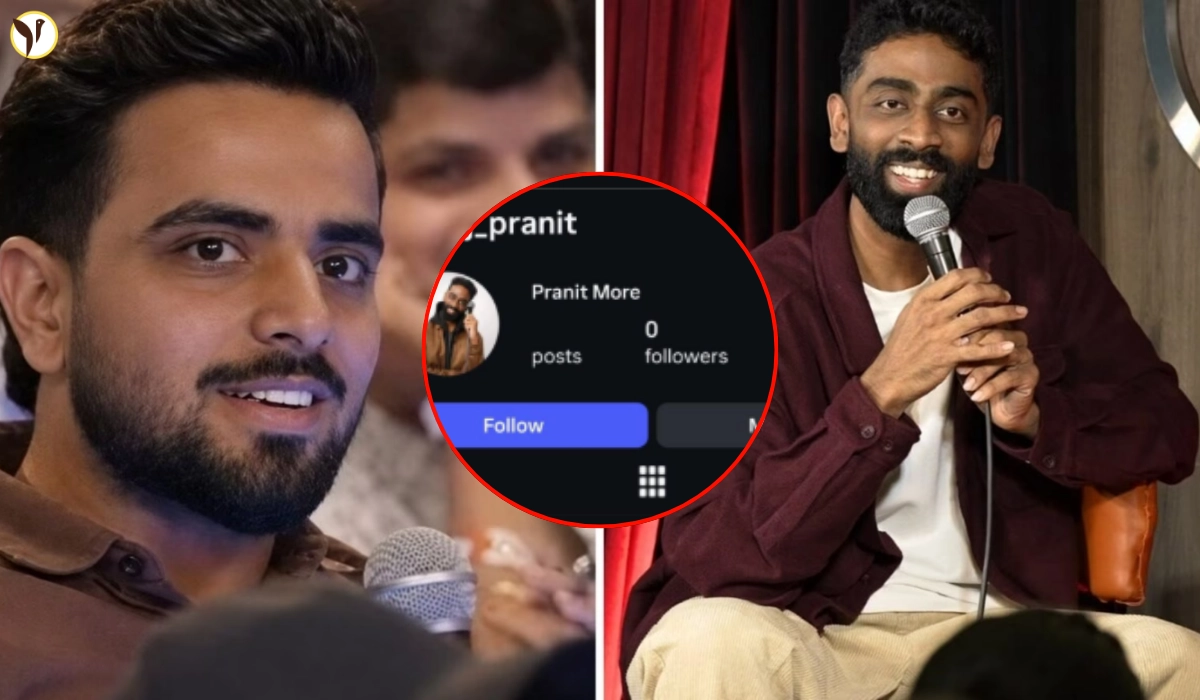


A single crowdwork interaction at a stand-up comedy show has snowballed into one of India's most talked-about social media controversies this week. Comedian Pranit More, known for his viral comedy clips and millions of followers online, has apparently deactivated his Instagram account after facing intense backlash over the now-infamous “Rs 370 biryani” incident.
What began as a seemingly ordinary audience interaction quickly transformed into a nationwide debate about consent, dating culture, accountability in comedy, and the consequences of viral content in the digital age.
The incident raises a larger question: When does a joke stop being a joke, and who bears responsibility when problematic views are amplified on a public platform?
What Happened: The Rs 370 Biryani That Started Everything
It began, as most viral outrages do, with a short clip — barely 90 seconds. During a crowd-work segment at a stand-up show in Gurugram, comedian Pranit More invited an audience member, Himanshu Jangra, a 23-year-old web developer, to share a dating anecdote. What followed was not a punchline. It was a confession.
Jangra recounted spending Rs 370 on a plate of chicken biryani on a date. He then stated — in Hindi — that since he had spent the money, he intended to "recover" his investment. The implication was unmistakable: physical intimacy as a financial return. He went further, describing how he had pressured the woman to accompany him to a "dark" park despite her repeatedly saying no.
Pranit More did not challenge this. He laughed. He labelled it a "Peak Gurgaon moment." He then did something that transformed a distasteful stage moment into a national flashpoint: he edited the clip, added subtitles, and uploaded it to his own social media channels — Instagram, YouTube, and X — where it spread rapidly across the internet.
The Cascade: From Clip to Career Consequences
The public reaction was swift and unsparing. What had been an audience member's off-colour comment now had an audience of millions — and the commentary was furious.
Within days, the backlash reached Jangra's employer. Starvik Design, a Gurugram-based branding and design firm, received hundreds of emails, calls, and messages about the incident. Founder Vivek Vishwakarma released a video statement confirming termination. He stated that the comments were "offensive," did not represent the company's values, and "should not be influencing young minds." He acknowledged that an internal review found no prior workplace complaints against Jangra — but concluded that the public conduct had become inseparable from the organisation's reputation.
Jangra issued an apology and deactivated his social media accounts. The woman at the centre of the story has not spoken publicly.
The Comedian Under the Microscope
More's role in this controversy goes beyond passive bystander. Three actions put him directly in the line of fire:
|
|
|
|
|
|
|
|
|
|
|
|
When the backlash grew, More issued a statement: "The comments made by the audience member do not reflect my views. That was a lapse in judgement on my part. I should have challenged the remark." He also removed the clip from his platforms.
But the apology, many felt, arrived too late and too conveniently. Critics pointed out that the editing and subtitling of the clip — a process that requires time, thought, and intent — made the "I didn't agree with it" defence difficult to sustain.
Ultimately, on June 10, 2026, More deactivated his Instagram account (@rj_pranit), which had been his primary platform for audience engagement and content promotion. His YouTube channel (over 2 million subscribers) remains active at the time of publication.
Celebrities Weigh In — And They Don't Hold Back
The controversy pulled in some of India's most prominent digital voices, and they largely spoke with one position.
Elvish Yadav, YouTuber and Bigg Boss OTT 2 winner, posted on X: "Rs 370 ki biryani ne do cheezein expose kar di: Ek aadmi ko laga consent ka MRP hota hai. Aur ek comedian ko laga har uncomfortable silence ko laughter track se bachaya ja sakta hai." (Translation: "The Rs 370 biryani exposed two things: one man thought consent has a price tag, and one comedian thought every uncomfortable silence could be saved by a laugh track.")
Kusha Kapila, actor and content creator, dissected More's defence methodically. Speaking in a series of Instagram Stories, she argued that the clip had gone through recording, editing, a 90-second cut decision, and promotion — each a conscious choice. Her question was direct: if you do all of that, how do you then say the audience member's views don't reflect yours?
Khushboo Patani, sister of actor Disha Patani, called out the absence of any pushback during the live show, saying such incidents reveal how women are often objectified and judged by what men believe they are owed.
Netizens also resurfaced a remark More reportedly made on stage: "185 toh vasool ho gaya" — a quip that implied half the woman's "value" had already been extracted. This comment, more than anything else, made the apology feel hollow to many observers.
Why This Controversy Cuts Deeper Than Comedy
This is not the first time Indian stand-up comedy has faced a consent-related reckoning. Critics have noted a recurring pattern across different shows, stages, and years — audience members or comedians framing women as obligated to return male attention, gifts, or spending with affection or access to their bodies.
What makes the Pranit More incident different is the editorial chain. This was not a joke that slipped out and went viral against the comedian's wishes. It was captured, edited, labelled, subtitled, and distributed — which means the content decision happened well after the show, in the cold light of a laptop screen, by a professional with an audience of millions.
The broader conversation this has ignited touches on:
- Consent and transactional dating culture among young urban Indians
- The responsibility of public entertainers when their platform amplifies harmful narratives
- Employer accountability for employees' public conduct outside the workplace
- The limits of an apology when the harm has already been packaged and served to millions
The Employment Question: Was Jangra's Firing Fair?
This aspect of the controversy has divided opinion. Starvik Design's founder explicitly noted that Jangra had no prior complaints at work and was described as professional by colleagues. The firing was driven by reputational impact, not workplace misconduct.
This raises a question without a clean answer: should a person lose their livelihood for views they expressed outside work, on their personal time, in a social setting? Where is the boundary between personal conduct and professional consequence in the age of viral social media?
Legal experts in India have pointed out there is no straightforward framework here — employment contracts, company values, and reputational harm assessments vary case by case.
What Comes Next
At the time of writing:
- Pranit More's Instagram is deactivated. His YouTube channel remains live.
- Himanshu Jangra has issued an apology and gone offline.
- Starvik Design has moved on from the public statement phase.
- No legal action has been reported from either side.
- The woman named in the anecdote has not spoken publicly; her identity has not been disclosed.
The larger question — about what Indian stand-up comedy owes its audiences in terms of accountability — will not resolve cleanly. But the conversation it has forced is unlikely to disappear with More's Instagram page.
Other Articles to Read: