

The Bigg Boss OTT 2 winner weighed in on a viral consent controversy — then got trolled for not speaking on NEET and CBSE. His four-word comeback lit up X. Here's the full picture.
It takes a plate of chicken biryani worth Rs 370 to expose a great deal about how some people think about dating — and, apparently, even more about how internet criticism works in 2026. When YouTuber and Bigg Boss OTT 2 winner Elvish Yadav stepped into the furious national conversation around comedian Pranit More's viral crowd-work clip, few expected the backlash to bounce back at the person doing the calling-out. Yet that is precisely what happened, producing a sharp four-word verdict that became its own trending moment: "Obsession isn't activism."
The Spark: What the Rs 370 Biryani Controversy Is Really About
To understand Elvish's response, the origin story matters. The controversy began when a crowd-work clip from one of comedian Pranit More's recent stand-up shows in Gurugram started circulating widely. In the clip, a 23-year-old audience member named Himanshu Jangra described a date during which he had spent money on a meal — roughly Rs 370 for chicken biryani and water — and proceeded to suggest, in terms that were immediately read as entitlement, that he expected something physical in return.
The remark drew outrage not merely for what Jangra said, but for how Pranit More handled it on stage — laughing at the comment, calling it a "Peak Gurgaon moment," and subsequently editing, subtitling, and uploading the clip to his own social media channels. In the eyes of critics, More did not just fail to challenge the remark: he actively amplified it for engagement.
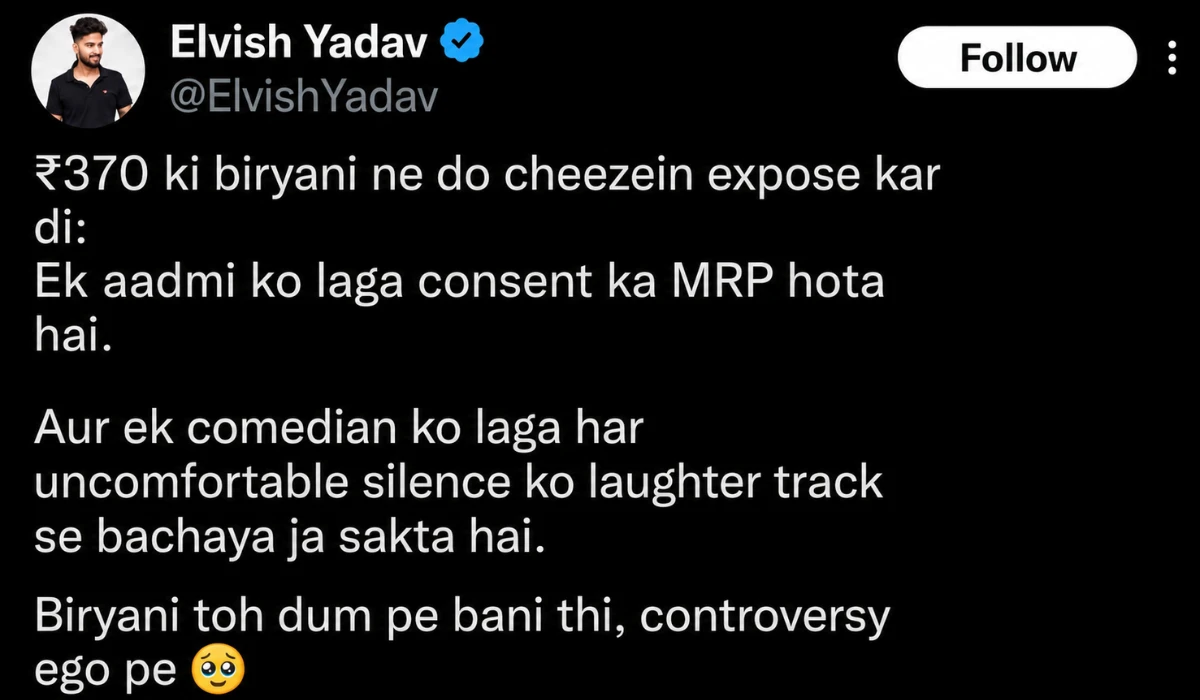
"Biryani toh dum pe bani thi, controversy ego pe."
Elvish Yadav's Entry: Sharp, Specific, and Immediately Viral
Elvish Yadav's first post on the matter was characteristically blunt. Writing on X on June 10, 2026, he argued that the incident had exposed two parallel failures: a man who believed a woman's consent carries a price tag like a product on a store shelf, and a comedian who assumed that every moment of uncomfortable silence can be smoothed over with a laugh track. The closing line — roughly translated as "the biryani was slow-cooked, the controversy was cooked on ego" — was the kind of line that travels well on social media: quotable, pointed, and sting-at-the-end in structure.
|
|
|
|
|
|
|
|
|
|
|
|
|
|
|
|
|
|
|
|
|
|
|
|
|
|
|
|
|
|
|
|
|
|
|
The Counter-Attack: Why Trolls Came for Elvish — and How He Responded
Within hours of his widely-praised post, a section of social media did what it does best: it pivoted from the original issue to the person speaking about it. A user on X posted a scorecard of Elvish's posts, noting that he had zero posts on NEET paper leaks, zero posts on student suicides, and zero posts on CBSE-related concerns — yet was actively commenting on an entertainment controversy. The implicit charge was hypocrisy: speak up for viral causes, go quiet on systemic ones.
Elvish Yadav's reply was a repost with one sentence appended: "You support whoever fits your narrative, attack the country you can't stop talking about, and then wonder why people don't take you seriously. Obsession isn't activism."
Who Said What: The Wider Celebrity Response
|
|
|
|
|
|
|
|
|
|
|
|
|
|
|
|
|
|
|
|
|
|
|
|
|
|
|
|
|
|
|
|
|
|
|
Why the Trolling Backfired — and What It Reveals
The attempt to discredit Elvish Yadav by invoking NEET and CBSE is not a new playbook. It follows a pattern that has become predictable on Indian social media: when a celebrity or influencer comments on a cultural or social controversy, a subset of users immediately demands they justify their silence on a different — usually more politically charged — issue. The logic is that unless a public figure speaks on everything, they may speak on nothing without being labelled selective.
Elvish's reply rejects that framework. His post implies that the intent behind the trolling — tracking a content creator's posts for political inconsistencies — is itself a form of bad-faith engagement, driven by compulsion rather than conviction. Whether that reading is right or unfair is a matter of genuine debate. But the structure of his response correctly identified that the shift from "Pranit More's consent problem" to "Elvish Yadav's NEET silence" was a deflection, not an argument.
Elvish Yadav has reacted to the ₹370 controversy, with his viral one-liner sparking fresh debate across social media.
— NewsBreak24 (@NewsBreak24Live) June 10, 2026
.
.
.
.#ElvishYadav #370Controversy #ViralPost #SocialMedia #TrendingNow pic.twitter.com/V58oszJW7t
The Larger Question: What Do Audiences Expect from Influencers in 2026?
This episode crystallises a genuine tension that runs through contemporary digital culture. Elvish Yadav has over 15.8 million YouTube subscribers and commands a significant following across platforms. To many followers, that reach implies a responsibility — if not to comment on every issue, at least to not be conspicuously absent from those that matter. To Elvish, and to a vocal number of supporters, the expectation itself is the problem: treating public follower counts as a civic obligation is a category error.
Kusha Kapila's take on the original controversy is instructive here. She argued that when a comedian edits, subtitles, and uploads a clip to their own channel, the act of publication converts bystander status into endorsement — the crowd member's views become the comedian's brand. That logic applies in reverse too: someone who posts on a cultural controversy is not automatically accountable for every systemic issue in the news cycle. The two are simply different types of content, produced for different reasons, on different days.
What Happens Next
For Pranit More, the path forward involves rebuilding a professional reputation that the viral clip damaged severely. His deactivated Instagram and deleted video suggest a recognition that the standard apology-and-return cycle may need more time this round. Himanshu Jangra has lost both his online presence and his job, consequences that are uncommon enough to serve as a signal to others.
For Elvish Yadav, the episode is unlikely to hurt him in any lasting way — if anything, his original post on consent landed with clarity and wit. The troll-counter, however, invites a question his detractors will keep asking: what is the threshold, if any, at which a content creator's cultural capital becomes a civic obligation? There is no clean answer, but the conversation itself is worth having — and that, ultimately, is what a biryani worth Rs 370 inadvertently started.
Other Articles to Read: